Understanding How Artificial Intelligence Is Changing Employment
Artificial intelligence refers to computer systems designed to perform tasks that traditionally require human intelligence. These tasks can include recognising patterns, understanding language, making predictions, generating information, solving problems, and supporting decisions. Modern AI systems can process large amounts of information and produce outputs that are useful in professional environments.
The development of generative AI has expanded these capabilities. Employees can use AI tools to draft documents, summarise reports, create presentations, generate software code, analyse customer feedback, and explore ideas. Businesses can integrate AI into customer service, recruitment, finance, marketing, logistics, product development, and administrative operations.
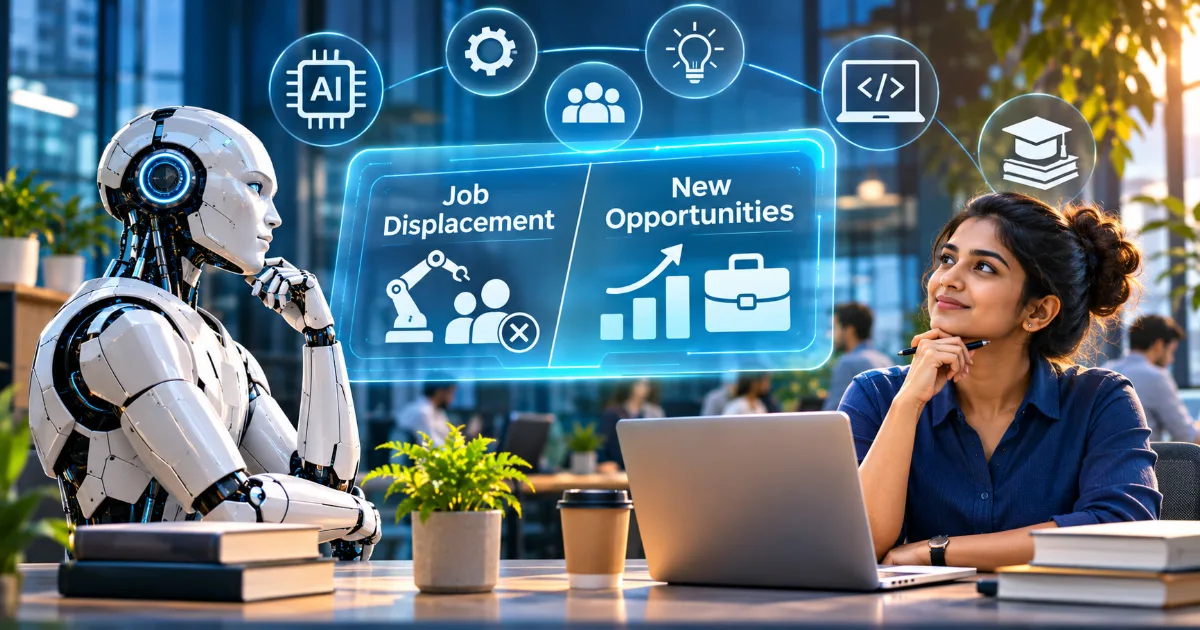
However, AI does not affect every occupation in the same way. A profession usually contains several different responsibilities. Some involve repetitive information processing, while others require judgement, physical interaction, emotional understanding, creativity, accountability, and complex decision-making. AI may be able to automate one part of a profession while increasing the importance of another.
Consider an accountant. Financial software can automate data entry, organise transactions, identify unusual entries, and prepare preliminary reports. However, businesses still need professionals who understand financial regulations, interpret complex situations, communicate with clients, assess risks, and take responsibility for financial decisions. The profession may change significantly without disappearing.
Continue Reading
This distinction between automating tasks and eliminating entire occupations is central to understanding the future of work.
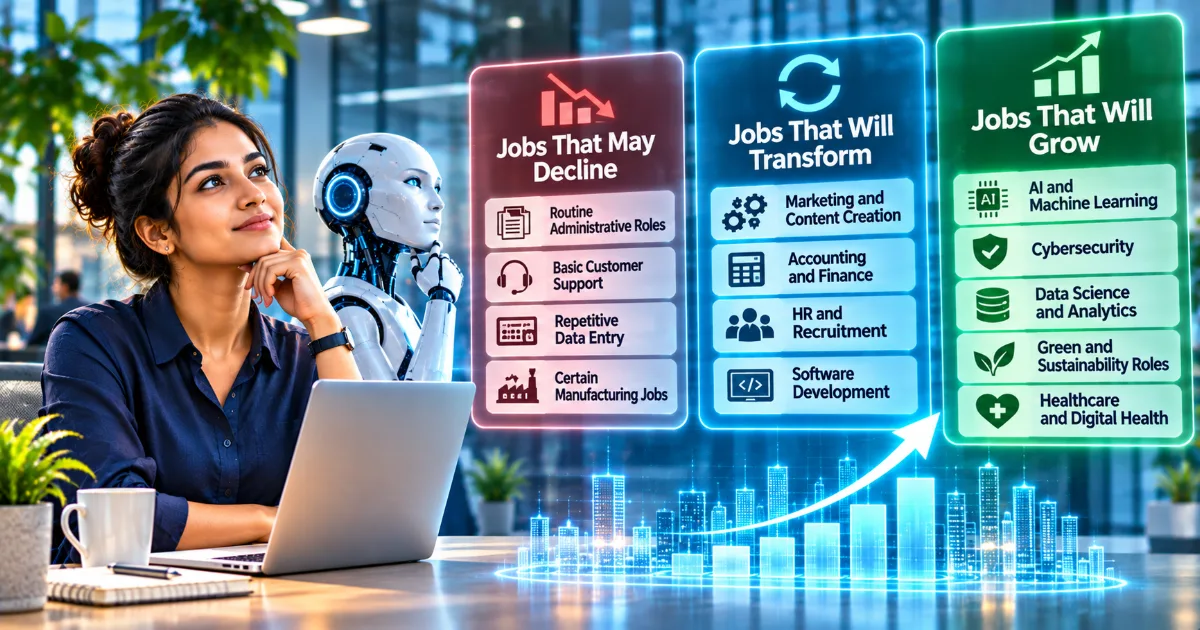
Jobs That May Decline as AI Automation Expands
Some occupations face greater exposure to automation because a large part of their work involves predictable, repetitive, and standardised activities. When tasks follow established rules and depend on structured information, software and automated systems can often perform them efficiently.
This does not mean every employee in these occupations will lose employment. The impact will depend on the industry, the complexity of the work, the cost of automation, customer expectations, regulations, and the ability of workers to move into higher-value responsibilities.
Data Entry and Basic Administrative Work
Data entry is one of the areas where automation can reduce the need for manual effort. Many organisations receive information through forms, invoices, applications, customer records, and digital documents. AI-powered systems can extract relevant information, classify documents, identify missing fields, and transfer data between business applications.
Tasks that once required employees to manually enter information into spreadsheets or databases may increasingly be handled by automated workflows.
Basic administrative responsibilities may also change. Scheduling, document organisation, routine correspondence, and simple report preparation can be supported by AI assistants and business automation platforms.
However, administrative professionals who develop strong organisational, communication, coordination, and problem-solving skills can continue to provide significant value. Their responsibilities may shift from repetitive processing toward managing workflows, supporting teams, coordinating projects, and handling exceptions.
Basic Customer Support
Customer service is another area experiencing rapid technological change. AI-powered chat systems can answer common questions, provide product information, check order status, explain standard policies, and guide customers through simple processes.
Businesses can use automated systems to handle large volumes of routine enquiries without requiring a human representative for every interaction.
This may reduce demand for some basic support positions, particularly where customer interactions are predictable and require limited judgement.
However, customer service is not limited to answering standard questions. Customers often face complicated situations involving complaints, financial concerns, technical problems, unusual requests, and emotional frustration. These situations may require empathy, negotiation, judgement, and personal attention.
Human support professionals who understand products, communicate effectively, and resolve complex problems are likely to remain important. Their work may increasingly involve supervising automated systems and handling interactions that require a human response.
Basic Bookkeeping and Transaction Processing
Accounting software already automates several routine financial activities. AI can extend this automation by categorising transactions, identifying irregularities, preparing summaries, and supporting reconciliation.
Employees who perform only repetitive transaction processing may face changing demand as businesses adopt more advanced financial systems.
Nevertheless, financial management involves much more than recording numbers. Organisations need professionals who understand taxation, financial planning, internal controls, compliance, auditing, business performance, and risk management.
The opportunity for finance professionals will increasingly involve combining financial knowledge with digital skills and the ability to interpret AI-generated information.
Routine Transcription and Document Processing
Speech recognition technology can convert audio into written text. AI systems can also summarise meetings, organise notes, extract information from documents, and identify important details.
This can reduce demand for certain routine transcription and document-processing activities.
However, specialised transcription involving technical terminology, legal accuracy, confidential information, or complex subject matter may still require human review.
The important skill will be the ability to verify information, understand context, identify mistakes, and ensure that documents meet professional standards.
Certain Repetitive Manufacturing Tasks
Manufacturing has used automation for many years. Robotics and intelligent systems can perform repetitive assembly, packaging, inspection, sorting, and material-handling activities.
As robotics becomes more capable and affordable, additional production tasks may become automated.
The impact will vary depending on the type of manufacturing, equipment costs, production volume, safety requirements, and the complexity of physical operations.
Automation can also create demand for technicians, robotics specialists, maintenance professionals, quality engineers, and production supervisors who manage increasingly advanced systems.
Basic Content Production
AI tools can generate product descriptions, simple promotional copy, routine social media captions, basic summaries, and standard marketing material.
This may change the demand for content production that depends mainly on producing large quantities of repetitive text.
However, effective communication involves much more than generating words. Businesses still need people who understand audiences, develop brand identity, conduct research, create original ideas, verify information, and build trust.
Content professionals who combine creativity, strategic thinking, subject knowledge, and AI capabilities may become more valuable than those who depend only on repetitive production.
Jobs That Will Change Rather Than Disappear
Many professions are likely to experience substantial transformation without becoming obsolete. AI will become part of everyday workflows, changing how employees perform tasks and how organisations measure professional value.
Marketing and Digital Advertising
Marketing professionals increasingly use AI for audience analysis, keyword research, campaign planning, content drafting, customer segmentation, and performance reporting.
AI can help marketers identify patterns in customer behaviour and generate different campaign ideas. It can also support the creation of advertisements and assist with testing marketing messages.
However, successful marketing requires an understanding of human behaviour, market positioning, customer trust, brand identity, and business objectives.
A marketing professional must decide which audience to target, what message is appropriate, how a brand should be presented, and whether a campaign supports long-term business goals.
The future marketing professional will need to understand AI tools while developing strategic thinking, creativity, analytical skills, and communication abilities.
Software Development
AI coding assistants can generate code, explain programming concepts, identify possible errors, suggest improvements, and help developers understand unfamiliar systems.
This can accelerate certain stages of software development. Developers may spend less time writing repetitive code and more time designing systems, evaluating solutions, reviewing generated code, and solving complex technical problems.
However, software engineering involves much more than producing code. Developers must understand user requirements, system architecture, security, performance, scalability, reliability, and maintenance.
AI-generated code can contain errors, security weaknesses, or assumptions that do not match the actual requirements. Human developers remain responsible for evaluating whether a solution is correct and suitable.
The profession will increasingly reward people who understand software systems deeply and can use AI to improve their engineering capabilities.
Accounting and Finance
AI can support financial analysis, forecasting, reconciliation, fraud detection, risk assessment, and reporting.
Accountants and financial analysts may increasingly work with automated systems that prepare preliminary information and identify unusual patterns.
Their responsibilities can shift toward interpretation, strategic planning, financial advice, regulatory compliance, and decision support.
Professionals who combine financial expertise with data literacy and technology awareness will be better positioned to adapt.
Human Resources and Recruitment
Recruitment teams can use AI to organise applications, identify relevant skills, schedule interviews, prepare job descriptions, and support workforce planning.
HR professionals may also use AI to analyse employee feedback, identify training requirements, and improve administrative processes.
However, hiring decisions involve fairness, context, communication, professional judgement, and legal responsibilities. AI systems can produce biased or inaccurate recommendations if their data or design is flawed.
Human resources professionals will need to understand how to use these systems responsibly while preserving transparency, confidentiality, and human oversight.
Education and Teaching
AI can support personalised learning, generate practice exercises, explain difficult concepts, and provide feedback on student work.
Teachers may use these tools to prepare learning materials, identify areas where students need additional support, and reduce some administrative responsibilities.
However, education is not simply the delivery of information. Teachers help students develop curiosity, discipline, critical thinking, communication, confidence, and social skills.
The future educator will need to understand how to use AI as a learning resource while ensuring that students develop independent thinking rather than becoming dependent on automated answers.
Legal Services
AI can assist with document review, legal research, contract analysis, case organisation, and the identification of relevant information.
These capabilities may reduce the time required for certain routine legal tasks.
However, legal practice involves interpreting laws, understanding specific circumstances, advising clients, presenting arguments, negotiating, and accepting professional responsibility.
Lawyers will need to understand AI-generated material, verify legal information, protect confidential data, and apply professional judgement.
Journalism and Media
AI can assist journalists with transcription, research organisation, translation, summarisation, and preliminary analysis of large datasets.
It can also generate basic reports from structured information.
However, journalism depends on verification, investigation, source protection, editorial judgement, public accountability, and the ability to understand complex human situations.
The value of credible journalism may become even more important in an environment where AI-generated content can spread inaccurate information quickly.
Journalists who combine strong reporting skills with digital investigation and AI literacy can adapt to changing media operations.
Careers That May Grow in the AI Economy
While automation can reduce demand for certain activities, it can also create demand for new products, services, technical capabilities, and professional responsibilities.
The expansion of AI requires people who can develop intelligent systems, maintain digital infrastructure, manage data, protect organisations, and ensure that technology is used responsibly.
Artificial Intelligence and Machine Learning Specialists
AI specialists develop, train, test, evaluate, and improve intelligent systems. Their work may involve machine learning models, natural language processing, computer vision, recommendation systems, and generative AI applications.
Businesses across different industries are exploring ways to integrate AI into their operations. This creates opportunities for professionals who understand programming, mathematics, statistics, data engineering, model evaluation, and system deployment.
AI careers are not limited to research laboratories. They also include applied engineering, product development, implementation consulting, testing, and operational management.
Data Scientists and Data Analysts
Organisations increasingly depend on data to understand customers, evaluate performance, identify risks, and make decisions.
Data analysts interpret information and communicate findings to business teams. Data scientists may develop predictive models, conduct advanced analysis, and identify patterns that are difficult to detect through traditional methods.
AI can support data analysis, but businesses still need professionals who understand data quality, statistical reasoning, business context, and the limitations of automated conclusions.
The ability to explain what data means and how it should influence a decision will remain important.
Cybersecurity Professionals
As businesses become more dependent on digital systems and AI-powered services, cybersecurity becomes increasingly important.
Organisations need professionals who can protect networks, applications, customer information, financial systems, and digital infrastructure.
Cybersecurity careers include security analysis, incident response, penetration testing, cloud security, digital forensics, governance, and risk management.
AI may help security teams identify unusual activity and analyse threats. At the same time, malicious actors can also use AI to create more sophisticated attacks.
This creates a continuing need for skilled professionals who understand technology, security principles, and risk management.
AI Ethics and Governance Specialists
AI systems can influence decisions involving employment, finance, healthcare, education, public services, and personal information.
Organisations must consider fairness, privacy, transparency, accountability, safety, and regulatory requirements when adopting these technologies.
AI governance professionals help businesses establish policies, assess risks, evaluate systems, and ensure that AI is used responsibly.
This field may involve legal expertise, technology knowledge, risk management, public policy, auditing, and organisational leadership.
Robotics and Automation Engineers
Robotics combines mechanical engineering, electronics, software, sensors, and intelligent control systems.
Robotics engineers develop and maintain machines used in manufacturing, healthcare, logistics, agriculture, warehouses, and other operational environments.
As businesses automate more physical processes, they may need professionals who can install, configure, monitor, repair, and improve these systems.
The field offers opportunities for people with engineering knowledge and practical problem-solving abilities.
Cloud Computing and Infrastructure Specialists
AI applications often require significant computing resources, storage, networking, and reliable infrastructure.
Cloud professionals help organisations design, manage, secure, and optimise these systems.
Relevant roles include cloud engineers, platform engineers, site reliability engineers, infrastructure architects, and cloud security specialists.
The growth of AI services may increase the importance of professionals who can manage complex digital environments efficiently.
Digital Health and Healthcare Technology Professionals
Healthcare is increasingly using digital tools for patient management, medical imaging, remote consultations, health data analysis, and clinical administration.
AI can assist with identifying patterns in medical information and supporting certain clinical workflows.
However, healthcare decisions require professional expertise, careful evaluation, patient communication, and regulatory oversight.
This creates opportunities at the intersection of healthcare, data science, software engineering, medical technology, and health information management.
Sustainability and Green Technology Careers
The transition toward more sustainable business operations creates demand for professionals working in renewable energy, environmental analysis, energy efficiency, sustainable infrastructure, and climate-related risk assessment.
AI can support energy forecasting, resource optimisation, environmental monitoring, and the analysis of complex sustainability data.
Professionals who understand both technology and environmental challenges may find opportunities across energy, manufacturing, transport, construction, and consulting.
The Skills That Will Matter Most in an AI-Driven Workplace
The future job market will reward more than technical knowledge. Employees will need a combination of digital capabilities, professional expertise, communication skills, and the ability to adapt.
AI Literacy
AI literacy means understanding what AI systems can do, how they work at a practical level, where they can fail, and how to use them responsibly.
Employees do not all need to become machine learning engineers. However, professionals across many industries may benefit from understanding how to use AI tools relevant to their responsibilities.
A marketer should understand AI-assisted research and content workflows. A financial professional should understand automated analysis and its limitations. A software developer should know how to evaluate AI-generated code.
AI literacy is becoming a practical workplace capability rather than a skill reserved for technology specialists.
Critical Thinking
AI can generate answers, recommendations, summaries, and predictions. However, generated information is not automatically correct.
Employees need to question assumptions, evaluate evidence, identify inconsistencies, and determine whether an output is appropriate for a particular situation.
Critical thinking becomes especially important when AI produces convincing information that contains factual errors or missing context.
Communication and Collaboration
Technology can automate parts of communication, but organisations still depend on people who can explain ideas, understand different perspectives, resolve disagreements, and build relationships.
Clear communication is essential when employees work with colleagues, customers, managers, and external partners.
Professionals who can translate complex technical information into practical business language will have an advantage.
Creativity and Innovation
AI can generate many possible ideas, but identifying meaningful opportunities requires an understanding of human needs, cultural context, business problems, and practical limitations.
Creativity involves more than producing something new. It also involves recognising what is worth creating and why it matters.
Employees who combine subject expertise with original thinking can use AI as a tool to expand their capabilities.
Data Literacy
Data literacy is the ability to understand, interpret, question, and communicate information derived from data.
As AI becomes more integrated into business operations, employees will increasingly encounter dashboards, predictions, automated reports, and analytical recommendations.
They must understand what these outputs represent, what limitations they contain, and how to use them in decisions.
Adaptability and Continuous Learning
Technology changes quickly. Skills that are highly valuable today may need to be updated as tools, industries, and business models evolve.
Employees should develop a habit of learning, experimenting, reviewing their knowledge, and adapting to new responsibilities.
Adaptability does not mean learning every new tool that appears. It means understanding the changes that affect your profession and responding in a practical way.
Emotional Intelligence
Emotional intelligence includes self-awareness, empathy, relationship management, and the ability to understand emotional situations.
These capabilities matter in leadership, healthcare, education, negotiation, customer relationships, teamwork, and conflict resolution.
As technology handles more routine information-processing tasks, human interaction and trust may become even more important in many professions.
How Students Should Prepare for an AI-Driven Job Market
Students entering the workforce today will build careers in an environment where AI is likely to be integrated into many professional activities.
Choosing a career only because it appears safe from automation may not be a reliable strategy. Technology changes continuously, and the responsibilities of almost every profession can evolve.
Students should focus on building strong foundations that can be applied across different industries.
Build Strong Fundamentals
A student interested in software development should learn programming principles rather than depending entirely on AI-generated code. Someone interested in finance should understand accounting, economics, financial analysis, and business operations.
Fundamental knowledge helps people evaluate technology outputs and solve problems that cannot be addressed through simple instructions.
Develop Practical Projects
Employers often want evidence that candidates can apply their knowledge.
Students can build websites, analyse datasets, create automation workflows, develop mobile applications, conduct research, or complete projects related to their chosen profession.
Practical work helps develop problem-solving abilities and provides examples that can be discussed during interviews.
Learn How to Use AI Responsibly
Students should experiment with AI tools for research, learning, coding, writing, and productivity. However, they should verify important information and understand the difference between assistance and independent competence.
Using AI to understand a difficult concept can be helpful. Submitting generated work without understanding it can weaken learning.
The goal should be to become more capable through technology rather than dependent on it.
Develop Communication Skills
Technical ability alone may not be sufficient for professional success. Students need to explain their ideas, present projects, write clearly, participate in discussions, and collaborate with others.
Communication skills are relevant across almost every career path.
How Working Professionals Can Protect Their Careers
Professionals who are already employed should not assume that AI will automatically make their experience irrelevant. Industry knowledge, professional judgement, customer understanding, and practical expertise can remain valuable even when technology changes the way work is performed.
The key is to understand how AI affects the tasks within a particular role.
Identify Which Parts of Your Job Can Be Automated
Start by examining your daily responsibilities. Identify tasks that are repetitive, predictable, and based on structured information.
Then consider which responsibilities require judgement, communication, creativity, relationship management, or specialist knowledge.
This exercise can help professionals understand where automation may have the greatest impact and where they can develop additional value.
Become the Person Who Can Use AI Effectively
Employees who understand how to use AI tools in their field may be able to complete work more efficiently and contribute to process improvements.
For example, a marketing professional could use AI to organise research while focusing on strategy. A finance professional could use automated analysis while concentrating on financial interpretation. A software developer could use coding assistants while reviewing architecture and security.
The goal is not to compete with AI at every task. It is to develop the ability to combine human expertise with useful technology.
Build Skills Beyond Your Current Job Description
Professionals should explore related capabilities that may expand their career options.
A customer support employee could learn customer success management, product operations, or technical support. An administrative professional could develop project coordination, business analysis, or workflow automation skills.
Developing related capabilities can make career transitions more manageable.
Maintain a Strong Professional Network
Professional relationships can provide access to information, mentorship, opportunities, and industry knowledge.
Employees should participate in professional discussions, connect with colleagues, share useful insights, and learn from people working in related fields.
A strong professional network can become especially valuable when industries and job responsibilities change.
What Businesses Must Do to Prepare Their Workforce
The responsibility for adapting to AI does not belong only to employees. Organisations must also create conditions that allow people to learn, transition, and contribute effectively.
Invest in Employee Training
Businesses should identify which roles are likely to change and provide relevant training before employees are forced to adapt under pressure.
Training programmes can cover AI literacy, data analysis, automation, cybersecurity, digital communication, and role-specific technology.
Learning should be connected to actual workplace responsibilities rather than limited to general awareness sessions.
Redesign Jobs Around Human and Machine Capabilities
Organisations should evaluate which tasks can be automated and which responsibilities require human expertise.
Instead of simply replacing existing processes with AI tools, companies can redesign workflows to improve quality, efficiency, and employee contribution.
For example, a customer service team could allow AI to handle routine enquiries while employees focus on complex cases, customer relationships, and service improvement.
Establish Responsible AI Policies
Employees need clear guidance about approved tools, confidential information, accuracy checks, copyright considerations, customer data, and human review.
Organisations should not assume that employees understand the risks associated with every AI application.
Responsible policies help protect customers, employees, business information, and organisational reputation.
Support Employees During Workforce Changes
Some roles may experience reduced demand as automation expands. Organisations should consider retraining, internal transfers, career guidance, and opportunities to move into emerging responsibilities.
Workforce transformation should be managed with transparency and respect.
Companies that treat employees only as costs to be reduced may damage trust and lose valuable institutional knowledge.
Measure the Real Impact of AI
Businesses should evaluate whether AI adoption improves productivity, quality, customer satisfaction, decision-making, and operational performance.
The number of automated tasks is not enough to demonstrate success.
Companies should also monitor error rates, employee workload, customer experience, security, and the long-term effects of automation on their workforce.
Will AI Create More Jobs Than It Replaces?
This question is difficult to answer with certainty because employment outcomes depend on technology adoption, economic growth, investment, regulation, consumer demand, and the ability of workers to move between occupations.
Historically, technological developments have changed the nature of employment. Mechanisation transformed agriculture and manufacturing. Computers changed office administration, finance, design, and communication. The internet created new industries and changed how businesses reach customers.
Artificial intelligence may follow a similar pattern, although its ability to perform cognitive tasks creates a different set of challenges.
AI can reduce the amount of human effort required for certain activities. At the same time, lower operating costs and new capabilities may allow businesses to create products, services, and markets that were previously difficult or expensive to develop.
For example, AI-enabled healthcare services may create demand for professionals who manage digital health systems. Automated manufacturing may increase the need for robotics technicians and maintenance specialists. AI adoption in finance may increase demand for technology governance, data security, and model risk professionals.
However, new opportunities may not automatically appear in the same locations, industries, or time periods as jobs affected by automation.
A worker whose role changes may need additional training before moving into a new occupation. Some communities may experience greater disruption than others. Educational institutions, employers, and governments will need to support workers through these transitions.
The important question is not simply whether AI creates or destroys jobs overall. It is whether people have realistic opportunities to access the new work that emerges.
The Future of Jobs in India
India has a significant opportunity to participate in the growth of the AI economy. Its technology services industry, startup ecosystem, educational institutions, digital infrastructure, and large professional workforce provide a foundation for developing AI-related capabilities.
However, the effects of AI will differ across sectors and regions.
Opportunities in Technology and IT Services
Indian technology companies can use AI to improve software development, business process operations, cybersecurity, cloud services, data analytics, and enterprise automation.
This may change the nature of traditional IT services work. Organisations may increasingly need employees who understand AI integration, system architecture, data engineering, automation, and technology consulting.
Professionals who combine technical knowledge with business understanding can help companies implement practical AI solutions.
Changes in Business Process Operations
India has a large business process services industry involving customer support, finance operations, documentation, data processing, and administrative services.
Some repetitive activities may be automated as companies adopt intelligent systems.
At the same time, demand may grow for complex customer support, process management, automation specialists, quality assurance, analytics, and technology operations.
Employees in these sectors can benefit from developing skills beyond routine processing.
Opportunities for Startups and Entrepreneurs
AI tools can lower the cost of experimentation and help small businesses perform activities that previously required larger teams.
Entrepreneurs can use AI to research markets, develop prototypes, automate workflows, support customers, and analyse business performance.
This may create opportunities for new products and services across education, healthcare, agriculture, finance, retail, and professional services.
However, successful businesses will still need to solve genuine problems, understand customers, maintain quality, and build trust.
The Importance of Education and Skill Development
India will need accessible and practical AI education across different levels of the workforce.
Students, working professionals, small business owners, teachers, and public-sector employees may all need different forms of AI training.
The focus should not be limited to producing advanced AI engineers. The wider workforce also needs to understand how AI affects everyday professional responsibilities.
Digital literacy, critical thinking, communication, data awareness, and continuous learning will be important across many occupations.
A Practical Roadmap for Building an AI-Ready Career
Preparing for the future does not require every person to become an AI expert. It requires individuals to understand how technology affects their field and develop capabilities that remain useful as responsibilities change.
A practical roadmap can begin with five steps.
First, understand your current profession. Identify the tasks you perform, the skills you use, and the responsibilities that create the greatest value.
Second, explore AI tools relevant to your industry. Learn how they work, what problems they can solve, and where human review remains necessary.
Third, strengthen your professional fundamentals. Build knowledge in your chosen field so that you can evaluate technology outputs rather than accept them without question.
Fourth, develop complementary skills. Communication, analytical thinking, creativity, leadership, collaboration, and problem-solving can help professionals contribute beyond automated tasks.
Fifth, demonstrate your capabilities through practical work. Build projects, improve existing processes, document measurable results, and develop examples that show how you can combine professional knowledge with technology.
This approach is more sustainable than chasing every new AI application or assuming that a single course will guarantee long-term career security.
Conclusion: The Future Belongs to People Who Can Adapt
Artificial intelligence will change the employment landscape, but the future of jobs will not be determined by technology alone. It will also depend on the choices made by businesses, employees, educators, governments, and society.
Some repetitive occupations may experience declining demand. Many established professions will be transformed as AI becomes part of everyday workflows. New opportunities will emerge in areas such as AI engineering, cybersecurity, data science, robotics, digital health, and technology governance.
The most important distinction will increasingly be between people who simply perform tasks and people who understand problems, make informed decisions, manage complex situations, and create value.
Employees should not view AI only as a threat. They should understand it as a technology that can change their responsibilities and expand what they are capable of achieving. At the same time, businesses must recognise that successful AI adoption requires investment in people, training, responsible governance, and thoughtful workforce planning.
The future will not belong exclusively to machines or to people who avoid technology. It will offer the strongest opportunities to individuals and organisations that understand how to combine human knowledge, creativity, judgement, and experience with the capabilities of intelligent systems.
The question every professional should begin asking is not whether AI will affect their job. It is how they can prepare to remain valuable as their work changes.
#FutureOfWork #ArtificialIntelligence #FutureOfJobs #AIAndEmployment #CareerDevelopment