Is Artificial Intelligence a Threat to Human Employment or the Beginning of a New Career Revolution?
Artificial intelligence is changing the world of work faster than many people anticipated. Tasks that once required hours of human effort can now be completed in minutes with the assistance of intelligent software.
Businesses are using AI to analyze information, generate reports, communicate with customers, write content, develop software, manage data, automate administrative responsibilities, and improve operational efficiency. Industries that traditionally depended heavily on human expertise are beginning to integrate AI into their everyday operations.
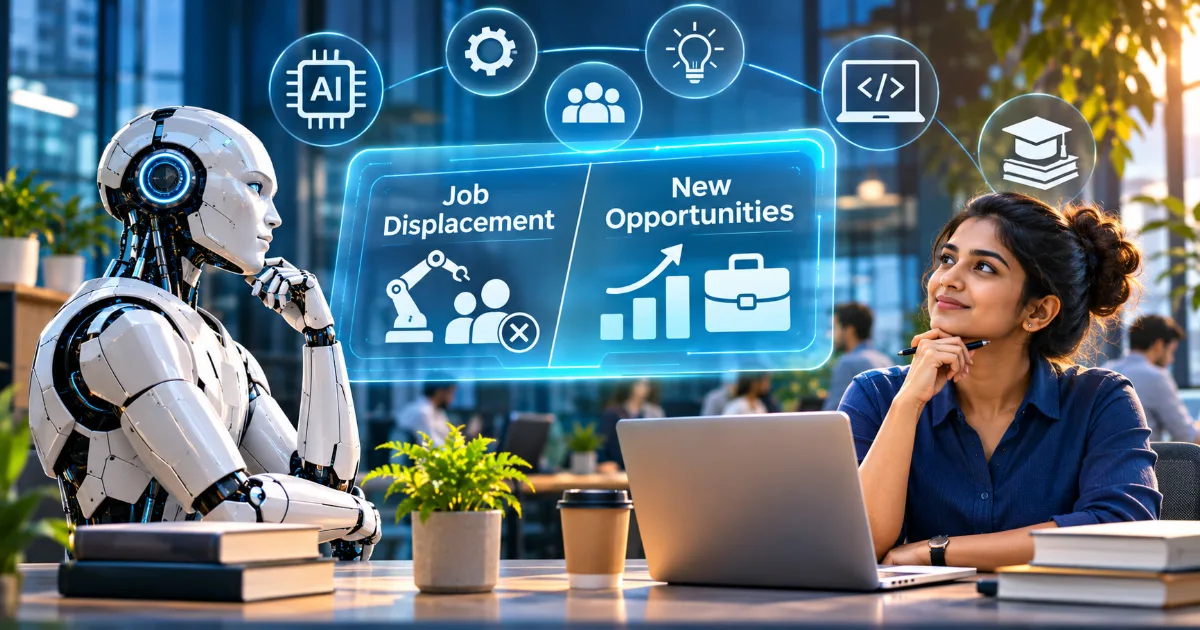
These developments have created an important question for employees, students, entrepreneurs, and business owners: Will artificial intelligence eventually replace human jobs, or will it create entirely new career opportunities?
The concern is understandable. Employees worry about job security, students question which qualifications will remain valuable, and professionals wonder whether the experience they have accumulated over many years will continue to matter. Businesses, meanwhile, are evaluating how AI can reduce costs, improve productivity, and help them compete in increasingly technology-driven markets.
Continue Reading
However, the relationship between artificial intelligence and employment is more complicated than a simple competition between humans and machines. Throughout history, technological revolutions have transformed industries, eliminated certain types of work, and created new professions. Industrial machinery changed manufacturing, computers transformed administration, and the internet introduced entirely new digital industries. Artificial intelligence represents another major stage in this continuing transformation.
The difference is that modern AI can perform activities involving language, information processing, pattern recognition, prediction, and content generation. This means its influence extends beyond physical labor and into professional occupations traditionally associated with knowledge and intellectual work.
Some jobs will experience significant disruption. Certain responsibilities will become automated, while others will require fewer working hours. New professions will emerge around AI development, implementation, governance, security, and human-machine collaboration. Many existing careers will evolve rather than disappear completely.
Understanding these changes is essential for preparing for the future of work. Instead of focusing only on which jobs AI might eliminate, individuals should understand which skills will become more valuable, which industries are likely to change, and how they can position themselves to participate in emerging opportunities.
1. Understanding How Artificial Intelligence Is Changing Employment
Artificial intelligence refers to computer systems designed to perform activities that typically require human-like capabilities, such as understanding language, identifying patterns, recognizing images, generating content, and supporting decisions.
Modern AI applications include machine learning, natural language processing, computer vision, recommendation systems, predictive analytics, generative AI, and increasingly capable autonomous systems.
These technologies are already being used across different industries. Financial institutions use AI to identify unusual transactions and support risk analysis. Hospitals use intelligent systems to assist with medical imaging and administrative processes. Retail businesses use recommendation systems to personalize customer experiences. Manufacturers use computer vision to inspect products and identify quality problems.
In professional environments, generative AI can help employees prepare documents, summarize information, analyze spreadsheets, generate software code, and develop creative concepts.
The important change is that AI is no longer limited to specialized research laboratories or large technology companies. It is becoming accessible through everyday business applications.
This accessibility allows organizations of different sizes to experiment with AI-assisted operations. A small business can use AI for customer communication, while a large enterprise can integrate intelligent systems into supply chains, finance, recruitment, and customer management.
However, AI adoption does not automatically mean that an organization will eliminate employees. The actual impact depends on the tasks being automated, the quality of the technology, the business model, the regulatory environment, and the availability of human expertise.
2. The Difference Between Replacing a Job and Automating a Task
One of the biggest misunderstandings in discussions about AI and employment is the assumption that automating a task means eliminating the entire job.
Most occupations involve several different responsibilities. Some activities are repetitive and predictable, while others require judgment, communication, creativity, problem-solving, and accountability.
Consider the responsibilities of a human resources professional. The role may involve preparing job descriptions, reviewing applications, scheduling interviews, communicating with candidates, conducting discussions, evaluating organizational requirements, resolving employee concerns, and supporting management decisions.
AI may help prepare job descriptions, organize applications, and schedule interviews. However, understanding an organization's culture, evaluating interpersonal compatibility, handling sensitive conversations, and making responsible hiring decisions still require human involvement.
The same principle applies to many professions.
An accountant may use AI-assisted tools for transaction classification and preliminary financial analysis but remain responsible for interpreting financial information and ensuring compliance.
A teacher may use AI to prepare learning materials but continue to play an important role in motivating students, understanding individual difficulties, and developing critical thinking.
A software developer may use AI to generate code suggestions but remain responsible for understanding requirements, designing systems, evaluating security, and ensuring that the final application works correctly.
Therefore, the future of employment is likely to involve a combination of task automation, job redesign, and the emergence of new responsibilities.
The more useful question is not simply whether AI can perform a particular activity. It is whether an entire occupation can be performed effectively without human judgment, interaction, and responsibility.
3. Which Jobs Are Most Likely to Be Affected by AI?
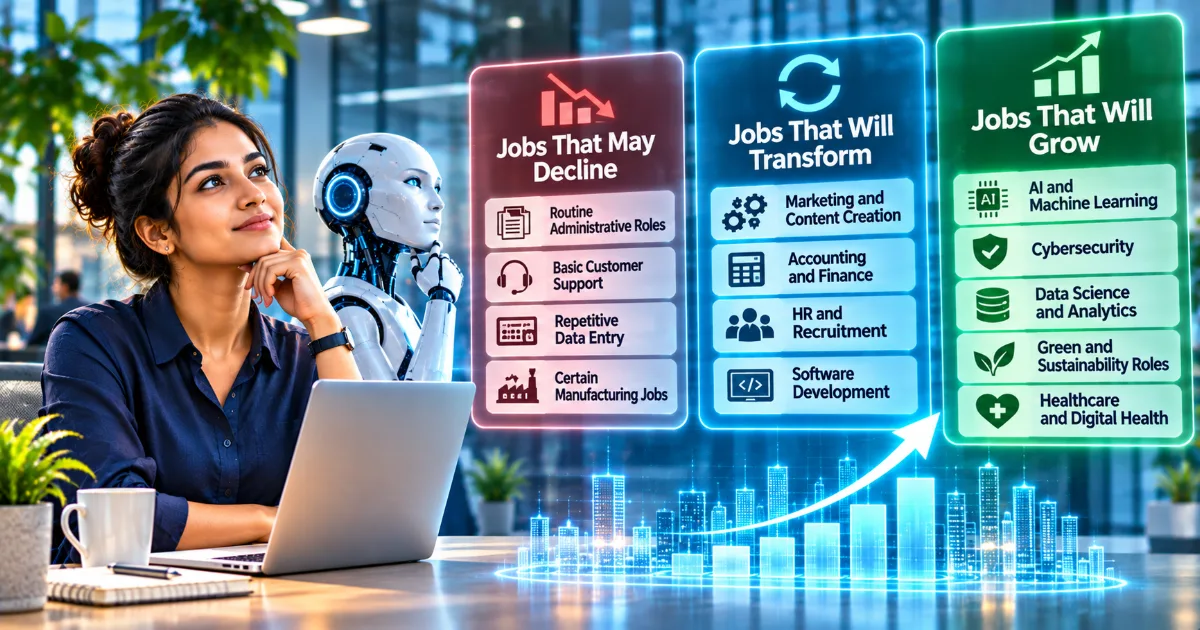
AI does not affect every occupation in the same way. Jobs involving repetitive digital activities and standardized information processing may experience substantial automation.
However, the level of exposure varies depending on the complexity of the responsibilities and the availability of reliable AI systems.
Data Entry and Administrative Processing
Data entry involves collecting, organizing, and transferring information between documents, databases, and business applications. Many of these activities follow predictable procedures.
AI-powered document processing systems can extract information from invoices, forms, receipts, and reports. Automation tools can transfer this information into business systems and identify missing fields.
As these capabilities improve, organizations may require fewer employees for purely repetitive data processing.
However, professionals who understand data quality, business operations, reporting, and information management can move towards more valuable analytical and supervisory responsibilities.
Basic Customer Support
AI chatbots and virtual assistants can answer frequently asked questions, provide order updates, explain standard policies, and guide customers through routine procedures.
This can reduce the workload associated with common customer inquiries.
However, customer service is not limited to answering questions. Difficult complaints, emotional situations, unusual requests, and complex service failures require understanding and judgment.
Human customer support professionals may increasingly focus on complicated cases, relationship management, and customer retention.
Routine Content Production
Generative AI can create initial drafts of articles, product descriptions, social media captions, email messages, and marketing material.
This may affect jobs that involve producing large quantities of standardized content.
However, effective communication requires more than generating sentences. Content professionals must understand audiences, develop original perspectives, verify information, maintain brand identity, and create meaningful communication strategies.
Writers who combine strong communication skills with subject expertise, research, editing, and AI literacy may find new opportunities.
Basic Accounting and Bookkeeping
Accounting software already automates many financial processes. AI can further assist with transaction categorization, document extraction, reconciliation, and preliminary reporting.
This may reduce the demand for manual processing activities.
Nevertheless, financial interpretation, taxation, auditing, compliance, risk management, and professional advisory services continue to require specialized knowledge and accountability.
Routine Translation and Transcription
AI-powered speech recognition and translation systems can process large volumes of audio and text.
These tools can support meeting transcription, document translation, and multilingual communication.
However, specialized translation involving legal, medical, cultural, literary, or technical meaning may still require human expertise and careful review.
4. Jobs That May Be More Difficult to Replace Completely
Certain occupations involve responsibilities that are difficult to automate entirely because they depend on human interaction, physical adaptability, complex judgment, or emotional understanding.
This does not mean these professions will remain untouched by AI. Rather, AI may become a supporting technology instead of a complete replacement.
Healthcare Professionals
Doctors, nurses, therapists, and other healthcare professionals work with people in situations involving physical health, emotional concerns, uncertainty, and ethical responsibility.
AI can assist with medical imaging, patient record organization, research, and clinical decision support. However, healthcare professionals must interpret information in context, communicate with patients, consider individual circumstances, and take responsibility for treatment decisions.
The future of healthcare will likely involve greater collaboration between medical expertise and intelligent systems.
Teachers and Educators
AI can explain concepts, generate practice questions, prepare lesson materials, and provide personalized learning assistance.
However, teaching involves understanding student behavior, encouraging curiosity, supporting emotional development, managing classrooms, and adapting explanations to individual needs.
Teachers who understand how to integrate AI into education may become more effective rather than less relevant.
Skilled Trades and Technical Services
Electricians, plumbers, mechanics, construction professionals, maintenance technicians, and other skilled workers operate in environments that are often unpredictable.
Physical work involves navigating different spaces, identifying unusual problems, handling specialized equipment, and responding to unexpected conditions.
Robotics may automate some industrial and repetitive physical activities, but many real-world technical tasks remain challenging to automate economically and reliably.
Leadership and Management
AI can analyze performance data, generate reports, and provide recommendations. However, effective leadership involves motivating people, resolving conflicts, communicating strategy, building trust, and making decisions when information is incomplete.
Managers who combine technological understanding with strong human leadership will remain important in many organizations.
5. The New Career Opportunities Created by Artificial Intelligence
While automation may reduce demand for certain responsibilities, AI is also creating new professional requirements.
Every new technology introduces the need for people who can develop it, implement it, maintain it, evaluate it, secure it, and help organizations use it effectively.
Artificial intelligence is no exception.
AI Engineer
AI engineers develop and implement systems that use artificial intelligence to solve practical problems.
Their work may involve machine learning models, data pipelines, application development, model integration, performance evaluation, and deployment.
They generally require strong programming knowledge, mathematical understanding, software engineering capabilities, and familiarity with AI frameworks.
Machine Learning Engineer
Machine learning engineers build systems that learn patterns from data and use those patterns to make predictions or classifications.
They work on model training, testing, optimization, deployment, and monitoring.
These professionals are important in industries such as finance, healthcare, retail, logistics, manufacturing, and technology.
AI Research Scientist
AI research scientists investigate new methods for improving artificial intelligence systems.
Their work may involve developing machine learning techniques, studying model behavior, improving reasoning capabilities, and exploring new approaches to computer vision or language processing.
This career generally requires advanced technical knowledge and, in many research positions, postgraduate education.
AI Product Manager
AI product managers connect business objectives with technical development.
They identify problems that AI can solve, understand user requirements, coordinate development teams, evaluate product performance, and ensure that AI solutions deliver practical value.
This role is particularly relevant because successful AI products require more than sophisticated technology. They must solve genuine problems for customers and organizations.
AI Ethics and Governance Specialist
AI governance specialists help organizations use artificial intelligence responsibly.
Their responsibilities may include reviewing risks, developing policies, assessing fairness, supporting compliance, documenting AI systems, and establishing accountability procedures.
As organizations use AI in increasingly important decisions, the need for responsible oversight is becoming more significant.
AI Security Specialist
AI systems introduce new security concerns involving sensitive data, model manipulation, unauthorized access, malicious inputs, and misuse of automated capabilities.
AI security professionals help identify vulnerabilities and protect intelligent systems.
Their work connects artificial intelligence with cybersecurity, information security, software engineering, and risk management.
AI Automation Consultant
AI automation consultants help organizations identify activities that can be improved through intelligent automation.
They study business processes, select suitable technologies, design workflows, coordinate implementation, and evaluate results.
This career combines business understanding with technical knowledge and problem-solving.
6. The Rise of Human-AI Collaboration Jobs
One of the most interesting developments in the future of work is the emergence of roles that involve working directly with AI systems.
Instead of replacing human employees, organizations may redesign responsibilities around collaboration between people and intelligent software.
For example, a marketing specialist may use AI to analyze customer behavior, identify content ideas, and prepare campaign drafts. The professional then evaluates the results, understands the audience, develops the strategy, and makes creative decisions.
A financial analyst may use AI to process large datasets and identify patterns. The analyst then investigates the findings, considers business conditions, and explains the implications to management.
A software developer may use AI coding assistants to accelerate development while retaining responsibility for architecture, testing, security, and maintainability.
This model requires professionals to understand both their domain and the technology they use.
The future may therefore create more opportunities for people who can translate business requirements into effective AI-assisted workflows.
7. How AI Is Transforming Different Industries
The employment impact of artificial intelligence will differ significantly between industries.
Banking and Financial Services
Banks and financial institutions use AI for fraud detection, transaction monitoring, customer support, risk analysis, and operational automation.
These technologies may reduce repetitive processing activities while increasing demand for professionals in financial analytics, cybersecurity, AI governance, regulatory compliance, and digital banking.
Financial professionals who understand both traditional financial principles and modern technology may have an advantage.
Healthcare and Pharmaceuticals
Healthcare organizations can use AI to support medical imaging, research, administrative processes, patient communication, and clinical information analysis.
Pharmaceutical companies can use AI-assisted methods to explore research data and support drug development.
This may create opportunities for professionals who understand healthcare operations, medical technology, biomedical research, health data, and AI systems.
Education and EdTech
AI-powered educational platforms can support personalized learning, automated assessments, interactive tutoring, and content development.
Educational institutions may need professionals who understand instructional design, digital learning systems, educational technology, and AI-assisted teaching.
The role of teachers may increasingly include guiding students in evaluating information and using intelligent tools responsibly.
Manufacturing and Engineering
Manufacturing companies can use AI and robotics for quality inspection, predictive maintenance, production planning, and supply chain management.
These technologies may change factory responsibilities while creating demand for robotics technicians, automation engineers, industrial data analysts, and maintenance specialists.
Retail and E-Commerce
Retail businesses use AI for recommendation systems, inventory forecasting, customer analysis, pricing support, and personalized marketing.
The industry may create opportunities in customer analytics, e-commerce technology, digital merchandising, automation management, and customer experience design.
Media and Marketing
AI can assist with content production, audience research, campaign analysis, advertising optimization, and creative experimentation.
Marketing professionals will increasingly need to combine communication, analytical thinking, strategic planning, and AI literacy.
8. Will AI Reduce Salaries and Increase Competition for Jobs?
Another important concern is whether AI will put downward pressure on salaries.
The answer will depend on the occupation, the level of automation, the availability of skilled professionals, and the economic value of the work being performed.
When technology makes certain activities faster and easier, businesses may need fewer working hours to complete the same amount of work. This can influence staffing requirements and compensation structures.
For example, if an organization can automate a significant portion of routine document processing, it may reduce the number of employees required for that particular activity.
However, the same technology may increase demand for professionals who can manage automated systems, interpret information, and solve more complex problems.
AI may also increase competition in some professions because individuals with access to similar tools can produce certain types of work more efficiently.
A freelancer who once competed mainly with professionals in a local market may now compete with specialists from different countries.
This makes differentiation important.
Professionals will need to demonstrate expertise, reliability, creativity, communication skills, and the ability to solve problems that customers genuinely care about.
The long-term effect on salaries is unlikely to be uniform. Some specialized roles may become more valuable, while certain routine activities may experience greater competition and pressure.
9. Why AI Literacy Will Become Essential for Almost Every Profession
AI literacy is the ability to understand, evaluate, and use artificial intelligence systems effectively and responsibly.
It does not mean that everyone must learn advanced programming or become a machine learning engineer.
A teacher, accountant, designer, lawyer, recruiter, entrepreneur, or marketing professional can benefit from understanding how AI tools work and where they are useful.
AI literacy involves knowing how to provide clear instructions, evaluate generated results, recognize inaccurate information, protect confidential data, and understand the limitations of automated systems.
For example, a marketing executive may use AI to generate campaign ideas. However, the executive must understand the target audience and verify that the proposed message is accurate and appropriate.
An accountant may use an AI tool to analyze a financial report but must verify calculations and interpret the findings using professional knowledge.
A student may use AI to understand a difficult subject but should still develop the ability to solve problems independently.
The most important principle is that AI should strengthen human capability rather than replace independent thinking.
10. Skills That Will Help Professionals Remain Relevant
The future workplace will reward professionals who can combine technical knowledge with human capabilities.
Critical Thinking
AI can produce answers, summaries, predictions, and recommendations. However, those outputs must be evaluated.
Critical thinking helps professionals identify errors, question assumptions, compare evidence, and make informed decisions.
Communication
Strong communication is essential for explaining ideas, understanding customers, working with teams, and presenting recommendations.
Technology can help generate information, but professionals must still communicate meaning effectively.
Creativity
Creativity involves identifying new opportunities, developing original approaches, and solving problems in unfamiliar ways.
AI can support creative exploration, but people must understand the context and decide which ideas are valuable.
Data Literacy
Data literacy involves understanding information, interpreting charts, identifying patterns, and making evidence-based decisions.
As organizations become more data-driven, this capability will be useful across many occupations.
Adaptability
Professionals must be willing to learn new tools, change working methods, and develop new responsibilities.
Adaptability is particularly important because the exact requirements of future occupations cannot always be predicted.
Emotional Intelligence
Emotional intelligence involves understanding emotions, managing relationships, responding appropriately to others, and handling difficult conversations.
These capabilities are valuable in leadership, customer service, healthcare, education, recruitment, and many other professions.
11. How Students Should Prepare for an AI-Driven Job Market
Students entering the workforce today may experience significant changes during their professional careers.
Some occupations they are preparing for may evolve substantially, while entirely new professions may emerge.
The most effective preparation is to combine foundational education with practical experience and continuous skill development.
Students should focus on understanding the principles of their chosen subjects rather than memorizing information alone.
A computer science student should develop programming fundamentals, data structures, software engineering, databases, and problem-solving abilities before relying heavily on AI coding tools.
A commerce student should understand accounting, finance, economics, business operations, and analytical methods while learning relevant digital applications.
A design student should develop visual communication, creative thinking, user experience principles, and design fundamentals alongside modern digital tools.
Students should also build practical projects. A portfolio demonstrating actual capabilities can help employers understand what a candidate can contribute.
Internships, research projects, volunteering, competitions, and collaborative work can provide valuable professional experience.
Most importantly, students should develop the habit of learning independently. The ability to acquire new knowledge throughout a career may become more important than relying on a single qualification.
12. How Working Professionals Can Protect Their Careers
Employees who are already established in their careers may wonder whether they should change professions or return to formal education.
A complete career change is not always necessary.
A more practical approach is to examine existing responsibilities and identify how AI is changing them.
An administrative professional can learn business process automation and data management.
A content writer can develop expertise in research, editing, brand communication, and content strategy.
A recruiter can learn AI-assisted sourcing, talent analytics, and workforce planning.
A financial professional can strengthen knowledge of financial modelling, data analysis, and automated reporting.
A software developer can improve system architecture, cybersecurity, cloud computing, and AI integration skills.
Professionals should also communicate their achievements in terms of measurable contributions. Employers need to understand how an employee improves efficiency, solves problems, supports customers, and contributes to business objectives.
Building professional relationships and staying informed about industry changes can also help individuals identify opportunities before their existing responsibilities become outdated.
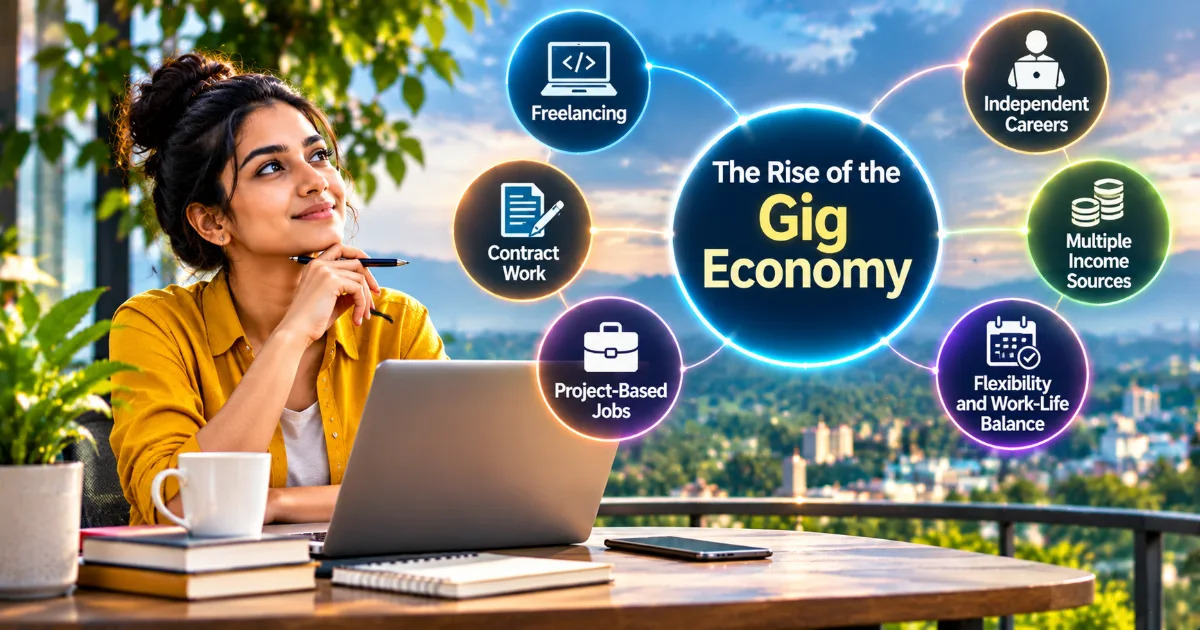
13. Can AI Create More Opportunities for Freelancers and Entrepreneurs?
Artificial intelligence may create important opportunities for independent professionals and small businesses.
Previously, individuals starting a business often needed to hire specialists for content creation, design, research, administration, and customer communication.
AI tools can now assist with some of these activities, reducing the initial effort required to establish certain business operations.
A freelance consultant can use AI to organize research and prepare initial client reports.
A small online retailer can use intelligent tools to support product descriptions, customer communication, and inventory analysis.
An independent educator can use AI to prepare learning materials and organize online courses.
A startup founder can use AI-assisted development tools to explore product ideas and create early prototypes.
However, access to AI does not guarantee business success.
Entrepreneurs still need to understand customers, develop valuable products, manage finances, establish trust, and deliver reliable services.
The biggest opportunity may belong to individuals who combine AI efficiency with genuine expertise and a clear understanding of customer needs.
14. The Risks of Depending Too Much on Artificial Intelligence
Although AI can improve productivity, excessive dependence on it can create problems.
One risk is the gradual weakening of independent problem-solving skills. If employees use AI for every activity without understanding the underlying process, they may struggle when systems produce incorrect results or become unavailable.
Another concern is inaccurate information. Generative AI systems can produce convincing explanations that contain factual mistakes, missing context, or fabricated details.
Data privacy is also important. Employees may unintentionally share confidential company information, customer records, or sensitive documents with tools that are not approved for such use.
There are also concerns involving intellectual property, algorithmic bias, cybersecurity, and accountability.
Organizations must therefore establish responsible AI policies and provide appropriate training.
Employees should understand which tools are approved, what information can be shared, when human verification is required, and who is responsible for final decisions.
AI should be treated as a powerful assistant, not an unquestionable authority.
15. The Role of Governments and Educational Institutions
The transition towards AI-enabled employment cannot be managed by individuals and businesses alone.
Governments and educational institutions have important responsibilities in preparing workers for technological change.
Education systems should strengthen digital literacy, analytical thinking, communication, creativity, and practical problem-solving.
Vocational training institutions can introduce programs related to automation, robotics, data analytics, cybersecurity, and emerging technologies.
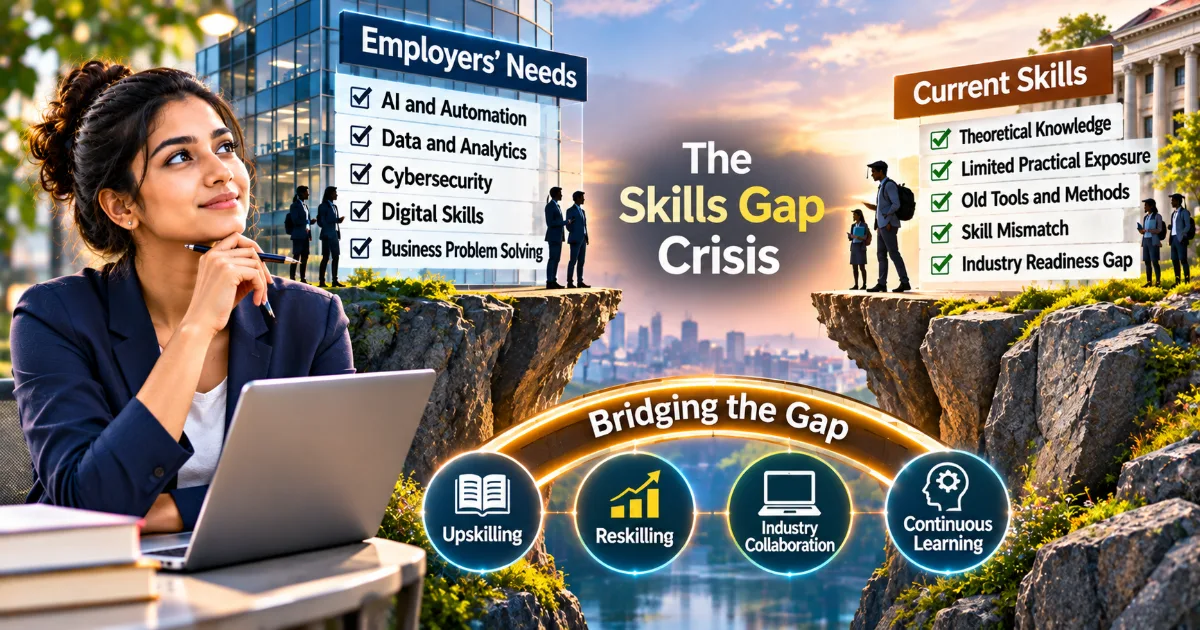
Universities can collaborate with industries to ensure that academic programs remain connected with real professional requirements.
Governments can support reskilling initiatives, employment transition programs, digital infrastructure, and policies that protect workers affected by automation.
They must also consider the broader social implications of technological change, including income inequality, employment security, access to education, and responsible AI regulation.
The objective should not be to prevent technological development. It should be to ensure that the benefits of innovation are accessible to a wider section of society.
16. What Will the Job Market Look Like in 2030?
By 2030, AI may be deeply integrated into many everyday business applications.
Employees may regularly use intelligent assistants for research, communication, documentation, planning, and data analysis.
Some organizations may operate with smaller teams supported by more advanced automation systems, while other industries may create new roles requiring specialized human expertise.
Recruitment may increasingly focus on demonstrated skills, practical projects, and the ability to work effectively with digital tools.
Traditional qualifications will continue to matter in many professions, especially where formal licensing and specialized education are required. However, employers may also place greater emphasis on continuous learning and practical capability.
New responsibilities may emerge around AI governance, model evaluation, automation design, AI security, human-machine collaboration, and digital transformation.
The transition will not happen equally everywhere. Countries with stronger infrastructure, education systems, investment, and technology adoption may experience changes at different rates from regions with limited digital access.
Therefore, the future job market will likely be diverse rather than following one universal employment model.
17. A Practical Action Plan for the Next Five Years
Preparing for AI-driven employment requires practical action rather than simply following technology news.
Individuals should begin by identifying the activities that occupy most of their working time. They should examine which responsibilities are repetitive, which require specialized judgment, and which may be supported by AI.
Next, they should identify relevant tools used in their industry and learn how to apply them safely.
A professional should also choose one or two complementary skills that increase career value. These could include data analytics, communication, automation, project management, cybersecurity, or a specialized technical capability.
Practical experience is equally important. Employees should experiment with suitable projects, document improvements, and build evidence of their abilities.
A useful approach is to review professional skills periodically rather than waiting until an employer announces organizational changes.
For students, this means developing a combination of academic knowledge, practical projects, internships, and digital literacy.
For business owners, it means evaluating business processes and introducing automation where it creates genuine value.
For independent professionals, it means developing expertise that differentiates their services from generic AI-generated output.
The goal is to become more capable and adaptable, not simply to accumulate certificates or learn every new application.
18. The Future Will Be About Human Potential, Not Just Machine Intelligence
The debate about AI and employment often focuses heavily on what machines can do.
However, another important question is what people can accomplish when they have access to more powerful tools.
A researcher may investigate more possibilities. A teacher may provide additional learning support. A small business owner may serve customers more efficiently. A developer may experiment with more product ideas. A healthcare professional may spend less time on certain administrative activities and more time interacting with patients.
These possibilities depend on thoughtful implementation, appropriate resources, and responsible use.
Technology should ideally help people focus on activities where human knowledge, judgment, creativity, and empathy provide meaningful value.
The future of work should not be measured only by how many tasks can be automated. It should also be measured by whether people have better opportunities to learn, earn, innovate, and contribute to society.
Conclusion: AI Will Change Jobs, but Human Adaptability Will Shape the Future
Artificial intelligence will undoubtedly transform employment. Certain tasks will become automated, some occupations will experience disruption, and businesses will rethink how work is organized.
However, AI will also create new professional requirements, expand opportunities in emerging industries, and introduce ways of working that are not yet common.
The future will not be determined simply by whether machines become more capable. It will also depend on how individuals, organizations, educational institutions, and governments respond to technological change.
For employees, the priority should be continuous learning, digital literacy, adaptability, critical thinking, and the ability to use AI responsibly.
For students, the focus should be on building strong foundations, developing practical experience, and preparing for careers that may evolve throughout their professional lives.
For entrepreneurs and business owners, AI offers opportunities to improve efficiency, develop new services, and reach customers in innovative ways.
For organizations, successful AI adoption will require a balance between automation, human expertise, employee development, and responsible governance.
The most important lesson is that people should not wait until AI changes their jobs before preparing for it.
Instead of asking only whether artificial intelligence will take away employment, individuals should ask how they can develop the skills and capabilities required to create value in an AI-enabled economy.
The future may belong to professionals who understand technology, but it will also belong to those who know how to think independently, communicate effectively, solve complex problems, and understand people.
AI may transform the way we work, but the choices humans make will determine what that transformation ultimately means for employment, opportunity, and society.
#ArtificialIntelligence #FutureOfWork #FutureOfJobs #AIAndEmployment #CareerOpportunities