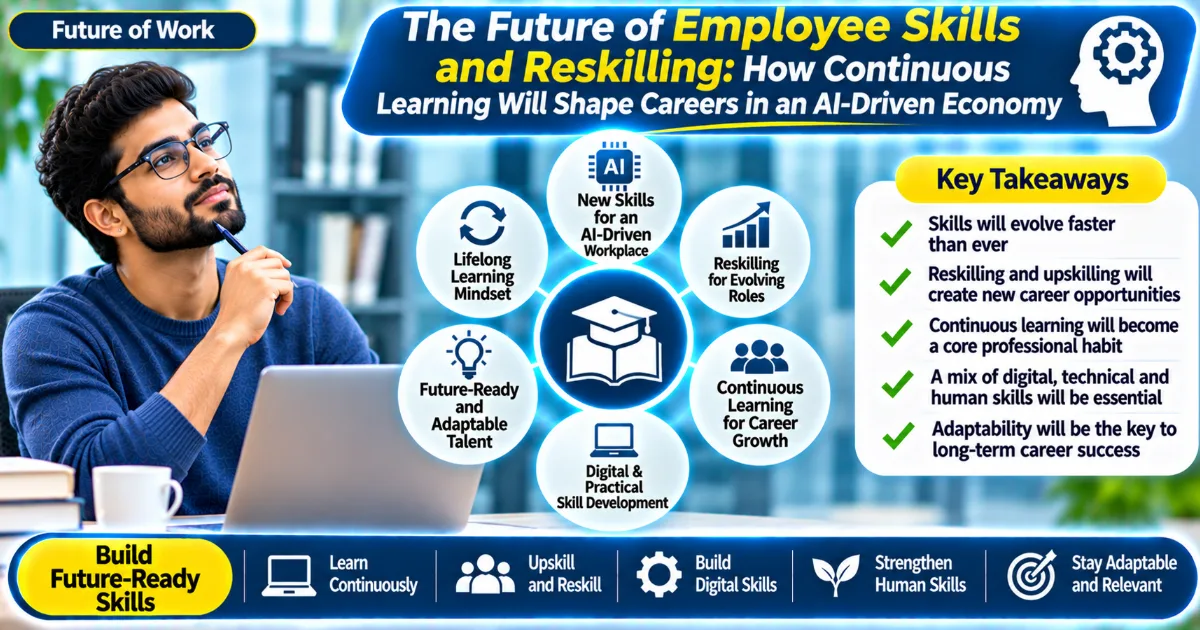
The world of work is changing faster than traditional education and career development systems were designed to accommodate. Artificial intelligence, automation, robotics, cloud computing, data analytics and digital platforms are transforming how organisations operate and how employees perform their responsibilities. Tasks that once required hours of manual effort can increasingly be completed with intelligent software. Entire industries are adopting new technologies, while established professions are changing their workflows, expectations and skill requirements.
These developments are creating a fundamental challenge for employees and employers: the skills that make someone successful today may not be sufficient for the responsibilities they will face tomorrow. A professional who has spent years developing expertise in a particular process may discover that automation has changed that process. A graduate entering the job market may find that employers expect practical digital capabilities alongside academic qualifications. An experienced manager may need to understand AI tools, data interpretation and digital collaboration to remain effective.
This does not mean that technology will make human skills irrelevant. On the contrary, the future workplace will require a combination of technical knowledge, critical thinking, creativity, communication, adaptability and professional judgement. As machines become more capable of handling repetitive and predictable activities, human workers will increasingly need to focus on solving complex problems, understanding people, evaluating information and making responsible decisions.
The answer to this challenge is not simply to collect more certificates or attend occasional training programmes. It is to build a culture of continuous learning in which individuals regularly update their capabilities, organisations invest in employee development and education systems remain connected to changing industry requirements.
Reskilling and upskilling will become essential parts of career development. Reskilling helps employees prepare for different roles when their existing responsibilities change. Upskilling helps them become more capable in their current or closely related roles. Together, these approaches can help workers remain relevant, organisations become more adaptable and economies manage technological transitions more effectively.
Continue Reading
1. Why Employee Skills Are Changing
For much of the industrial and early digital economy, many jobs followed relatively stable patterns. Employees learned a profession, developed experience and gradually became more specialised. Although technology changed working methods, the underlying responsibilities of many roles remained recognisable for long periods.
Today, digital transformation is affecting a much wider range of occupations. Artificial intelligence can support writing, research, software development, customer service, financial analysis, design and decision-making. Robotic systems can perform physical tasks in manufacturing, logistics and other operational environments. Cloud platforms allow teams to collaborate across geographical boundaries, while data analytics changes how organisations understand customers and markets.
These technologies do not affect every profession in the same way. Some tasks can be automated almost completely, while others require substantial human involvement. In many occupations, technology will change the composition of work rather than eliminate the entire role.
For example, an accountant may spend less time entering routine information and more time reviewing financial patterns, advising clients and identifying unusual transactions. A customer service professional may use AI to retrieve information and draft responses while concentrating on complex complaints and relationship management. A software developer may use AI-assisted coding tools but still need to understand system architecture, security, testing and product requirements.
The important change is that employees must learn to work effectively with evolving tools. Professional knowledge remains valuable, but it increasingly needs to be combined with the ability to adapt that knowledge to new situations.
2. Understanding Reskilling and Upskilling
Reskilling and upskilling are related concepts, but they address different development needs.
Reskilling involves learning a substantially new set of capabilities to move into a different role or occupation. It becomes particularly important when an existing job changes significantly, demand for a particular skill declines or an employee wants to pursue a new career direction.
For example, a worker whose responsibilities involve repetitive data processing may learn data analysis, business intelligence or process automation. A professional from a traditional administrative role may develop skills in digital operations, project coordination or customer success.
Upskilling involves improving or expanding capabilities within an existing role or professional area. A marketing professional learning advanced analytics, AI-assisted research and marketing automation is upskilling. A project manager learning new collaboration platforms, risk analysis methods and AI-based project planning is also upskilling.
Both approaches are necessary because career development is not always a matter of changing professions. Many employees will remain in the same broad industry while their responsibilities become more technology-enabled and specialised.
Organisations should identify whether employees need deeper expertise in their current work, new capabilities for evolving responsibilities or a complete transition into another role. The learning programme should match the actual need rather than offering generic training without a clear purpose.
3. Artificial Intelligence and the New Skills Economy
Artificial intelligence is becoming one of the most influential forces shaping future skill requirements. AI systems can process information, generate content, identify patterns, assist with coding and support complex workflows. As these capabilities become more accessible, employees across many industries will need to understand how to use them effectively.
AI literacy will become a practical workplace skill. Employees should understand what AI tools can do, what they cannot reliably do and how to evaluate their outputs. They should know when information needs verification, how to protect confidential data and why human judgement remains necessary.
For example, an employee using an AI tool to prepare a business report should not automatically accept every generated statement. They should verify figures, examine the source of information, check assumptions and ensure that the final report reflects the organisation's actual circumstances.
Prompting and workflow design may also become useful capabilities. Employees who can clearly describe a problem, provide relevant context, evaluate outputs and integrate AI into a responsible process may work more effectively than those who use AI without a defined objective.
However, AI literacy should not be confused with learning a single tool. Specific platforms and interfaces may change. The more durable capability is understanding how to work with intelligent systems, assess their reliability and apply them to meaningful tasks.
4. The Most Important Skills for the Future Workplace
The future workforce will require a balanced combination of technical and human capabilities. No single skill will guarantee long-term career success, and the right combination will vary by profession.
Digital literacy
Digital literacy is the ability to use digital technologies confidently, safely and effectively. It includes working with common business software, online collaboration platforms, digital communication systems and information management tools.
As organisations become more technology-dependent, employees will need to understand how digital workflows operate. They should be able to organise information, collaborate online, manage digital documents and identify basic security risks.
Data literacy
Data literacy means understanding how to read, interpret and communicate information derived from data. Employees do not necessarily need to become data scientists, but they should be comfortable working with relevant metrics and recognising the limitations of numerical information.
A sales professional may need to interpret conversion rates and customer trends. A human resources specialist may analyse recruitment patterns and employee engagement information. A manufacturing supervisor may use production data to identify inefficiencies.
Critical thinking
Technology can generate recommendations, but employees must evaluate whether those recommendations make sense. Critical thinking involves examining evidence, questioning assumptions, comparing alternatives and recognising incomplete information.
It becomes especially important when AI-generated material is used in professional decisions.
Creativity and innovation
Creative thinking helps employees identify new opportunities, develop solutions and improve existing processes. While AI can generate ideas and variations, people remain responsible for understanding context, defining meaningful objectives and deciding which solutions are appropriate.
Communication and collaboration
Modern workplaces depend on people sharing information, explaining decisions and coordinating responsibilities. Employees must be able to communicate clearly in writing, meetings and digital collaboration environments.
Adaptability
Adaptability is the ability to respond constructively when responsibilities, tools or working conditions change. It includes willingness to learn, reconsider assumptions and develop new approaches.
Ethical judgement
Employees increasingly need to understand privacy, fairness, intellectual property, security and responsible technology use. These issues are not limited to senior management. Anyone handling sensitive information or using AI-powered systems may encounter ethical responsibilities.
5. Technical Skills Will Continue to Evolve
Technical skills remain essential, but their specific requirements will change as industries adopt new systems.
In software development, employees may need to understand AI-assisted coding, cloud infrastructure, cybersecurity, software testing, system integration and data engineering. The ability to write code remains important in many roles, but developers will also need to review generated code, understand system behaviour and identify security weaknesses.
In finance, digital accounting systems, financial modelling, analytics and automation may become increasingly relevant. Professionals will need to understand how technology affects reporting, compliance and financial controls.
In healthcare, digital health records, diagnostic support systems, medical data management and telehealth platforms are changing professional workflows. Human expertise, patient communication and ethical judgement remain essential.
In manufacturing, workers may need skills in robotics, industrial automation, predictive maintenance, quality monitoring and connected production systems.
In marketing, professionals may increasingly work with customer analytics, AI-assisted research, digital advertising platforms, automation and content evaluation.
The lesson is not that every employee must learn every new technology. It is that workers should identify which technologies are relevant to their profession and develop practical competence in those areas.
6. Human Skills Will Become a Competitive Advantage
As automation expands, human capabilities that are difficult to standardise may become increasingly valuable.
Empathy helps professionals understand customers, colleagues and stakeholders. Negotiation helps people resolve competing interests. Leadership supports coordination and decision-making during uncertainty. Creativity helps organisations develop new products and services. Communication makes complex information understandable.
Consider a customer service department that uses AI to answer routine questions. Employees may increasingly handle complicated complaints, emotionally sensitive situations and cases requiring negotiation. These responsibilities require patience, listening and judgement.
Similarly, a manager using AI-based analytics must still understand employee concerns, communicate organisational priorities and make decisions that consider people as well as performance metrics.
Human skills are not optional additions to technical expertise. They help determine whether technology produces useful outcomes.
7. Why Continuous Learning Will Become a Career Habit
Traditional education often follows a defined period of study before employment. Continuous learning introduces a different approach: professional development becomes an ongoing activity throughout a person's working life.
Employees may need to update their knowledge whenever their industry adopts new tools, regulations or business practices. Learning may take place through formal education, short courses, professional communities, workplace projects, mentoring and independent study.
A continuous learning mindset helps workers respond to change before it becomes an urgent career problem.
For example, a finance professional who regularly learns about analytics and automation may be better prepared when their organisation introduces a new financial platform. A teacher who explores digital learning tools can adapt more easily when classroom practices change. A small business owner who develops digital marketing skills may discover new ways to reach customers.
Continuous learning does not require employees to study every day for several hours. It requires a realistic and consistent approach to identifying knowledge gaps and taking action.
A small amount of focused learning each week can become valuable when combined with practical application and regular review.
8. The Role of Employers in Employee Reskilling
Reskilling should not be treated as the responsibility of employees alone. Organisations benefit when their workforce can adapt to changing business requirements.
Employers often have a clearer view of upcoming technology investments, new service models and operational changes. They can identify which capabilities will become important and create learning opportunities before existing skills become insufficient.
A structured reskilling programme begins with workforce planning. Organisations should examine current roles, expected changes and the capabilities needed for future operations.
They can then identify employees whose existing knowledge may transfer to new responsibilities. For example, an employee with strong operational experience may be suitable for a process improvement role after developing data analysis and automation skills.
Employers should provide access to relevant courses, practical assignments, mentoring and opportunities to demonstrate new capabilities. Training should be connected to actual job requirements rather than measured only through attendance.
Managers also play an important role. They should discuss development goals with employees, provide useful feedback and create opportunities to apply newly acquired knowledge.
A successful learning strategy benefits both the organisation and the individual. The business develops a more capable workforce, while employees gain stronger career options.
9. Building a Personal Reskilling Strategy
Employees can take a proactive approach to career development by building a personal reskilling strategy.
The first step is to understand the current role. Employees should identify their main responsibilities, the tools they use and the skills that contribute most to successful performance.
The second step is to examine how the role may change. They can study industry developments, job descriptions, professional discussions and technology adoption in their field.
The third step is to identify skill gaps. A person may discover that they need stronger data skills, better digital communication, familiarity with AI tools or more advanced professional knowledge.
The fourth step is to prioritise. Attempting to learn too many subjects at once can create confusion. Employees should focus on a small number of capabilities that are relevant to their immediate career goals.
The fifth step is to practise. Watching tutorials or completing theoretical courses is useful, but practical application builds confidence. Employees can create sample projects, improve an existing workflow, complete a portfolio assignment or volunteer for a relevant workplace task.
Finally, they should review progress regularly. Learning goals may need to change as the employee gains experience or as industry requirements evolve.
10. Learning Through Practical Projects
Practical learning is one of the most effective ways to turn knowledge into professional capability.
A person studying data analytics can work with a sample dataset, prepare a dashboard and explain the patterns they identify. Someone learning web development can build a small application. A marketing professional can design a campaign plan and evaluate its results.
Projects provide evidence that a person can apply knowledge rather than merely describe concepts.
They also help employees understand the limitations of their learning. A course may explain how a tool works, but a real project reveals issues involving incomplete information, conflicting requirements, time constraints and user needs.
Employers can support practical learning by assigning employees to cross-functional projects, allowing them to observe experienced colleagues and giving them opportunities to solve real operational problems.
A project-based approach also creates material for professional portfolios, interviews and career discussions.
11. Microlearning and Flexible Education
Traditional training programmes can be expensive and difficult to schedule, particularly for employees with demanding responsibilities.
Microlearning offers a flexible alternative by dividing learning into smaller, focused units. Employees may study a particular concept, tool or process through short lessons, demonstrations, exercises or practical explanations.
For example, an employee learning spreadsheet automation may complete a short lesson on formulas, practise a task, then move to data validation and reporting. This creates a manageable learning path.
Microlearning works best when the lessons form part of a broader development plan. Short sessions should connect to practical outcomes rather than becoming disconnected pieces of information.
Flexible learning platforms can also support employees working remotely or across different locations. Organisations can combine self-paced courses with live discussions, mentoring and practical assignments.
12. The Importance of Skills-Based Hiring
As skills requirements change, employers may increasingly look beyond traditional qualifications and job titles.
Skills-based hiring focuses on whether candidates can demonstrate the capabilities required for a role. This may involve practical assessments, portfolios, work samples, structured interviews and evidence of relevant experience.
A candidate who has developed strong data analysis skills through practical projects may be suitable for an entry-level analytics role even if their academic background is not exclusively focused on data science.
Similarly, a professional who has successfully managed digital projects may demonstrate relevant capabilities through work experience, independent projects or recognised training.
Skills-based hiring can widen access to opportunities, but it must be designed carefully. Assessments should be relevant, fair and accessible. Employers should not replace one form of bias with another by relying on poorly designed tests or subjective judgements.
For employees, this shift creates an incentive to demonstrate practical competence. A portfolio, project record or clear description of professional achievements can help communicate capabilities to potential employers.
13. Certifications, Degrees and Professional Experience
Formal qualifications will continue to matter in many professions, especially where legal, regulatory or professional requirements apply. Degrees, licences and recognised certifications can provide structured knowledge and demonstrate that an individual has completed an established learning programme.
However, qualifications alone may not demonstrate readiness for every modern role. Employers also need to understand how candidates apply their knowledge in practical situations.
Professional experience provides context, judgement and familiarity with real workplace challenges. Practical projects can demonstrate newer capabilities. Certifications can provide evidence of focused learning.
The strongest career profile often combines these elements.
Employees should evaluate courses and certifications based on their relevance, quality, recognition and practical value. They should avoid assuming that collecting a large number of certificates automatically creates employability.
A focused learning path supported by meaningful projects can be more useful than completing unrelated courses without applying the knowledge.
14. Career Transitions in an AI-Driven Economy
Technological change may encourage some employees to move into different roles. Career transitions can happen within the same organisation, between industries or through independent professional work.
An administrative professional may move toward operations coordination after learning digital workflow management. A graphic designer may expand into user experience design and digital product development. A customer support specialist may develop skills in customer success, product training or quality assurance.
Successful transitions often build on existing strengths rather than starting from zero.
Employees should identify transferable skills such as communication, organisation, problem-solving, customer understanding and project coordination. These capabilities may remain valuable across several occupations.
A career transition plan should include research into the target role, identification of required skills, practical learning, portfolio development and networking with professionals in the field.
Employees should also consider financial responsibilities and the time required to develop competence. Not every transition needs to happen immediately. A gradual move through projects, part-time learning or internal opportunities may be more realistic.
15. The Reskilling Challenge for Different Career Stages
Employees at different career stages may face different learning challenges.
Early-career professionals often need to build foundational knowledge, practical experience and confidence. They may benefit from internships, project work, mentoring and opportunities to explore different areas of a profession.
Mid-career professionals may need to update established expertise, move into leadership or adapt to new technologies. Their experience can be valuable, but they may need structured opportunities to learn unfamiliar tools and methods.
Experienced professionals may possess deep industry knowledge and strong professional judgement. Reskilling can help them transfer these strengths into advisory, mentoring, specialist or technology-enabled roles.
Employees approaching retirement may also wish to continue developing selected capabilities, support younger colleagues or pursue independent work. Learning should not be restricted by assumptions about age.
The right approach depends on an individual's goals, circumstances and professional interests. Organisations should make development opportunities accessible across the workforce.
16. Reskilling and the Future of Work in India
India has a large and diverse workforce operating across technology services, manufacturing, financial services, healthcare, education, retail, logistics, agriculture and emerging digital businesses.
Digital adoption creates opportunities for employees to enter new occupations and improve existing responsibilities. At the same time, differences in access to quality education, reliable internet, professional networks and training resources can affect who benefits from these opportunities.
Reskilling initiatives should therefore be practical, accessible and connected to real employment needs.
For technology professionals, relevant areas may include cloud computing, cybersecurity, data engineering, AI integration and software quality. For manufacturing workers, opportunities may involve industrial automation, equipment maintenance, robotics and digital quality systems. For professionals in small businesses, useful capabilities may include digital marketing, online commerce, accounting software, customer relationship management and workflow automation.
India's education providers, employers, training organisations and public institutions all have roles to play. Stronger connections between education and industry can help ensure that learning programmes reflect actual workplace requirements.
Employers should also recognise the potential of employees outside major metropolitan technology centres. Remote collaboration and digital learning can create opportunities for professionals in smaller cities when supported by appropriate infrastructure and training.
The long-term objective should be to make career development a practical possibility for a broad range of workers, not only those already employed in highly digital industries.
17. Barriers to Reskilling and How to Overcome Them
Although continuous learning offers significant benefits, employees and organisations face several barriers.
Time is one of the most common challenges. Employees may struggle to balance training with work and personal responsibilities. Organisations can address this by providing protected learning time and realistic development expectations.
Cost can also limit access. High-quality courses, certifications and equipment may be expensive. Employers can support learning through training budgets, internal programmes and access to shared resources. Employees can compare options and prioritise learning that offers practical value.
Lack of clarity is another barrier. People may understand that technology is changing their industry but remain uncertain about which skills to learn. Career guidance, skills assessments and conversations with experienced professionals can help identify priorities.
Fear of failure can discourage employees from trying unfamiliar tools or moving into new responsibilities. Managers should create supportive environments where people can practise, ask questions and learn from mistakes without compromising safety or quality.
Finally, training may fail when employees do not have opportunities to apply new knowledge. Organisations should connect learning programmes with real projects, internal mobility and job responsibilities.
18. Measuring the Success of Learning Programmes
Organisations should evaluate learning programmes through meaningful outcomes rather than relying only on course completion rates.
Useful indicators may include improvement in relevant job performance, successful completion of practical assessments, internal movement into new roles, reduction in process errors and increased ability to use newly introduced technologies.
Employee confidence and engagement can also provide useful information, although they should not be treated as the only measures of success.
For example, if an organisation trains employees to use an AI-assisted customer service platform, it can examine whether employees can handle cases more effectively, whether customer outcomes improve and whether the system introduces any new risks.
Learning programmes should be reviewed regularly. If employees complete training but cannot apply the skills, the organisation may need to improve the course design, provide more practical exercises or change the working environment.
The objective is to develop capability that produces value for employees, customers and the organisation.
19. The Role of Educational Institutions
Schools, colleges, universities and vocational institutions influence how prepared people are for the changing workplace.
Education systems need to combine foundational knowledge with practical problem-solving, communication, digital literacy and opportunities for applied learning.
Students should learn how to evaluate information, collaborate with others, understand technology and adapt when requirements change. They should also gain exposure to real workplace problems through internships, projects and industry partnerships.
Universities can strengthen their connection with employers by reviewing course content, supporting applied research and creating opportunities for students to work on practical assignments.
Vocational education and professional training are equally important. Not every career requires the same academic route, and many industries need skilled technicians, operators, specialists and service professionals.
Education should prepare people not only for their first job but also for continued learning throughout their careers.
20. How AI Can Personalise Learning
AI-powered learning systems may help employees identify knowledge gaps, recommend relevant resources and practise skills through interactive exercises.
A learning platform could assess a person's current understanding of a subject and suggest lessons based on their performance. It may provide explanations, generate practice questions or offer feedback on completed assignments.
For example, an employee learning business communication could practise writing reports and receive suggestions for improving clarity. A beginner studying programming could use an AI tutor to understand errors and explore alternative approaches.
These tools can make learning more accessible and flexible. However, their recommendations should be evaluated carefully. AI-generated explanations can contain errors, and automated assessments may not fully capture practical competence.
Organisations should also protect employee learning data and avoid using educational activity as an unfair measure of employee commitment or performance.
AI can support the learning process, but meaningful development still requires practice, feedback, reflection and human guidance.
21. The Future of Freelancing and Independent Careers
Reskilling may also create opportunities for employees to move toward freelancing, consulting, independent services and entrepreneurship.
Digital platforms allow professionals to offer specialised services to clients across geographical boundaries. Skills in software development, design, content, marketing, analytics, education and business operations can support independent careers.
However, technical competence alone is not enough for successful independent work. Freelancers also need client communication, pricing, project management, negotiation, time management and financial planning.
AI tools may help independent professionals prepare proposals, organise research and automate selected administrative tasks. They must still ensure that deliverables are accurate, original where required and appropriate for client needs.
Employees considering independent work should build practical experience, understand market demand and develop a clear service offering. A portfolio and professional reputation can be important in attracting clients.
The future of work may include more varied career paths in which people combine employment, independent projects and lifelong learning.
22. A Practical 90-Day Employee Reskilling Plan
A structured 90-day plan can help employees move from general interest to measurable progress.
During the first 30 days, the focus should be assessment and direction. Employees can review their current responsibilities, study relevant job descriptions, identify emerging industry requirements and choose one or two priority skills.
During the next 30 days, the focus should shift to learning and practice. Employees can complete relevant lessons, follow guided exercises and begin a small project that demonstrates their developing capability.
During the final 30 days, the focus should be application and evaluation. Employees can improve their project, seek feedback from experienced professionals and identify opportunities to use the skill in their current workplace or a target role.
At the end of the period, they should review what they learned, what remains difficult and what the next development goal should be.
The plan should be flexible. Some skills require more than 90 days to develop, while others can be learned in a shorter period. The purpose is to establish a repeatable process for professional development.
23. What Employees Should Do to Stay Relevant
Employees can strengthen their long-term career prospects by taking ownership of their development.
They should understand the direction of their industry, follow changes in relevant technologies and review the skills required in roles they may want to pursue. They should practise using appropriate tools rather than relying entirely on theoretical knowledge.
They should also develop the ability to explain their professional value. A clear record of projects, achievements and practical capabilities can help demonstrate readiness for new opportunities.
Networking and knowledge sharing remain useful. Conversations with colleagues, mentors and industry professionals can reveal emerging requirements and help employees discover learning opportunities.
Most importantly, employees should avoid treating learning as something that ends after receiving a degree or securing a job. Professional development is an ongoing process that helps people remain capable as their responsibilities evolve.
Conclusion
The future of employee skills will be shaped by technological transformation, changing business models and evolving expectations across industries. Artificial intelligence and automation will change many tasks, but they will also create opportunities for people who can combine technical knowledge with creativity, critical thinking, communication and sound judgement.
Reskilling and upskilling will become essential tools for navigating these changes. Employees will need to update their capabilities, employers will need to invest in workforce development and educational institutions will need to connect learning more closely with practical requirements.
The most valuable professional skill may ultimately be the ability to keep learning. Tools will change, job descriptions will evolve and new occupations will emerge. People who can identify what they need to learn, practise new capabilities and adapt their knowledge to changing situations will be better prepared for long-term career development.
The organisations that succeed will not simply be those that purchase the newest technologies. They will be those that help their employees understand, use and improve those technologies responsibly.
The future of work belongs neither exclusively to machines nor to people who rely only on yesterday's expertise. It will be shaped by individuals and organisations that bring human capability and technological progress together through continuous learning.
What Comes Next?
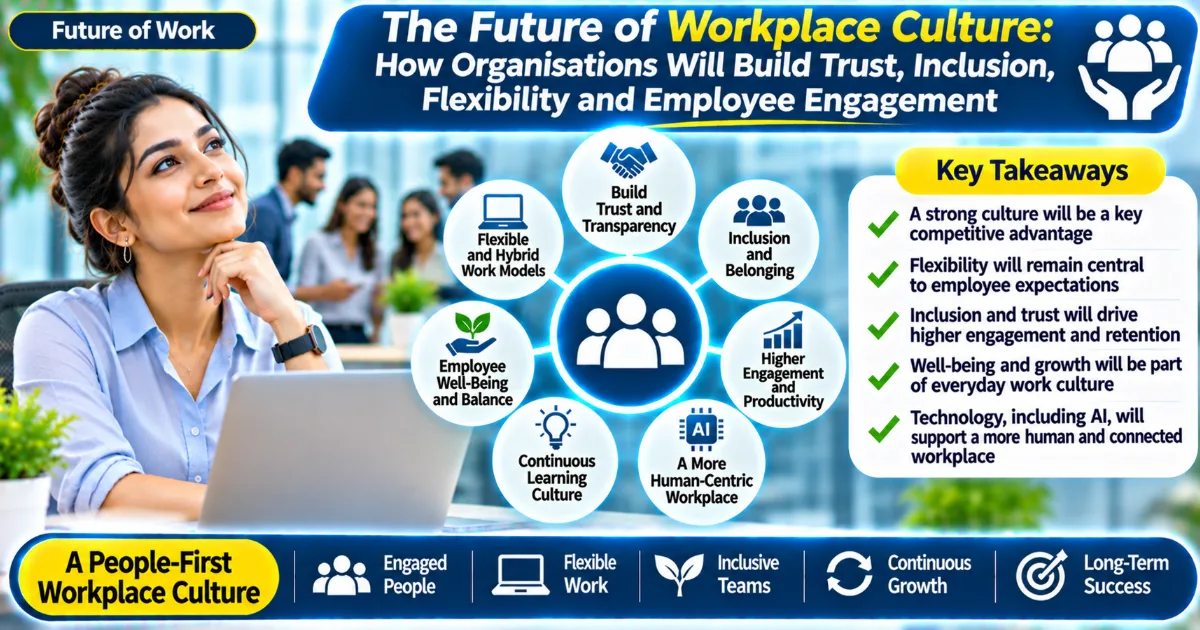
In Post 25 of the Future of Work series, we will explore The Future of Workplace Culture: How Organisations Will Build Trust, Inclusion, Flexibility and Employee Engagement. We will examine how changing employee expectations, distributed teams and digital transformation are reshaping organisational culture and what businesses can do to create workplaces where people feel valued and motivated to contribute.
#FutureOfWork #Reskilling #Upskilling #FutureSkills #ContinuousLearning