Recruitment has always been one of the most important responsibilities of an organisation. Businesses depend on people with the right knowledge, abilities and experience to deliver products, serve customers, manage operations and support growth. However, finding and hiring suitable employees has become increasingly complex. Organisations compete for skilled professionals, candidates expect faster and more transparent hiring processes, and technology continues to change the capabilities required across different industries.
For many years, recruitment followed a relatively familiar process. Employers published job advertisements, collected CVs, shortlisted candidates, conducted interviews, checked references and selected individuals for available positions. Educational qualifications, previous job titles and years of experience often played a major role in deciding who progressed through the process.
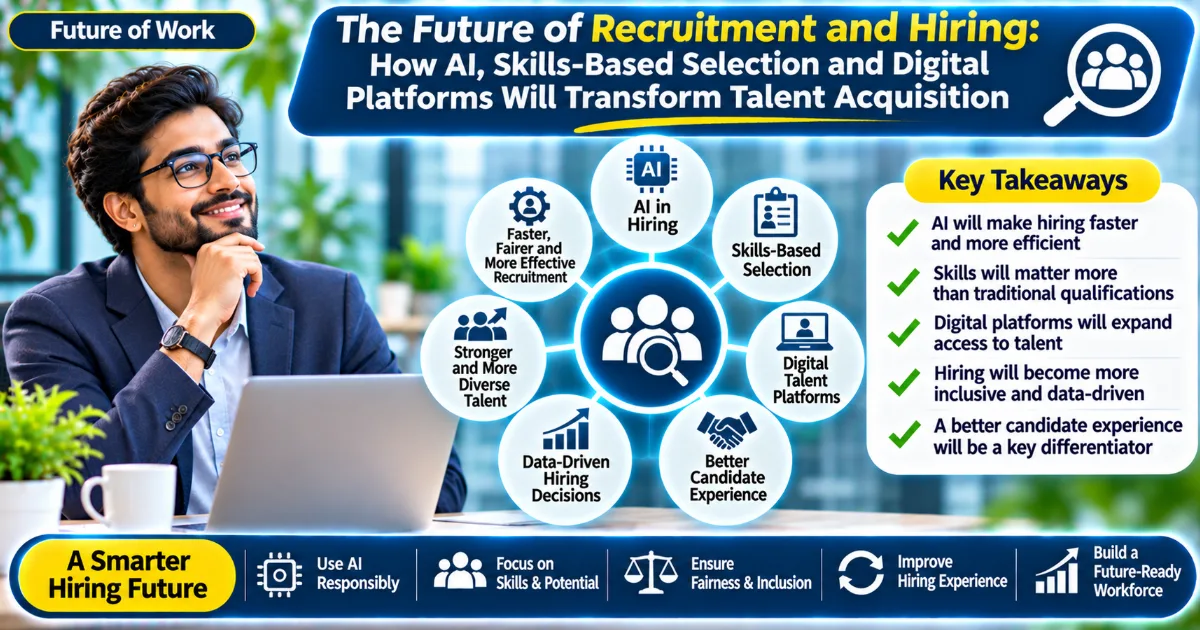
That model is changing. Artificial intelligence can now help recruiters organise applications, identify relevant skills and automate administrative tasks. Digital recruitment platforms connect employers with candidates across geographical boundaries. Skills-based assessments allow organisations to evaluate practical capabilities rather than relying entirely on qualifications or job titles. Video interviews, online assessments and automated scheduling are making recruitment more flexible.
These developments create opportunities, but they also introduce important questions about fairness, privacy, accuracy and human judgement. An automated system may process thousands of applications quickly, but speed does not guarantee that the right candidates will be identified. A digital interview may make recruitment more convenient, but it cannot always reveal how someone will collaborate with a team or handle a difficult workplace situation.
The future of recruitment will therefore depend on combining technology with thoughtful human decision-making. AI and digital platforms will improve efficiency and access, while recruiters and hiring managers will remain responsible for understanding people, evaluating potential and making accountable decisions.
Organisations that adapt successfully will move towards more skills-focused, inclusive, data-informed and candidate-centred hiring practices. They will not simply search for people who match an existing job description. They will identify the capabilities required for future business needs and build stronger ways to recognise talent.
Why Traditional Recruitment Models Are Changing
Traditional recruitment was largely built around fixed job descriptions and established career histories. Employers identified a vacancy, listed required qualifications and experience, and evaluated candidates according to how closely their backgrounds matched those requirements.
This approach can work well when the role has clearly defined responsibilities and the required expertise is widely available. However, it may become restrictive when industries change quickly or when organisations need capabilities that are not represented by conventional career paths.
For example, a company recruiting a digital marketing professional may need someone who understands analytics, AI-assisted content workflows, customer behaviour and campaign optimisation. A candidate with experience in a different industry may possess these capabilities even without having held the exact job title advertised.
Continue Reading
Traditional screening may overlook such candidates if recruiters rely too heavily on previous titles or narrowly defined qualifications.
Another challenge is the growing volume of applications. Popular vacancies may attract hundreds or thousands of candidates, making manual screening time-consuming. Recruiters must balance the need to review applications carefully with the pressure to fill positions quickly.
Candidate expectations are also changing. Job seekers increasingly want clear information, timely communication and a recruitment process that respects their time. Long application forms, repeated interviews and unexplained delays can discourage qualified people from continuing.
The modern recruitment model must therefore become more flexible. It needs to evaluate relevant capabilities, communicate effectively and use technology to reduce unnecessary administrative work without removing meaningful human interaction.
Artificial Intelligence Will Transform Talent Acquisition
Artificial intelligence is becoming an important part of recruitment operations. AI-powered systems can assist with several stages of talent acquisition, including job description preparation, application organisation, candidate matching, interview scheduling and recruitment analytics.
One common application is CV and application screening. AI systems can help identify information related to skills, qualifications and experience, allowing recruiters to organise large volumes of applications more efficiently. They may also help identify candidates whose experience is described differently from the terminology used in a job advertisement.
AI assistants can support recruiters by preparing interview questions, summarising candidate information and drafting communication. These capabilities may reduce administrative workload and give recruitment professionals more time to focus on candidate engagement and evaluation.
Some systems can also help organisations identify potential talent from existing databases or professional networks. Recruiters may use search and matching capabilities to find candidates with specific technical or professional skills.
However, AI-generated recommendations should not be treated as final hiring decisions. Systems can make mistakes, overlook relevant experience or reproduce patterns contained in historical data. If previous recruitment decisions were biased, an AI system trained on those decisions may repeat similar patterns.
Organisations should understand how their recruitment tools operate, evaluate their accuracy and provide appropriate human oversight. Candidates should not be rejected solely because an automated system produces an unexplained score.
The most useful role for AI in recruitment will be to support administrative efficiency and improve access to relevant information. Hiring decisions should remain accountable, explainable and connected to genuine job requirements.
Skills-Based Hiring Will Become More Important
One of the most significant changes in recruitment will be the movement towards skills-based hiring. Instead of evaluating candidates primarily through educational qualifications, job titles and years of experience, employers will increasingly examine what people can actually do.
A candidate may have developed valuable skills through formal employment, independent projects, freelance assignments, volunteering, apprenticeships or self-directed learning. A traditional CV may not fully communicate these capabilities, especially when the candidate is changing industries or entering the workforce.
Skills-based hiring allows organisations to define the capabilities required for a role and evaluate candidates against those requirements. These capabilities may include technical knowledge, communication, problem-solving, analytical thinking, collaboration and practical experience.
For example, a software development position may require knowledge of particular programming concepts, the ability to debug applications and an understanding of software security. Employers can evaluate these capabilities through relevant work samples, technical discussions and structured assessments rather than relying entirely on a candidate's previous job title.
A customer service role may require communication, patience, problem-solving and product understanding. Practical scenarios can help assess these capabilities more directly than a general interview question asking whether the candidate considers themselves a good communicator.
Skills-based hiring can expand access to talent and help organisations identify people with non-traditional career backgrounds. It also encourages candidates to demonstrate their capabilities through practical evidence.
However, assessments must be relevant, accessible and proportionate. Employers should avoid creating lengthy unpaid assignments that place unnecessary demands on candidates. The objective is to evaluate job-related skills fairly, not to make the application process more difficult.
Digital Recruitment Platforms Will Expand Access to Talent
Digital recruitment platforms have transformed how employers and candidates discover one another. Businesses can publish vacancies online, search candidate profiles, manage applications and communicate with applicants through digital systems.
These platforms have reduced the geographical limitations of traditional recruitment. An organisation may identify candidates from different cities or countries, depending on the role and applicable employment requirements. Job seekers can also discover opportunities beyond their immediate local employment market.
The next stage of digital recruitment will involve greater integration between job discovery, candidate profiles, skills verification, communication and hiring workflows.
Candidates may increasingly maintain professional profiles that showcase their experience, projects, certifications and practical capabilities. Employers may use these profiles to identify relevant talent without relying exclusively on conventional CV formats.
Recruitment platforms may also provide better matching between candidate interests and employer requirements. Instead of searching only through job titles, systems may identify transferable skills and suggest roles that candidates could realistically perform with limited additional training.
For employers, digital platforms can improve vacancy visibility and reduce administrative effort. For candidates, they can make job discovery more accessible and provide opportunities to present a broader professional identity.
However, platform quality matters. Employers need accurate information, relevant candidate matching and reliable communication features. Candidates need transparent vacancy details, genuine opportunities and protection against fraudulent job advertisements.
Digital recruitment will be most effective when platforms help both sides make informed decisions rather than simply increasing the number of applications.
The Importance of Better Candidate Experience
Recruitment is not only a process through which employers evaluate candidates. It is also an experience through which candidates evaluate employers.
Every stage of hiring communicates something about an organisation. A clear job advertisement suggests that the employer understands the role. A simple application process demonstrates respect for candidates' time. Timely updates show that the organisation values professional communication.
A poor candidate experience can damage an employer's reputation. Candidates may become frustrated when they receive no response, face repeated interviews without clear purpose or discover that the advertised responsibilities differ significantly from the actual role.
The future of recruitment will place greater emphasis on candidate experience. Employers will need to provide accurate job information, explain selection stages and communicate realistic timelines.
Application systems should be straightforward and accessible. Candidates should not be required to enter the same information repeatedly or complete unnecessary steps that do not contribute to meaningful evaluation.
Recruiters should also provide updates when decisions take longer than expected. Even when an applicant is unsuccessful, respectful communication can leave a positive impression.
AI may help personalise communication and automate routine updates, but important conversations should retain a human element. Candidates may need clarification about salary, responsibilities, workplace arrangements or assessment outcomes.
A strong candidate experience helps organisations build trust and encourages qualified people to remain engaged throughout the recruitment process.
Video Interviews and Digital Assessments
Digital interviews and online assessments have become common elements of modern recruitment. They allow employers to evaluate candidates without requiring every participant to travel to a physical location.
Video interviews can be particularly useful for distributed recruitment. An organisation can speak with candidates from different regions and coordinate interviews across multiple hiring teams.
Online assessments may evaluate technical knowledge, language ability, numerical reasoning, problem-solving or role-specific capabilities. Practical exercises can also help candidates demonstrate how they approach realistic workplace situations.
However, digital assessments should be selected carefully. A test must measure capabilities that are genuinely relevant to the position. Excessively difficult or unrelated assessments may exclude capable candidates without improving hiring quality.
Employers should also consider accessibility and technical limitations. Candidates may have unreliable internet access, limited equipment or disabilities that require reasonable adjustments. A fair recruitment process should provide appropriate alternatives where necessary.
Video interviews also have limitations. A candidate's internet connection, camera quality or home environment should not automatically be interpreted as evidence of professional ability.
Structured evaluation criteria can help recruiters focus on relevant responses rather than subjective impressions. Human interviewers should receive guidance on asking consistent questions and evaluating answers fairly.
Digital interviews are useful tools, but they should complement rather than automatically replace other forms of candidate evaluation.
## Skills Assessments and Practical Hiring Exercises
Practical assessments can provide valuable evidence about a candidate's ability to perform specific responsibilities. They allow employers to move beyond claims made in a CV or interview and examine how someone approaches a relevant task.
For a software developer, this might involve reviewing a small code sample, explaining a technical decision or solving a problem related to the role. For a designer, it could involve discussing a portfolio project and explaining the reasoning behind design choices.
A finance candidate may be asked to interpret a simplified financial scenario, while a marketing candidate may be asked to explain how they would evaluate the performance of a campaign.
These exercises can help identify candidates who possess practical knowledge but have less conventional career histories.
Assessment design is important. Tasks should reflect actual job requirements and should not demand excessive unpaid work. Employers should explain what is being evaluated and how the results will be used.
A combination of practical exercises, structured interviews and relevant experience can provide a more complete picture of a candidate than any single assessment method.
Recruiters should also recognise that assessments may not capture every important capability. Collaboration, adaptability, professional judgement and communication may require discussion and observation across several stages.
Recruitment Analytics Will Improve Hiring Decisions
Recruitment analytics allows organisations to examine information about their hiring processes and identify opportunities for improvement.
Businesses may measure the time required to fill vacancies, the number of candidates progressing through each stage, offer acceptance rates and the effectiveness of different recruitment channels.
These indicators can help recruiters identify bottlenecks. For example, if a large number of candidates withdraw after the first interview, the organisation may need to review scheduling, communication or the structure of its selection process.
Analytics can also help employers understand which sources produce relevant candidates. A particular platform may generate many applications but relatively few qualified applicants, while a smaller professional network may provide better matches.
Organisations can examine retention and performance information to evaluate whether recruitment methods are identifying people who succeed in their roles. Such analysis should be interpreted carefully because employee performance depends on management, training, working conditions and other factors beyond recruitment.
Data should support better decisions rather than replace professional judgement. A high application-to-interview conversion rate does not necessarily indicate a fair or effective process.
Recruitment analytics must also protect candidate privacy. Employers should collect only appropriate information, establish access controls and follow applicable data protection requirements.
Used responsibly, analytics can help organisations improve recruitment quality, reduce avoidable delays and make better use of hiring resources.
Reducing Bias and Building Fairer Hiring Processes
Fairness is one of the most important challenges in recruitment. Hiring decisions can be influenced by assumptions about educational institutions, previous employers, age, gender, disability, location, language, career gaps and other characteristics that may not predict a person's ability to perform the role.
Technology can help standardise certain stages of recruitment, but it does not automatically eliminate bias. An AI system may reproduce patterns from historical hiring data, while a digital assessment may create barriers for candidates who need accessibility adjustments.
Organisations should begin by reviewing job requirements. Every qualification and experience requirement should have a clear connection to the responsibilities of the role. Unnecessary conditions can exclude capable applicants.
Structured interviews can improve consistency. Candidates should be assessed using relevant questions and transparent criteria. Interviewers should receive training on evaluating evidence rather than relying on personal similarity or instinct.
Employers should also review recruitment outcomes for patterns that may indicate unequal access or unintended barriers. Where sensitive demographic information is used for monitoring, organisations must follow applicable privacy and employment laws.
Accessibility should be built into recruitment platforms, application forms, assessments and interview arrangements. Candidates should have appropriate ways to request reasonable adjustments.
Fair recruitment does not mean selecting people without considering capability. It means evaluating capability through relevant and consistent processes while avoiding barriers that have no legitimate connection to the job.
Employer Branding Will Influence Recruitment Success
Employer branding refers to how an organisation is perceived as a place to work. It includes the company's reputation, workplace culture, leadership behaviour, career opportunities, compensation practices and employee experience.
Candidates increasingly research employers before applying. They may examine company websites, professional networks, employee reviews, social media content and public information about workplace practices.
A strong employer brand can help attract qualified candidates, but it must be supported by reality. Organisations that promote flexibility while maintaining unreasonable working expectations may damage trust when employees discover the difference.
Recruitment communication should explain what candidates can expect from the organisation. This includes responsibilities, development opportunities, management expectations, working arrangements and the values that influence everyday decisions.
Employee stories can provide useful insight into workplace culture, provided that they are genuine and not presented as a substitute for transparent employment information.
Employer branding also depends on how unsuccessful candidates are treated. People who experience a respectful hiring process may continue to view the organisation positively even when they do not receive an offer.
In the future, employer reputation will remain an important factor in attracting talent. Organisations will need to demonstrate their workplace values through consistent behaviour rather than relying only on promotional messaging.
Internal Mobility and Talent Marketplaces
Recruitment does not always need to begin outside the organisation. Existing employees may already possess skills that can support new roles, projects and business requirements.
Internal mobility allows employees to move between departments, take on new responsibilities or progress into different career paths. It can help organisations retain knowledge while providing employees with opportunities to develop.
Digital talent marketplaces may make internal opportunities easier to discover. Employees can identify projects, temporary assignments, mentoring opportunities and vacancies that match their skills and career interests.
For example, an employee in customer support may have strong analytical capabilities and an interest in product operations. An internal project could allow that person to gain experience before applying for a permanent role in another department.
Internal mobility can also support reskilling. Employees whose current responsibilities are changing may be able to move into roles that require related capabilities after receiving appropriate training.
However, internal recruitment should be transparent. Employees need clear information about eligibility, selection criteria and development requirements. Managers should not unnecessarily prevent capable team members from exploring opportunities elsewhere in the organisation.
A strong internal talent strategy complements external recruitment. It helps businesses recognise existing capability while continuing to bring in new knowledge and experience.
The Role of Human Recruiters in an AI-Driven Hiring Process
As recruitment technology becomes more capable, the role of human recruiters will change. Administrative activities may become increasingly automated, allowing recruitment professionals to focus more on communication, assessment, relationship management and workforce planning.
Recruiters will need to understand business requirements and translate them into clear hiring criteria. They will work with managers to identify essential skills, evaluate candidate evidence and determine whether applicants are suitable for the actual responsibilities of a role.
Human judgement is especially important when evaluating context. A candidate may have a career gap because of caregiving, education, health-related circumstances or a career transition. A CV alone may not explain the person's current capabilities.
Recruiters also help candidates understand the organisation. They can explain the hiring process, answer questions, clarify expectations and communicate decisions respectfully.
The future recruiter will need digital literacy and an understanding of AI systems. They should know how automated tools support recruitment, what limitations they have and when human review is necessary.
Recruitment professionals will also need strong communication, ethical judgement and analytical skills. Their value will increasingly depend on their ability to combine technology with a genuine understanding of people and organisational needs.
Data Privacy and Responsible Use of Candidate Information
Recruitment involves collecting personal information, including contact details, employment history, qualifications, assessment results and sometimes sensitive information. As digital recruitment systems become more connected, protecting this information will be essential.
Organisations should explain what candidate information they collect, why it is required and how it will be used. Information should be stored securely and accessed only by people with legitimate recruitment responsibilities.
Employers should also establish appropriate retention policies. Candidate information should not be kept indefinitely without a valid reason and a lawful basis.
AI tools create additional considerations. Recruitment teams must understand whether information entered into external systems may be stored, reused or processed by third parties. Confidential candidate information should not be uploaded to unapproved tools.
Automated scoring and ranking systems should be evaluated for accuracy and fairness. Candidates should have appropriate ways to seek clarification or request human review where automated processes materially affect their applications.
Organisations should also consider cybersecurity. Recruitment databases can be attractive targets because they contain personal information about many individuals. Access controls, secure authentication, employee training and vendor reviews can help reduce risks.
Responsible data management is not simply a technical requirement. It is part of building trust between employers and candidates.
The Future of Recruitment in India
India's recruitment landscape is changing as businesses expand their digital operations, technology adoption increases and organisations compete for specialised talent.
Technology companies are recruiting professionals in software development, cloud computing, AI, cybersecurity, data engineering and digital product management. At the same time, industries such as manufacturing, healthcare, logistics, finance, education and retail are creating new requirements for digitally capable employees.
Digital recruitment platforms have expanded access to vacancies across cities and regions. Candidates can explore opportunities beyond traditional local employment markets, while employers can discover talent from a wider geographical area.
Skills-based recruitment may be particularly valuable in India because candidates develop capabilities through different educational institutions, vocational programmes, online learning and practical experience. Employers that evaluate relevant skills alongside qualifications may reach a broader talent pool.
However, recruitment accessibility remains important. Candidates may have different levels of internet access, digital confidence and familiarity with online assessments. Organisations should ensure that digital hiring processes do not unnecessarily exclude capable applicants.
Indian employers must also comply with applicable employment, privacy and workplace regulations. Recruitment technology should be reviewed carefully, especially when automated systems influence candidate selection.
Startups and small businesses may not require complex enterprise recruitment systems. They can still improve hiring through clear job descriptions, structured interviews, practical assessments and reliable candidate communication.
The opportunity for India is to build recruitment systems that combine digital reach with fair evaluation and a strong understanding of local workforce needs.
How Job Seekers Can Prepare for the Future of Recruitment
Candidates will also need to adapt as hiring practices become more skills-focused and technology-driven.
A well-structured CV remains useful, but applicants should ensure that it clearly communicates relevant capabilities, practical achievements and the value they have delivered. Responsibilities should be supported by evidence wherever possible.
Candidates should also build a professional portfolio when appropriate. Designers, developers, writers, marketers, analysts and other professionals may benefit from presenting selected projects that demonstrate their work.
Digital literacy will become increasingly important. Job seekers should be comfortable using online application systems, participating in video interviews and completing relevant digital assessments.
AI tools can help candidates organise their job search, improve written communication and prepare for interviews. However, applications should remain accurate and authentic. Candidates should not invent experience or submit AI-generated answers that they cannot explain.
Networking can also support career discovery. Professional relationships may provide information about opportunities, emerging skills and industry expectations.
Most importantly, job seekers should focus on developing capabilities that are relevant to their target roles. Practical experience, continuous learning and the ability to explain how skills can be applied will remain important advantages.
Building a Future-Ready Recruitment Strategy
Organisations preparing for the future should begin by examining their hiring requirements. They need to understand which capabilities are essential today and which may become important as technology and business models change.
Job descriptions should be reviewed regularly. Employers should distinguish between essential requirements and preferences that may unnecessarily restrict the candidate pool.
The recruitment process should then be designed around relevant evidence. This may include structured interviews, practical assessments, portfolio reviews and skills-based evaluation.
Technology should be introduced where it solves a clear problem. AI may help organise applications or automate scheduling, while analytics may reveal delays and weaknesses in the hiring process. Every tool should be evaluated for accuracy, security, fairness and suitability.
Candidate communication should remain a priority. Employers should provide realistic timelines, explain assessment stages and respond respectfully to applicants.
Recruiters and hiring managers should receive training in structured evaluation, responsible AI use and inclusive recruitment practices. Human oversight must remain meaningful, especially when technology influences decisions that affect candidates.
Finally, organisations should measure the quality of hiring rather than focusing exclusively on speed. Useful indicators may include role performance, retention, candidate experience, recruitment cost and the effectiveness of different talent sources.
A future-ready recruitment strategy combines efficient processes with thoughtful decisions. It helps businesses identify the capabilities they need while treating candidates fairly.
Conclusion: The Future of Hiring Will Be More Skills-Focused, Digital and Human-Centred
Recruitment is moving beyond the traditional process of matching CVs to job descriptions. Artificial intelligence, digital platforms, skills-based assessments and recruitment analytics are changing how employers identify, evaluate and select talent.
AI will help organise applications, support communication and reduce administrative effort. Digital platforms will expand access to candidates across geographical boundaries. Skills-based hiring will help employers recognise capabilities developed through different educational and professional routes.
However, technology will not remove the need for human judgement. Employers must evaluate candidates fairly, understand their potential and consider the context behind their experience. They must also protect candidate information and ensure that automated systems do not create hidden barriers.
The role of recruiters will evolve towards relationship building, workforce planning, candidate engagement and responsible decision-making. Job seekers will need to demonstrate practical skills, digital confidence and a willingness to learn throughout their careers.
The most effective recruitment systems will not simply hire people faster. They will help organisations identify the right capabilities, provide a respectful candidate experience and build teams that can adapt to future business requirements.
Ultimately, the future of hiring will be defined by the quality of decisions made through technology and human collaboration. AI can help find patterns and organise information, but organisations still need people who understand what makes a capable professional, a collaborative colleague and a valuable contributor.
The next generation of recruitment will be more connected and data-informed, but its success will depend on something fundamental: recognising human potential and creating fair opportunities for people to contribute.
#FutureOfWork #FutureOfRecruitment #AIHiring #SkillsBasedHiring #TalentAcquisition