Workplace culture has always influenced how organisations operate, how employees interact and how businesses achieve their objectives. It shapes the everyday experience of work, from the way managers communicate and teams collaborate to how decisions are made, disagreements are resolved and achievements are recognised. Yet workplace culture is often misunderstood as a collection of office traditions, employee celebrations, corporate values displayed on walls or informal social activities. These elements may contribute to the atmosphere of an organisation, but culture goes much deeper. It is reflected in the behaviours people experience every day.
The future of workplace culture is being reshaped by artificial intelligence, remote and hybrid work, changing employee expectations, global collaboration, workforce diversity and continuous technological transformation. Employees increasingly expect organisations to provide flexibility, meaningful opportunities, professional development, transparent communication and respectful working environments. At the same time, businesses need productive teams, reliable processes, strong customer relationships and the ability to adapt to changing markets.
These priorities are closely connected. Organisations cannot build sustainable performance simply by introducing advanced technologies while ignoring the people who use them. Nor can they create an effective workplace by offering flexibility without clear expectations, accountability and collaboration. The challenge is to develop a culture that supports both organisational performance and employee contribution.
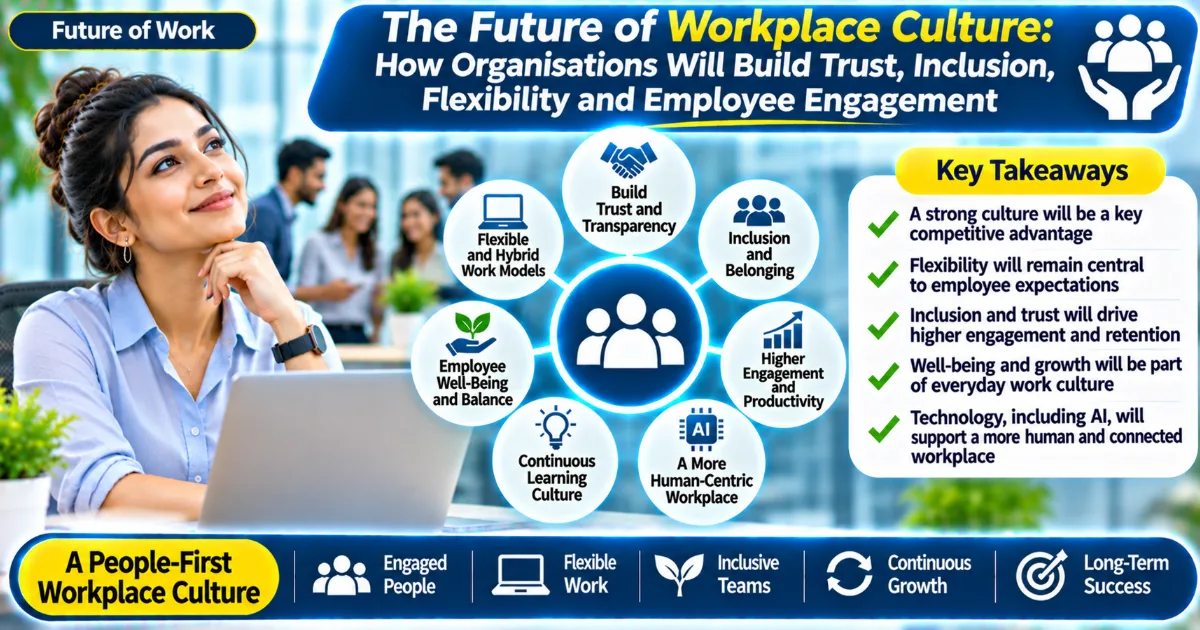
Future workplace culture will be built around trust, inclusion, flexibility, well-being, learning and responsible technology use. It will require leaders to create environments where employees feel respected, understand their responsibilities, have opportunities to grow and can contribute regardless of their location or background.
The organisations that succeed will not necessarily be those with the most elaborate employee engagement programmes. They will be those whose everyday practices consistently reflect the values they communicate. Workplace culture will become a strategic advantage, influencing talent attraction, retention, innovation, customer experience and long-term business resilience.
Continue Reading
1. Understanding Workplace Culture in a Changing Economy
Workplace culture refers to the shared behaviours, expectations, values and practices that influence how people work within an organisation. It is visible in formal policies, but it is equally visible in informal interactions and management decisions.
For example, an organisation may publicly promote collaboration, but if employees are regularly criticised for asking questions or sharing different opinions, the actual culture may discourage participation. A company may claim to value work-life balance, but if managers expect employees to respond to messages late at night, the daily experience communicates something different.
Culture is therefore not defined only by what an organisation says. It is defined by what employees repeatedly experience.
In the traditional office environment, culture often developed through physical interactions. Employees learned workplace expectations by observing managers, participating in meetings and interacting with colleagues. Informal conversations, shared routines and office practices helped establish a sense of belonging.
Modern organisations operate across a wider range of working arrangements. Some employees work from offices, others work remotely, and many follow hybrid schedules. Teams may include permanent employees, consultants, freelancers and contractors. Collaboration may take place through digital platforms rather than shared physical spaces.
This creates a new challenge. Organisations must develop a consistent culture even when employees do not share the same location, schedule or employment arrangement. They need clear communication, inclusive practices and reliable systems that help everyone understand how work is performed and how decisions are made.
2. Why Workplace Culture Is Becoming a Business Priority
Workplace culture is increasingly connected to business performance because employees influence almost every important organisational outcome.
A supportive culture can encourage employees to share ideas, raise concerns, solve problems and take responsibility for results. A poorly managed culture can create confusion, disengagement, unnecessary conflict and high employee turnover.
Consider a company introducing a new digital platform. If employees understand why the change is necessary, receive appropriate training and can raise concerns, adoption is more likely to be constructive. If the change is introduced without explanation or support, employees may resist the system or use it incorrectly.
Culture also influences customer experience. Employees who receive clear guidance and feel supported may be better positioned to serve customers effectively. Employees who face unclear responsibilities or constant internal conflict may find it harder to maintain consistent service.
For growing businesses, culture becomes especially important because informal practices can become difficult to maintain as teams expand. What worked when a company had ten employees may not work when it has several hundred people working across different locations.
Organisations therefore need to treat culture as an operational and strategic responsibility rather than an occasional human resources initiative.
3. Trust Will Become the Foundation of Future Workplaces
Trust is one of the most important elements of a healthy workplace culture. It influences whether employees feel comfortable communicating honestly, taking responsibility and working independently.
In traditional management structures, trust was sometimes confused with visibility. Managers could see employees working in an office and assume that physical presence indicated productivity. In remote and hybrid environments, this approach becomes less meaningful.
Future workplaces will increasingly need to measure outcomes rather than visible activity. Managers should define responsibilities, agree on deliverables and provide employees with the autonomy to organise their work within reasonable boundaries.
Trust must operate in both directions. Employees need confidence that managers will communicate honestly, treat people fairly and make decisions consistently. Managers need confidence that employees will fulfil their responsibilities, raise problems early and respect agreed commitments.
Transparency strengthens this relationship. Organisations should explain important decisions, communicate changes clearly and provide realistic information about business priorities.
Trust is not created through a single announcement or team-building activity. It develops through repeated experiences in which people see that commitments are respected and decisions are handled responsibly.
4. Transparency and Honest Communication
Transparency helps employees understand how an organisation operates and why particular decisions are made.
When people lack information, they may rely on assumptions or informal conversations. This can create uncertainty, especially during restructuring, technological change or periods of business difficulty.
Future organisations should establish communication practices that provide employees with relevant and timely information. Leaders should explain business priorities, changes in responsibilities, performance expectations and important policy updates.
Transparency does not mean sharing every confidential detail with every employee. Financial, legal, personal and commercially sensitive information may need appropriate protection. The objective is to communicate what employees reasonably need to understand their work and the decisions that affect them.
Honest communication also requires acknowledging uncertainty. Leaders should not make promises about future outcomes when those outcomes cannot be guaranteed. It is better to explain what is known, what is still being evaluated and when further information may become available.
A culture of honest communication makes it easier for employees to understand organisational direction and participate constructively.
5. Inclusion and Belonging in the Modern Workplace
Inclusion means creating an environment in which people have fair opportunities to participate, contribute and develop. Belonging is the feeling that an individual is respected and accepted as a meaningful member of the organisation.
Modern workplaces bring together people with different professional experiences, cultures, languages, abilities, educational backgrounds and personal circumstances. These differences can improve problem-solving and innovation when employees are encouraged to share their perspectives.
However, diversity alone does not guarantee inclusion. An organisation may recruit people from varied backgrounds while continuing to make decisions through informal networks that exclude certain employees. Meetings may be dominated by a small group of voices, or career opportunities may be distributed through relationships rather than transparent criteria.
Future leaders should examine how workplace practices affect participation. They should make meetings accessible, communicate decisions clearly and ensure that employees have fair access to development opportunities.
Inclusion also requires respect for different working styles and communication preferences. Not everyone is comfortable speaking immediately in a large meeting. Some employees may contribute more effectively through written feedback or smaller discussions.
A strong culture provides multiple ways for people to participate while maintaining common standards of professionalism and accountability.
6. Flexibility Will Become a Core Workplace Expectation
Flexibility has become an important part of the employment experience. Employees may value the ability to work remotely, adjust schedules, manage personal responsibilities or organise tasks around periods of high concentration.
However, flexibility does not mean the absence of structure. Organisations still need coordination, customer coverage, collaboration and reliable delivery.
The future workplace will need to balance employee autonomy with business requirements. Some roles may be suitable for remote work, while others require physical presence because of equipment, customer interaction, security or operational needs.
A fair flexibility policy should explain which arrangements are possible, how decisions are made and what responsibilities apply to employees and managers.
For hybrid teams, organisations should consider why office attendance is required. Office days can be used for activities that benefit from direct interaction, such as collaborative planning, mentoring, workshops and relationship-building. Routine tasks that can be completed effectively elsewhere may not always require physical presence.
The objective should be to design working arrangements around the nature of the work rather than treating location as a measure of commitment.
7. Remote and Hybrid Culture Must Be Deliberately Designed
Remote work can create flexibility, but it can also reduce informal interaction. Employees who rarely visit the office may miss important discussions or feel disconnected from colleagues.
Future organisations must make belonging possible across locations.
This begins with consistent communication. Important decisions should be documented and made accessible to relevant team members. Remote employees should have opportunities to participate in discussions rather than receiving information only after decisions have been made.
Managers should also pay attention to unequal visibility. Employees who work from the office more frequently may receive more informal attention, recognition or access to senior colleagues. Organisations should create fair processes for performance reviews, mentoring and career development.
Digital collaboration tools can support distributed culture, but technology alone is not enough. Teams need shared expectations about response times, meeting practices, documentation and communication channels.
A remote-first approach to documentation can help. When decisions and project information are recorded clearly, employees can access the same context regardless of location.
8. Employee Well-Being Will Become Part of Everyday Culture
Employee well-being is increasingly recognised as an important part of sustainable workplace performance. Workplaces that ignore workload, stress and personal boundaries may experience reduced engagement and greater difficulty retaining employees.
Well-being should not be reduced to occasional wellness events or motivational messages. It is influenced by practical management decisions.
Workload planning is one example. If employees repeatedly receive more work than they can reasonably complete, no amount of general encouragement will solve the underlying problem. Managers need to understand priorities, distribute responsibilities appropriately and address persistent capacity issues.
Work-life boundaries also matter. Digital communication makes it easy to contact colleagues outside normal working hours, but constant availability can create unnecessary pressure.
Organisations should define reasonable expectations around working hours, urgent communication and time off. Managers should model these expectations rather than encouraging a culture in which employees feel that they must always be online.
Psychological well-being is also influenced by respect, fairness and the ability to raise concerns. Employees should have access to appropriate support and know how to seek help when workplace pressures become difficult to manage.
9. Employee Engagement Will Depend on Meaningful Participation
Employee engagement refers to the extent to which employees feel involved, motivated and connected to their work and organisation.
Engagement is not simply about whether people enjoy workplace celebrations or receive occasional rewards. It is influenced by whether employees understand their responsibilities, receive useful feedback, have opportunities to develop and believe their contributions matter.
Future organisations will need to create more opportunities for meaningful participation.
Employees can contribute to process improvement, product development, customer experience and organisational problem-solving. Managers should encourage people to share ideas and explain how suggestions are evaluated.
Not every suggestion can be implemented. However, employees should receive a clear response rather than seeing their contributions disappear without acknowledgement.
Recognition should also be meaningful and fair. Organisations should recognise quality, collaboration, problem-solving, mentoring and customer impact rather than rewarding only highly visible achievements.
A culture of participation helps employees see themselves as contributors to organisational progress rather than simply recipients of instructions.
10. Artificial Intelligence and the Human-Centred Workplace
Artificial intelligence will influence workplace culture in several ways. AI systems can automate administrative tasks, support communication, analyse information and help employees complete work more efficiently.
Used responsibly, these tools may reduce repetitive workloads and give people more time for creative, strategic and interpersonal activities.
However, the introduction of AI can also create concerns about job security, monitoring, privacy and fairness. Employees may worry that automated systems will evaluate their performance without understanding the context of their work.
Organisations must communicate clearly about how AI is used, what information it processes and where human review remains necessary.
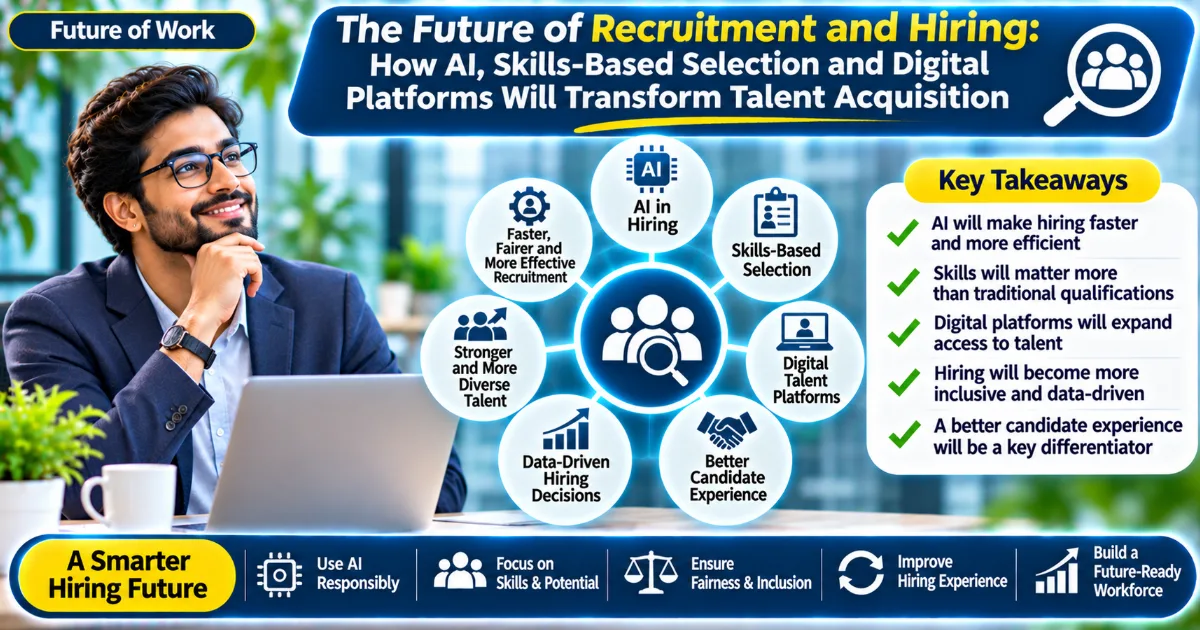
For example, if an organisation uses AI to support recruitment, it should establish safeguards to reduce bias and ensure that qualified human decision-makers remain accountable. If AI tools are used to analyse employee performance, the organisation should explain what data is considered and how employees can raise concerns.
A human-centred workplace uses technology to support people rather than treating employees as interchangeable components of an automated system.
11. Psychological Safety and the Freedom to Speak Up
Psychological safety is the belief that people can ask questions, express concerns, admit mistakes and offer different opinions without facing unnecessary humiliation or retaliation.
It is essential for learning and innovation because employees often identify problems before they become visible in formal reports.
Imagine a team developing a new product. An employee notices a potential security issue but worries that raising it will delay the launch or create conflict with senior colleagues. If the culture discourages disagreement, the risk may remain unaddressed.
A psychologically safe environment encourages employees to communicate concerns early. Managers should respond professionally, investigate issues and distinguish between honest mistakes and deliberate misconduct.
This does not mean that every opinion must be accepted or every decision made collectively. Organisations still need standards, responsibilities and decision-making authority.
The goal is to ensure that employees can contribute information and challenge assumptions without fear of personal attack.
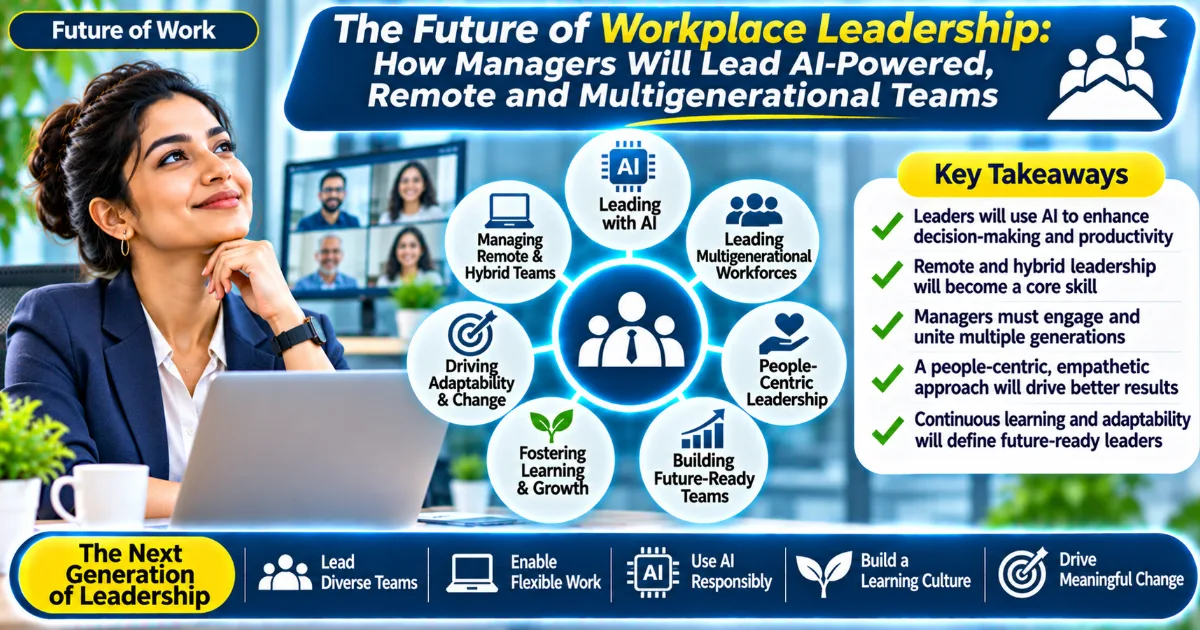
12. Leadership Behaviour Will Define Organisational Culture
Workplace culture is strongly influenced by leadership behaviour. Employees observe how managers respond to mistakes, distribute opportunities, communicate under pressure and treat people who disagree with them.
If leaders promote collaboration but reward individual competition at every opportunity, employees may learn that competition matters more than teamwork.
If managers encourage work-life balance but regularly send non-urgent messages late at night, employees may feel pressure to remain available.
If senior leaders speak about inclusion but ignore disrespectful behaviour, the stated values may lose credibility.
Future leaders must therefore demonstrate the culture they want to build.
This includes listening actively, providing clear feedback, admitting mistakes, recognising contributions and applying policies consistently. It also requires managers to understand their influence on the everyday employee experience.
Organisations should evaluate leadership not only through financial and operational outcomes but also through the quality of team management, employee development and ethical decision-making.
13. Learning and Growth as Cultural Values
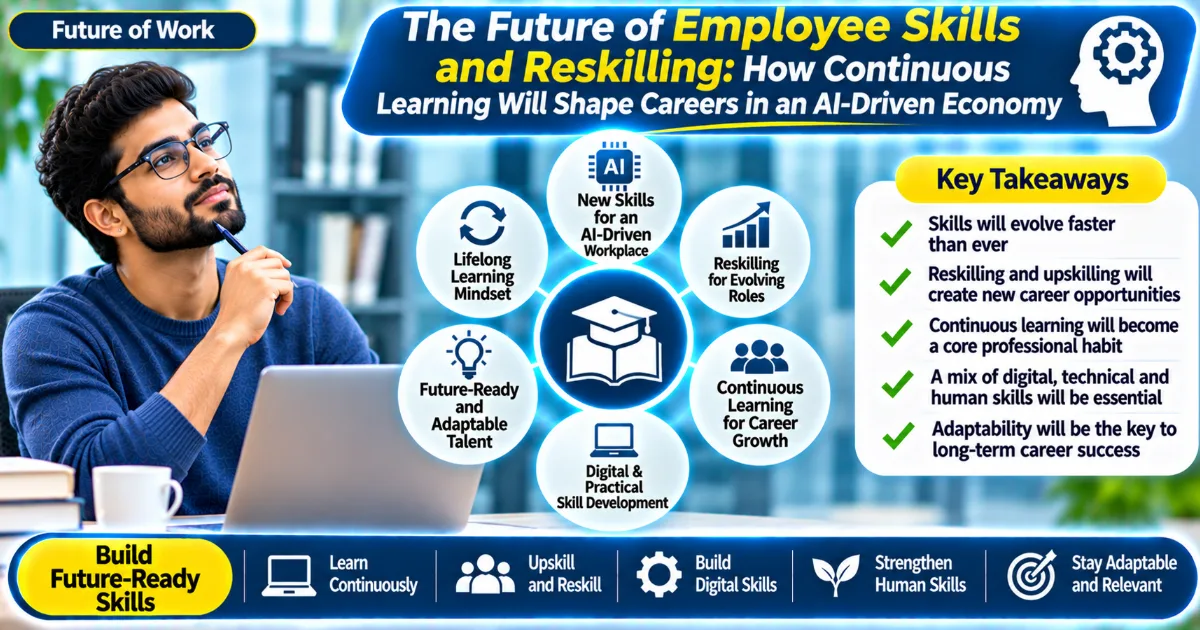
A workplace that supports continuous learning is better prepared to respond to changing technologies and market requirements.
Employees need opportunities to develop professional capabilities, explore new responsibilities and prepare for evolving roles. This is particularly important as automation and AI change the nature of many occupations.
A learning culture makes development part of normal work. Employees may learn through formal training, mentoring, peer discussions, practical projects and cross-functional assignments.
Managers should discuss development goals regularly and help employees identify realistic learning opportunities.
Knowledge sharing is equally important. Experienced employees can support colleagues through mentoring, while newer employees may introduce different approaches and familiarity with emerging tools.
Organisations should avoid creating an environment in which employees feel that admitting a knowledge gap is a weakness. Asking questions and learning new skills should be treated as normal professional behaviour.
14. Recognition, Fairness and Employee Motivation
Recognition communicates which contributions an organisation values.
Employees may appreciate financial rewards, promotions and formal awards, but recognition can also involve timely feedback, opportunities to lead projects, professional development and acknowledgement of meaningful contributions.
Fairness is essential. If recognition is consistently given to the same visible individuals, employees working behind the scenes may feel overlooked.
Organisations should establish clear criteria for evaluating performance and distributing opportunities. Managers should consider the quality of work, collaboration, reliability, problem-solving and contribution to shared objectives.
Recognition should be specific. Rather than offering only general praise, managers can explain what an employee did well and why it mattered.
For example, recognising an employee for identifying a process improvement provides clearer feedback than simply saying that the person is a valuable team member.
Fair recognition helps employees understand how their work contributes to organisational success.
15. Managing Conflict and Building Respectful Teams
Different perspectives are inevitable in diverse workplaces. Employees may disagree about priorities, project approaches, resource allocation and professional decisions.
A healthy culture does not eliminate disagreement. It provides constructive ways to handle it.
Managers should encourage employees to focus on the issue rather than attacking individuals. They should clarify responsibilities, listen to relevant perspectives and identify practical solutions.
Organisations should also establish clear expectations regarding professional conduct. Harassment, discrimination, bullying and repeated disrespect should not be excused as personality differences or ordinary workplace pressure.
In distributed teams, written communication requires additional care because messages may be interpreted without the context of tone or body language. Employees should know when to move a difficult discussion into a direct conversation.
Respectful disagreement can improve decisions by revealing assumptions and identifying risks. The goal is to create a workplace where people can challenge ideas while maintaining professional relationships.
16. The Role of Technology in Connecting Employees
Digital collaboration platforms are becoming central to workplace communication. They allow employees to share documents, manage tasks, conduct meetings and coordinate projects across locations.
These tools can strengthen culture when they make information accessible and reduce unnecessary communication barriers.
However, excessive notifications, overlapping platforms and constant meetings can create digital fatigue. Organisations should select tools based on actual needs and establish clear practices for their use.
For example, a team may use a project management platform for task ownership, a shared knowledge space for documentation and video meetings for discussions requiring direct interaction. Employees should understand where information belongs and how to find it.
Technology should simplify collaboration rather than create another layer of administrative work.
Organisations should also consider accessibility, privacy, information security and the needs of employees with different levels of digital experience.
17. Workplace Culture in Startups and Small Businesses
Startups and small businesses often develop culture through close working relationships and direct communication. Founders and early employees may influence everyday practices significantly.
As these organisations grow, informal culture can become harder to maintain. New employees may not understand unwritten expectations, and managers may interpret policies differently.
Small businesses should establish clear values and practical working principles early. These might include respectful communication, transparent responsibilities, customer focus, continuous learning and fair treatment.
They do not need complicated corporate programmes. Regular team discussions, clear onboarding, consistent feedback and straightforward policies can create a strong foundation.
Technology can help smaller organisations support distributed teams and organise workflows, but it should be introduced thoughtfully.
Founders and managers should remember that culture is shaped by daily decisions. The way a small business handles a customer complaint, employee mistake or disagreement can communicate more about its values than a formal statement.
18. Workplace Culture in India
India's workforce includes organisations operating across different regions, industries, languages and working environments. The expansion of technology services, startups, digital commerce, manufacturing and professional services is creating new workplace expectations.
Indian organisations may manage teams across major cities, smaller towns and international locations. They may also employ people with different educational experiences, career paths and access to professional development.
Future workplace culture must account for this diversity without making assumptions about individuals based on location, age or background.
Flexible work arrangements may be valuable in suitable roles, but organisations should consider infrastructure, customer requirements and operational responsibilities. Remote employees should have fair access to information, training and career opportunities.
India's growing digital economy also makes continuous learning important. Organisations need to support employees as AI, automation and new software platforms change professional responsibilities.
For small and medium-sized businesses, a strong culture can help attract and retain capable employees even when they cannot match every benefit offered by large corporations. Respectful management, learning opportunities, transparent expectations and meaningful responsibility can make a significant difference.
19. Measuring Workplace Culture Without Reducing It to a Score
Organisations often use employee surveys, engagement scores and retention figures to understand workplace culture. These measures can provide useful information, but they should not be treated as complete representations of employee experience.
A survey may reveal that employees are dissatisfied with communication, but managers need to investigate the reasons. The problem may involve unclear responsibilities, inconsistent decisions, excessive meetings or limited access to leadership.
Useful indicators can include employee feedback, internal mobility, retention patterns, absenteeism trends, participation in learning, reported concerns and the quality of performance conversations.
Organisations should combine quantitative information with discussions and practical observation. They should also protect employee confidentiality and explain how feedback will be used.
Collecting feedback without responding to it can reduce trust. If employees repeatedly identify the same problem and see no action, they may stop participating.
Measurement should lead to improvement. Leaders should identify specific issues, agree on realistic actions and review whether those actions make a difference.
20. Common Mistakes Organisations Must Avoid
One common mistake is treating culture as a branding exercise. Attractive values statements cannot compensate for inconsistent management behaviour.
Another mistake is assuming that employee engagement can be improved through events alone. Social activities may help colleagues connect, but they cannot resolve unfair workloads, poor communication or unclear career opportunities.
Organisations may also introduce flexibility without defining responsibilities. This can create confusion about availability, coordination and performance expectations.
A further mistake is adopting technology without considering its effect on employees. New platforms should solve real problems and be supported by appropriate training.
Some organisations collect extensive employee feedback but fail to communicate what happens next. This can make employees feel that their opinions are being requested only for appearances.
Finally, leaders may assume that one culture model works for every team. Different roles and working environments have different requirements. Common values should be supported by practical approaches suited to the work being performed.
21. How Organisations Can Build a Future-Ready Culture
Building a future-ready culture requires consistent action across the organisation.
Leaders should begin by defining the behaviours that matter most. Values such as trust, inclusion, accountability and learning should be translated into observable practices.
Managers should receive support in communication, coaching, conflict resolution and responsible technology use. They should be evaluated on how effectively they lead people, not only on whether their teams meet numerical targets.
Organisations should establish clear policies for flexible work, digital communication, performance management, employee privacy and professional conduct.
They should create accessible learning opportunities and ensure that employees have the time and support to develop relevant skills.
Feedback systems should allow employees to raise concerns and receive meaningful responses. Recognition and promotion processes should be transparent and based on appropriate criteria.
Finally, culture should be reviewed as the organisation changes. A growing company, a newly distributed team or a business adopting AI may need to adjust its practices while preserving its core principles.
Conclusion
The future of workplace culture will be shaped by technology, flexibility, inclusion, employee expectations and changing business requirements. Organisations will need to move beyond traditional approaches that depend on physical presence, rigid hierarchies and one-way communication.
Trust will become essential as teams work across locations and employees receive greater autonomy. Inclusion and belonging will help people contribute their different experiences and perspectives. Flexibility will need to be balanced with clear responsibilities, while well-being and continuous learning will become important parts of sustainable performance.
Artificial intelligence and digital platforms will influence how employees communicate and complete work, but technology cannot create a healthy culture by itself. Leadership behaviour, fairness, transparency and respect will remain central.
A strong workplace culture is built through everyday actions. It is reflected in how managers respond to concerns, how teams share information, how employees receive recognition and how organisations handle change.
The most successful workplaces will be those where employees understand their purpose, trust their colleagues, have opportunities to develop and can contribute meaningfully. Such organisations will be better prepared to attract talent, retain knowledge, encourage innovation and adapt to future challenges.
The future of work will not be defined only by where people work or which technologies they use. It will also be defined by the quality of the environments organisations create for people to do their best work.
What Comes Next?
In Post 26 of the Future of Work series, we will explore The Future of Employee Experience: How Technology, Personalisation and Human-Centred Design Will Transform the Employee Journey. We will examine how organisations can improve every stage of employment, from recruitment and onboarding to development, performance, well-being and career transitions.
#FutureOfWork #WorkplaceCulture #EmployeeEngagement #FutureOfWorkplace #HybridWork