When Work Is No Longer Tied to One Location
For generations, professional life followed a relatively predictable pattern. People travelled to an office, worked from a fixed location, followed an established schedule, and returned home at the end of the day. Even when employees changed companies, their working arrangements often remained similar. The workplace was generally a physical location, and professional opportunities were strongly connected to where a person lived.
Digital technology has begun to change this relationship. Cloud computing, high-speed internet, collaboration platforms, online payment systems, video conferencing, and digital business tools have made it possible for many professionals to work without being physically present in a traditional office. As a result, a growing number of people are exploring a lifestyle that combines professional responsibilities with travel and location independence.
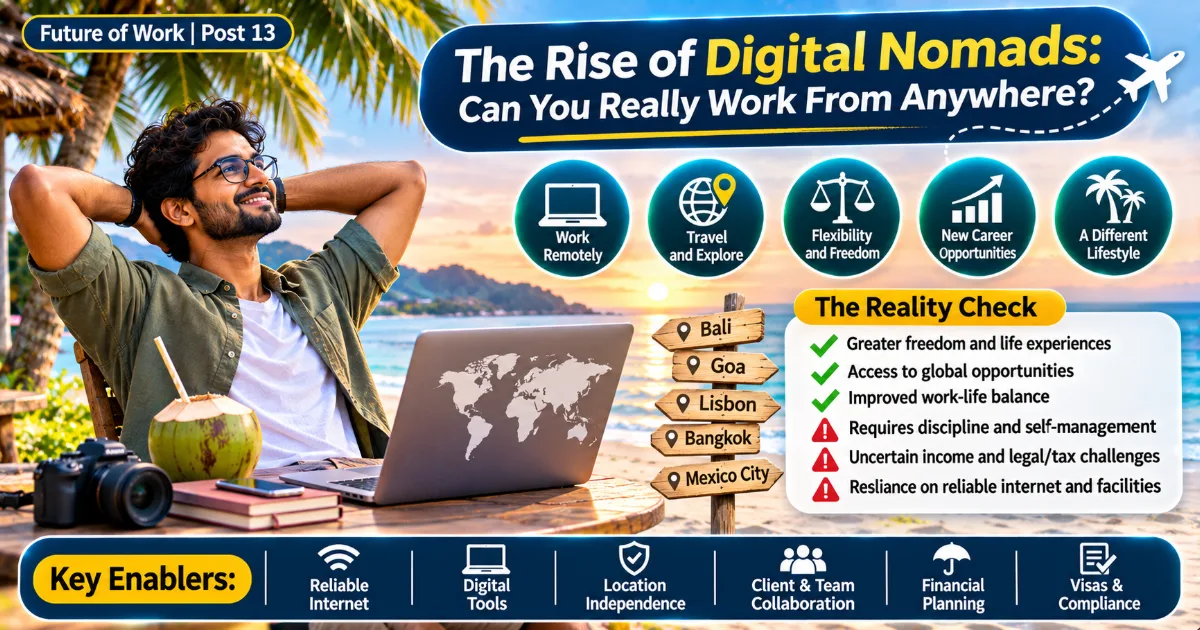
These professionals are commonly known as digital nomads. They may work from another city, another country, a rented apartment, a coworking space, or a temporary home near a beach. Their work can include software development, graphic design, digital marketing, consulting, writing, online education, customer support, and other activities that can be performed remotely.
The digital nomad lifestyle is often presented through attractive images of laptops beside swimming pools, ocean views, and workdays spent in beautiful destinations. However, the reality is more complicated. Working from different locations requires reliable internet access, financial planning, professional discipline, legal awareness, time management, and the ability to maintain relationships with clients and colleagues.
Continue Reading
Not every job can be performed remotely, and not every person enjoys travelling while working. Some professionals need a stable routine, while others prefer the flexibility of choosing where they live. Businesses also need to consider security, communication, employment regulations, and operational requirements before allowing employees to work internationally.
The rise of digital nomadism represents a broader transformation in how people think about employment, mobility, and professional freedom. This article explores what digital nomadism means, why it is growing, which careers support it, what challenges digital nomads face, and whether working from anywhere can become a sustainable career choice.
What Is a Digital Nomad?
A digital nomad is a person who uses digital technology to perform professional work while maintaining flexibility over their physical location. Instead of depending on a permanent office, digital nomads can work from different cities, regions, or countries, provided that their professional responsibilities and practical requirements can be managed.
Digital nomadism is not the same as simply working from home. A remote employee may work from the same home for several years, while a digital nomad may regularly change locations. A freelancer may work remotely but remain in one city. A digital nomad may be a freelancer, business owner, consultant, employee, or entrepreneur whose lifestyle includes location independence.
The defining characteristic is the ability to perform work through digital systems without requiring continuous physical presence at a particular workplace.
For example, a software developer employed by an international company may work from Bengaluru for several months, spend another period in Goa, and later travel to another country, subject to the employer's policies and legal requirements. A freelance designer may serve clients in multiple countries while living in different destinations throughout the year.
Digital nomadism is therefore not a single employment category. It is a way of organising professional work and personal location.
Why Digital Nomadism Is Growing
Several developments have contributed to the growth of digital nomadism. Technology has made remote work more practical, while changing attitudes towards flexibility have encouraged professionals to explore alternative working arrangements.
Improvements in Digital Technology
Cloud-based systems allow employees to access files, applications, and business information from different locations. Video conferencing enables teams to conduct meetings without travelling to the same office. Project management platforms help people coordinate tasks, monitor deadlines, and share progress.
Online payment systems and digital contracts have also made it easier for freelancers and independent professionals to serve clients internationally.
These technologies have reduced the importance of physical proximity for many types of work. However, they have not eliminated the need for reliable infrastructure, cybersecurity, and clear communication.
The Expansion of Remote Work
Remote working arrangements became more widely adopted during the global pandemic, forcing many organisations to reconsider how work could be performed.
Some businesses returned to office-based arrangements, while others retained remote or hybrid options. This experience demonstrated that certain responsibilities could be completed outside traditional offices when employees had suitable tools, clear expectations, and effective management.
As remote work became more familiar, some professionals began exploring whether they could perform their responsibilities from locations beyond their home cities.
Changing Employee Expectations
Many professionals increasingly value flexibility, independence, and control over their working environments. They may want to spend more time with family, explore different cultures, reduce commuting, or live in locations that better match their personal preferences.
For some people, digital nomadism offers a way to combine professional development with travel. Others are attracted by the possibility of living in a location with a lower cost of living while earning income from clients or employers in other markets.
These motivations vary considerably. Digital nomadism should not be treated as a universal lifestyle preference.
Growth of Freelancing and Independent Work
Online platforms have expanded access to freelance opportunities. Businesses can now find designers, developers, writers, consultants, marketers, and other specialists without limiting recruitment to their immediate geographical area.
Independent professionals can build portfolios, communicate with clients, negotiate contracts, and deliver work digitally.
This has created more opportunities for people who want to build careers outside traditional employment structures. However, independent work also involves responsibilities such as finding clients, managing income, handling taxes, and maintaining professional relationships.
International Demand for Digital Skills
Businesses increasingly work with customers, partners, and suppliers across borders. They may need specialists who understand different markets, languages, technologies, and customer expectations.
Digital professionals can serve international clients without relocating permanently to the countries where those clients operate. This can create opportunities for skilled workers in regions with lower living costs or different employment markets.
Careers That Can Support a Digital Nomad Lifestyle
Not every profession is suitable for location-independent work. Careers that depend on physical equipment, in-person service delivery, or continuous local presence may offer limited flexibility. However, many knowledge-based and digital professions can support remote working arrangements.
Software Development and Engineering
Software developers are among the professionals who can often work remotely. Their responsibilities may include building applications, maintaining websites, developing software systems, testing code, managing databases, and solving technical problems.
Most development work can be performed using digital tools, shared repositories, cloud environments, and collaboration platforms. Developers may work for technology companies, startups, agencies, or independent clients.
However, remote developers still need to coordinate with teammates, participate in code reviews, manage deadlines, and follow security procedures. Working from another country may also require employer approval and compliance with local regulations.
Graphic Design and UI/UX Design
Graphic designers and user experience professionals create digital assets, website layouts, application interfaces, brand identities, presentations, and other visual materials.
Their work can often be shared through online design platforms and collaborative review systems. Clients can provide feedback remotely, and designers can deliver final files digitally.
A strong portfolio, communication ability, understanding of design principles, and knowledge of professional tools are important for building a sustainable career in this field.
Digital Marketing and Content Creation
Digital marketing professionals can manage social media accounts, search engine optimisation, advertising campaigns, email marketing, content strategies, and online brand communication from different locations.
Content creators may produce articles, videos, graphics, newsletters, podcasts, and educational material for businesses and audiences.
These careers offer flexibility, but they often involve deadlines, client approvals, campaign schedules, and performance reporting. Digital marketers also need to understand how online platforms and audience behaviour change over time.
Writing, Editing, and Translation
Writers, editors, technical authors, translators, and content strategists can often complete their responsibilities remotely.
Their work may include preparing website content, technical documentation, business reports, educational materials, marketing campaigns, and publications.
Professional writing requires more than language proficiency. It involves research, accuracy, audience understanding, revision, and the ability to meet agreed standards.
Consulting and Professional Services
Consultants may provide expertise in business strategy, finance, technology, operations, marketing, human resources, or management.
Many consulting activities can be performed through online meetings, research, analysis, and digital reports. However, some assignments require on-site visits, access to local facilities, or direct interaction with clients.
Professionals should establish clear expectations about availability, deliverables, confidentiality, and travel requirements before accepting assignments.
Online Education and Training
Teachers, tutors, trainers, and course creators can deliver educational services through digital platforms. They may conduct live classes, prepare recorded lessons, develop learning materials, or provide individual coaching.
Online education can reach learners across geographical boundaries, but it requires effective teaching methods, reliable technology, and an understanding of the audience.
Time zone differences can also influence class schedules and student support arrangements.
Virtual Assistance and Customer Support
Virtual assistants may manage calendars, email, research, documentation, administrative tasks, and business coordination. Customer support professionals may assist users through chat, email, and remote service systems.
These roles can support location-independent work, but they may require fixed shifts, access to secure systems, and consistent availability during specific business hours.
The Benefits of Becoming a Digital Nomad
Digital nomadism can offer meaningful advantages when the work, lifestyle, and financial arrangements are suitable.
Greater Location Flexibility
The most obvious benefit is the ability to choose where to live and work. Digital nomads may select locations based on lifestyle, climate, cost of living, personal interests, or access to professional networks.
Some people prefer living in major cities with strong infrastructure and coworking facilities. Others choose quieter locations where they can focus on work and enjoy outdoor activities.
Location flexibility can also allow people to spend extended periods near family or explore regions they might otherwise only visit during short holidays.
Opportunities for Cultural Learning
Living in different places can expose people to new languages, customs, food, social expectations, and ways of working.
These experiences may improve cultural awareness and communication skills. Professionals who interact with people from different backgrounds may develop a broader understanding of international markets and customer needs.
However, meaningful cultural learning requires respect and engagement. Travelling frequently without understanding local communities does not automatically create cultural awareness.
Reduced Dependence on a Single Local Job Market
Remote professionals may access clients and employers in multiple geographical markets. This can reduce dependence on opportunities available in one city, although it does not remove competition or economic uncertainty.
For freelancers, a wider client base may create opportunities to diversify income. For employees, remote work may provide access to employers outside their immediate region.
The ability to access international opportunities depends on professional skills, language, legal permissions, payment systems, and market demand.
Potential Cost-of-Living Advantages
Some digital nomads choose destinations where accommodation, food, and daily expenses are less expensive than in their home cities.
This may help them manage expenses while earning income from clients or employers in higher-income markets. However, cost comparisons should include accommodation quality, healthcare, insurance, travel, taxes, visa expenses, and currency fluctuations.
A destination that appears inexpensive during a short holiday may become costly when someone needs a suitable long-term workspace, reliable transport, and professional infrastructure.
Personal Independence and Self-Management
Digital nomadism can encourage people to take greater responsibility for their schedules, professional decisions, and personal routines.
Independent workers often need to manage client relationships, income, deadlines, and learning without continuous supervision. These experiences can strengthen organisation, decision-making, and problem-solving abilities.
However, independence also requires discipline. Without appropriate routines, work can become inconsistent and personal responsibilities may become difficult to manage.
The Challenges of Working From Anywhere
The attractive image of digital nomadism does not always reflect its practical difficulties. Location independence introduces responsibilities that traditional office-based employees may not need to manage themselves.
Unreliable Internet and Infrastructure
Reliable internet is essential for most digital nomad careers. Video meetings, file transfers, cloud applications, and customer communication may become difficult when connectivity is unstable.
Some destinations have excellent digital infrastructure in central areas but limited connectivity elsewhere. Power interruptions, mobile network limitations, and unsuitable workspaces can also affect productivity.
Digital nomads should research connectivity before choosing accommodation and consider backup options such as mobile data or alternative workspaces.
Time Zone Differences
Working with clients and colleagues across multiple countries can create scheduling difficulties.
A professional living in India who serves clients in North America may need to attend meetings outside normal local working hours. Repeated late-night or early-morning schedules can affect sleep, personal commitments, and long-term routine.
Clear communication about availability is essential. Professionals should establish realistic meeting windows and avoid promising constant access across every time zone.
Financial Instability
Freelancers and independent consultants may experience inconsistent income. Projects can be delayed, clients may cancel contracts, and payment schedules can change.
Digital nomads also face travel expenses, accommodation costs, insurance, equipment replacement, and unexpected emergencies.
A sustainable lifestyle requires financial planning, emergency savings, reliable income arrangements, and realistic estimates of recurring costs.
Loneliness and Social Isolation
Frequent travel can make it difficult to build lasting relationships. Digital nomads may leave a destination just as they begin developing friendships and professional connections.
Working alone in temporary accommodation can also reduce social interaction.
Coworking spaces, professional events, local interest groups, and online networks may help people build connections. However, meaningful relationships require time and consistent participation.
Difficulty Maintaining a Routine
Changing locations can affect sleep schedules, exercise, meal planning, and focused work habits. Travel days may interrupt project schedules, while unfamiliar environments can make it difficult to concentrate.
Digital nomads need routines that remain practical across different destinations. This may include fixed working hours, daily planning, regular breaks, and designated workspaces.
Professional Boundaries
When home, travel, and work occupy the same environment, it can become difficult to separate professional responsibilities from personal time.
Some digital nomads find themselves working during holidays or responding to clients at unusual hours. Others struggle to stop working because they have no clear separation between their workspace and personal environment.
Establishing working hours and communicating availability can help protect personal time.
Legal, Tax, and Visa Considerations
One of the most important aspects of digital nomadism is understanding the legal requirements associated with working from another country.
A tourist visa does not automatically provide permission to perform remote work. Rules vary by country, nationality, employment arrangement, length of stay, and type of activity.
Digital Nomad Visas
Some countries have introduced visa categories or residence programmes designed for eligible remote workers and independent professionals.
These programmes may require proof of income, employment or business relationships, health insurance, accommodation, background checks, or other documentation.
Eligibility conditions differ significantly. Applicants should verify the current requirements through official government sources before making travel or relocation decisions.
Tax Residency and Income Reporting
Living and working across multiple countries can create complex tax questions. The country where a person is physically present, their tax residency, the location of their employer, and the source of income may all influence tax obligations.
A person should not assume that working online for a foreign client automatically removes local tax responsibilities.
Digital nomads should maintain accurate income records, understand relevant reporting requirements, and seek qualified tax advice when working across borders.
Employment and Immigration Compliance
Employees who want to work internationally should obtain approval from their employer before travelling. Companies may face legal, payroll, employment, insurance, or data protection obligations when employees work from another country.
Freelancers and business owners should also understand local rules relating to business activities, contracts, registration, and permitted work.
Legal compliance should be treated as part of the planning process rather than something to investigate after arriving at a destination.
Digital Nomadism in India
India has a growing population of technology professionals, freelancers, entrepreneurs, consultants, and digital service providers. Many already work with clients and companies located in other regions of the country or overseas.
The expansion of digital infrastructure and online business opportunities has created conditions in which some professionals can work from locations beyond traditional metropolitan offices.
Opportunities for Indian Professionals
Indian software developers, designers, marketers, writers, consultants, and educators can use digital platforms to access international clients.
Professionals may also choose to work from different Indian cities and regions while maintaining their existing client relationships, provided that their work arrangements allow it.
This can create opportunities for people who want to experience different locations without immediately changing their careers.
Domestic Work Destinations
Some professionals may choose locations such as Goa, Bengaluru, Pune, Jaipur, Kochi, or other cities based on their infrastructure, lifestyle, professional networks, and personal preferences.
The suitability of a location depends on more than its popularity. Digital nomads should consider internet reliability, accommodation, transportation, healthcare access, safety, and the availability of suitable workspaces.
A destination that works well for a short visit may not be suitable for several months of professional activity.
Financial and Tax Planning
Indian professionals working remotely should understand their applicable tax responsibilities, income reporting requirements, and contractual obligations.
Those working with international clients may also need to consider payment methods, currency conversion, documentation, and applicable business or tax rules.
Professional advice may be necessary when income sources, residency arrangements, or international work activities become complex.
Opportunities Beyond Major Cities
Location-independent work may allow skilled professionals to consider smaller cities and towns without abandoning access to national or international clients.
This could support local economic activity, encourage professional knowledge-sharing, and provide opportunities for people who prefer living outside major metropolitan centres.
However, reliable connectivity, infrastructure, healthcare, and suitable accommodation remain important requirements.
Technology That Makes Digital Nomadism Possible
Digital nomadism depends on a combination of tools that support communication, collaboration, security, and business operations.
Cloud Computing and File Management
Cloud storage and collaboration platforms allow professionals to access documents and project files from different devices and locations.
These systems make it easier to share work, manage versions, and collaborate with clients. However, users should configure permissions carefully and avoid storing sensitive information in unauthorised locations.
Video Conferencing and Communication
Video meetings, messaging applications, and collaboration platforms help distributed teams communicate.
Professionals should choose suitable communication methods for different situations. Complex discussions may require a meeting, while routine updates may be handled more efficiently through written messages.
Project Management Tools
Digital project management systems help teams organise tasks, deadlines, responsibilities, and progress.
Freelancers can use these systems to manage multiple clients, while remote employees can use them to coordinate work with colleagues.
Clear documentation is particularly important when people are working across different time zones.
Cybersecurity and Data Protection
Working from public networks and unfamiliar devices can increase security risks. Digital nomads should use strong authentication, approved devices, secure connections, updated software, and appropriate backup systems.
They should avoid accessing confidential business information through unsecured public computers and follow client or employer security policies.
Businesses should provide clear guidance on remote access and approved tools.
AI Tools and Productivity Systems
Artificial intelligence can help digital nomads research information, organise tasks, draft documents, analyse data, and automate repetitive activities.
These tools can support productivity, particularly for independent professionals managing several responsibilities.
However, AI-generated information should be checked for accuracy, and confidential client data should not be shared with unapproved systems. Professionals remain responsible for the quality and originality of their work.
How to Build a Sustainable Digital Nomad Career
Digital nomadism should be approached as a professional and financial decision, not simply as a travel choice.
Develop a Marketable Remote Skill
The first step is to build a skill that can be delivered digitally and has a clear market demand.
This may involve software development, design, writing, digital marketing, consulting, online education, data analysis, or another suitable profession.
Professionals should focus on demonstrable capability rather than collecting certificates without practical experience.
Build a Strong Portfolio
A portfolio helps potential employers and clients evaluate professional ability. It may include completed projects, case studies, demonstrations, published work, measurable results, or relevant certifications.
Freelancers should explain the problems they solved and the value they delivered rather than presenting only a list of tools they know.
Establish Reliable Income
Before travelling frequently, professionals should develop a realistic income plan.
Freelancers may need multiple clients, recurring contracts, and an emergency fund. Employees should confirm that their employer permits the intended working arrangement.
A sustainable plan should account for periods when work is delayed or income becomes uncertain.
Choose Destinations Carefully
Destination selection should consider practical working conditions, not only tourist attractions.
Professionals should research connectivity, accommodation, workspace availability, transport, safety, healthcare, local costs, and legal requirements.
Testing a destination through a shorter stay may help identify problems before committing to a longer arrangement.
Establish a Professional Routine
A consistent schedule can help maintain productivity while travelling.
Digital nomads may choose fixed working hours, regular planning sessions, designated workspaces, and clear boundaries around personal time.
The routine does not need to be identical every day, but it should provide enough structure to meet professional responsibilities.
Maintain Professional Relationships
Location independence does not remove the importance of professional networks.
Digital nomads should maintain regular communication with clients, colleagues, mentors, and industry contacts. They should deliver work reliably, communicate delays early, and remain available according to agreed arrangements.
Trust is built through consistent performance, not simply through digital connectivity.
How Businesses Can Support Digital Nomad Employees
Organisations that allow employees to work from different locations need policies that balance flexibility with operational responsibility.
Establish Clear Remote Work Policies
Businesses should explain which roles are eligible for remote work, whether international working is permitted, what approval is required, and which locations are allowed.
Policies should cover working hours, communication, performance expectations, equipment, security, and travel arrangements.
Address Legal and Compliance Requirements
Employers should review immigration, employment, payroll, tax, insurance, and data protection considerations before approving international working arrangements.
The legal position may vary depending on the employee's location and the nature of the work. Organisations should obtain appropriate professional guidance rather than assuming that a remote arrangement has no legal consequences.
Provide Secure Technology
Employees need access to approved tools, secure systems, technical support, and suitable equipment.
Businesses should establish procedures for remote access, device management, data handling, and security incidents.
Evaluate Performance Through Clear Outcomes
Remote employees should understand what they are expected to deliver and how their performance will be assessed.
Managers should focus on relevant results, quality, collaboration, and accountability rather than relying entirely on online presence or physical location.
Maintain Team Connection
Businesses should provide opportunities for remote employees to collaborate, learn, and build professional relationships.
Team meetings, mentoring, shared projects, and occasional in-person gatherings may help strengthen connections when planned appropriately.
Is Digital Nomadism Suitable for Everyone?
Digital nomadism can be attractive, but it is not automatically the best working arrangement for every professional.
Some people prefer stable routines, familiar surroundings, and long-term relationships within one location. Others may have family responsibilities, health requirements, financial commitments, or careers that depend on physical presence.
Certain remote jobs also require fixed shifts and continuous availability, leaving limited time for travel.
Personality and working preferences matter as well. Some people enjoy adapting to new environments, while others find frequent relocation tiring. Travel can introduce uncertainty, logistical responsibilities, and interruptions that make professional work more difficult.
The best working arrangement is the one that supports an individual's professional responsibilities, financial stability, personal priorities, and long-term well-being.
Digital nomadism should therefore be viewed as one possible way of organising work rather than a universal definition of career success.
The Future of Digital Nomadism
The future of digital nomadism will depend on technology, employer policies, international regulations, infrastructure, and changing employee expectations.
Artificial intelligence may make independent professionals more productive by assisting with research, administration, content development, coding, and data analysis. This could allow smaller teams and individual specialists to deliver services that previously required larger organisations.
Remote collaboration tools may become more sophisticated, making it easier to manage distributed projects and maintain professional relationships. Digital identity, secure authentication, and cloud-based business systems may also simplify some aspects of international work.
At the same time, governments may continue adjusting immigration, tax, and employment regulations in response to the growth of location-independent work. Businesses will need to balance employee flexibility with legal and operational responsibilities.
Digital nomad destinations may also evolve. Some cities and regions may invest in coworking spaces, reliable internet, community facilities, and accommodation designed for longer stays.
However, the future is unlikely to involve everyone working from anywhere without restrictions. Physical infrastructure, professional requirements, legal obligations, and personal circumstances will continue to influence where and how people work.
The more realistic future is one in which a wider range of professionals can negotiate flexible working arrangements when their responsibilities and circumstances allow it.
Conclusion: Freedom Requires Planning and Responsibility
The rise of digital nomadism reflects a significant change in how people think about professional life. Technology has made it possible for many workers to separate their careers from a single physical location, creating opportunities to explore new places while continuing to earn an income.
However, working from anywhere requires more than a laptop and an internet connection. It involves reliable professional skills, financial preparation, legal awareness, disciplined routines, cybersecurity, communication, and the ability to manage uncertainty.
For employees, digital nomadism depends on employer policies and the nature of their responsibilities. For freelancers and entrepreneurs, it requires sustainable income, client relationships, and business management. For organisations, it requires clear policies, appropriate technology, and careful attention to legal and operational obligations.
The most important lesson is that location independence should support a sustainable professional life rather than create a new set of pressures. Travel should not come at the cost of poor work quality, financial instability, or continuous exhaustion.
Digital nomadism may not suit everyone, but it demonstrates that the relationship between work and location is changing. As technology continues to develop and working arrangements become more flexible, professionals will have more opportunities to decide not only what they do but also where and how they do it.
The future of work may not mean that everyone becomes a digital nomad. It may mean that more people have the freedom to choose a working arrangement that fits their career, responsibilities, and way of life.
#FutureOfWork #DigitalNomads #RemoteWork #WorkFromAnywhere #FutureOfCareers