The workplace is undergoing a transformation that extends far beyond new technologies, flexible working arrangements and changing employee expectations. The nature of leadership itself is evolving. For decades, workplace leadership was often associated with supervision, authority, decision-making and the ability to manage employees within a physical office. Managers were expected to distribute responsibilities, monitor performance, resolve problems and ensure that teams achieved organisational targets.
That traditional model is becoming increasingly inadequate for the modern workplace. Employees now collaborate across cities and countries, artificial intelligence supports everyday business decisions, automation changes the nature of professional responsibilities, and organisations employ people from several generations with different experiences, expectations and working styles. At the same time, employees increasingly value flexibility, professional development, meaningful work, inclusion and psychological safety.
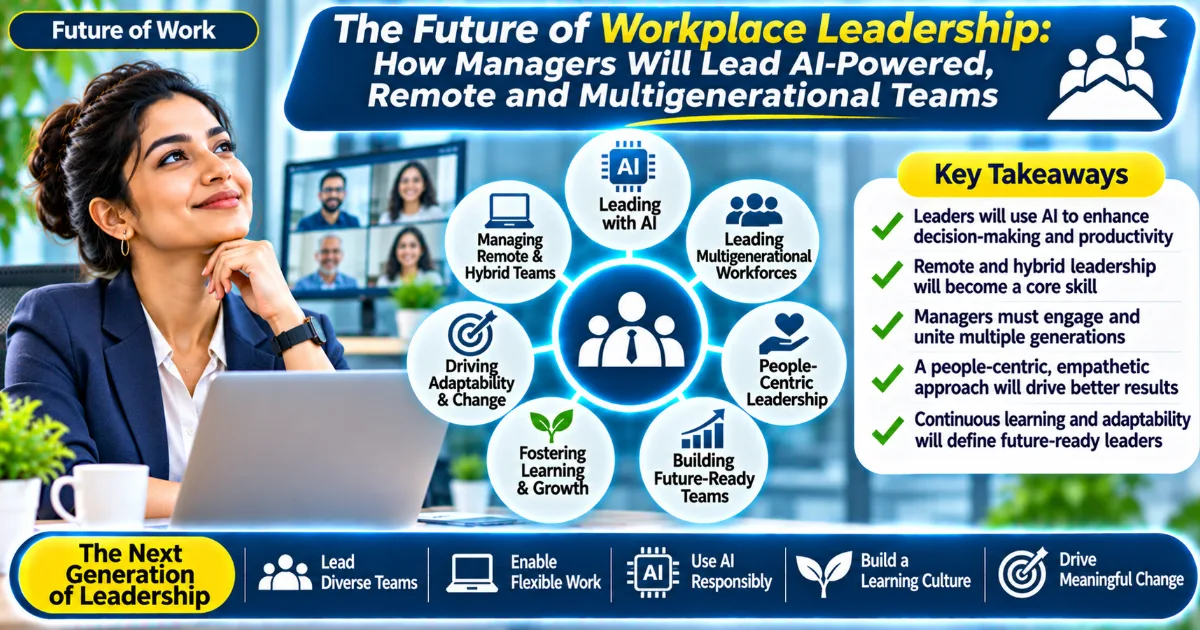
These developments require a different kind of leader. Future workplace leaders will need to combine technological understanding with emotional intelligence, strategic thinking with adaptability, and business performance with employee well-being. They will have to guide teams that may never meet in the same office, work effectively with AI-powered systems, and create environments in which people with different backgrounds and levels of experience can contribute successfully.
The future of workplace leadership will not simply be about managing people who use technology. It will involve leading people, technology and organisational change together. The most effective leaders will understand when to rely on automation, when human judgement is essential, how to develop talent continuously and how to build trust across increasingly distributed workplaces.
Continue Reading
1. Why Workplace Leadership Is Changing
The traditional workplace was built around relatively stable structures. Employees generally worked from a central location, followed established reporting relationships and performed responsibilities defined by their job descriptions. Managers could observe daily activities, conduct face-to-face meetings and resolve many operational issues through direct communication.
Modern organisations operate differently. Digital tools have made it possible for employees to collaborate across geographical boundaries. Businesses increasingly depend on cloud platforms, analytics, artificial intelligence, automation and interconnected digital systems. Teams may include permanent employees, freelancers, consultants, contractors and external specialists.
This creates a more complex leadership environment. Managers cannot rely exclusively on physical supervision or established organisational routines. They must coordinate work across different time zones, communicate through multiple channels, evaluate outcomes rather than visible activity and ensure that employees remain connected to organisational objectives.
Another major influence is the changing relationship between employees and employers. Many professionals expect greater transparency, opportunities to learn, flexibility and recognition. They want to understand how their work contributes to wider business goals. They also expect managers to communicate respectfully, provide useful feedback and support career development.
These expectations are not limited to younger workers. Professionals at different career stages increasingly experience the effects of digital transformation and changing employment patterns. Consequently, leadership must become more inclusive, flexible and responsive.
2. The Rise of AI-Powered Leadership
Artificial intelligence is becoming an important part of organisational management. AI-powered systems can analyse large datasets, identify patterns, automate repetitive processes and support decisions that previously required significant manual effort.
Future managers will increasingly work with AI tools that assist with workforce planning, project management, recruitment, customer analysis, performance reporting, forecasting and operational decision-making.
For example, a project manager may use an AI assistant to summarise meeting discussions, identify delayed tasks, prepare project updates and highlight potential delivery risks. A human resources manager may use analytics tools to understand employee engagement patterns or identify skills that an organisation needs to develop. A sales leader may use predictive systems to examine customer behaviour and prioritise opportunities.
These capabilities can reduce administrative workloads and give managers more time to focus on strategic responsibilities and people development.
However, AI should not become an unquestioned authority in management. Automated recommendations can be inaccurate, incomplete or influenced by biased data. A system may identify an employee as a performance risk without understanding that the employee has been handling unusually complex assignments or working under difficult circumstances.
Future leaders must therefore understand how AI systems work, what their limitations are and when human review is necessary. They must also establish clear rules regarding data privacy, transparency, accountability and appropriate use.
The central leadership challenge will be to use AI to improve decision-making without allowing technology to replace responsibility.
3. From Traditional Managers to AI-Augmented Leaders
A traditional manager often spends considerable time collecting information, preparing reports, tracking progress and coordinating routine activities. AI-powered systems can increasingly assist with these responsibilities.
This does not eliminate the need for managers. Instead, it changes where their attention should be directed.
An AI-augmented leader uses technology to improve awareness and efficiency while retaining responsibility for decisions that affect employees, customers and business outcomes.
Consider a department responsible for delivering multiple client projects. An AI-based project management system may identify that several deadlines are at risk because the same specialist has been assigned to too many tasks. The system can highlight the resource conflict and suggest alternative schedules. However, the manager must understand the clients' priorities, discuss workload concerns with the employees involved and decide how responsibilities should be redistributed.
Technology provides information and possible solutions. Leadership provides context, judgement and accountability.
This distinction will become increasingly important as AI tools become more sophisticated. Managers who understand how to collaborate with intelligent systems will be better positioned to make informed decisions, while those who rely entirely on automated recommendations may overlook important human and organisational factors.
4. Leading Remote and Hybrid Teams
Remote and hybrid work have changed how organisations coordinate employees. In a traditional office, communication often happens naturally through conversations, meetings and informal interactions. In distributed teams, these interactions must be supported by deliberate communication practices.
Future leaders will need to create clarity around responsibilities, deadlines, collaboration methods and expected outcomes. Employees should understand what they are responsible for, where they can find information, how decisions are made and when they need to communicate with colleagues.
One of the most important changes is the shift from monitoring attendance to evaluating results. An employee working remotely may complete excellent work without being continuously visible to a manager. Measuring performance through online availability, meeting attendance or the number of messages exchanged can create misleading impressions.
Outcome-based management focuses on the quality, timeliness and impact of work. Managers establish clear objectives, agree on measurable expectations and provide regular feedback. Employees receive autonomy to organise their work while remaining accountable for agreed results.
Hybrid leadership also requires attention to fairness. Employees who regularly work from the office should not automatically receive more recognition or access to opportunities than colleagues working remotely. Managers must ensure that important discussions, development opportunities and decisions are accessible to distributed team members.
5. Communication Will Become a Core Leadership Skill
Communication has always been important in management, but distributed and technology-enabled workplaces make it even more essential.
Future leaders will need to communicate clearly across video meetings, collaboration platforms, project management systems, email and face-to-face conversations. They must also recognise that different situations require different communication methods.
A complex organisational change may require a detailed discussion rather than a short message. A routine project update may be better communicated through a shared dashboard. Sensitive employee concerns may require a private conversation instead of a public team channel.
Good communication is not simply about sending information. It involves ensuring that people understand the message, have an opportunity to ask questions and know what action is expected.
Managers should also develop active listening skills. Employees often identify operational problems before senior management becomes aware of them. A culture in which people can raise concerns without fear of embarrassment or retaliation can help organisations detect risks earlier.
In remote teams, leaders should pay particular attention to communication gaps. Silence does not necessarily indicate agreement. An employee may be confused, overloaded or uncomfortable raising an issue in a group meeting. Effective leaders create several appropriate channels through which employees can share feedback.
6. Leading a Multigenerational Workforce
Modern workplaces often include professionals from several generations. Employees may differ in their career experiences, communication preferences, familiarity with digital tools, expectations of management and approaches to professional development.
It is important not to assume that every individual behaves according to a generational stereotype. Personal experience, education, culture, personality, profession and individual circumstances can influence workplace preferences as much as age.
Nevertheless, a multigenerational workforce creates opportunities for organisations to combine different forms of knowledge.
Experienced employees may bring industry understanding, institutional knowledge, customer relationships and practical problem-solving experience. Early-career professionals may contribute familiarity with emerging technologies, new digital practices and different perspectives on collaboration. Mid-career professionals may connect these strengths through their experience of managing projects, adapting to organisational change and developing specialist expertise.
Future leaders must create conditions in which these strengths complement one another.
For example, an organisation introducing a new digital platform could establish a cross-generational working group. Employees with deep operational knowledge could explain existing processes, while colleagues familiar with the new technology could help demonstrate its capabilities. Together, they could develop a practical implementation approach.
The objective should not be to divide employees into age groups. It should be to create opportunities for knowledge exchange, mutual respect and shared achievement.
7. Emotional Intelligence Will Become More Valuable
As technology automates more routine tasks, human capabilities such as empathy, judgement, negotiation and relationship-building will become increasingly important.
Emotional intelligence helps managers understand their own reactions, recognise the emotions of others and respond constructively to difficult situations.
A technically capable manager may still struggle if they cannot communicate respectfully, handle disagreements or understand why employees are experiencing stress. Similarly, a leader who understands business strategy but ignores the concerns of the workforce may find it difficult to build commitment during organisational change.
Consider a company introducing automation into a department. Employees may worry about job security, changes in responsibilities or the need to learn unfamiliar systems. Simply announcing the new technology and expecting immediate acceptance may create resistance.
An emotionally intelligent leader will explain why the change is happening, listen to employee concerns, clarify how roles may evolve and provide opportunities for training. The leader will acknowledge uncertainty rather than making unrealistic promises.
Empathy does not mean avoiding difficult decisions. It means recognising their human consequences and handling them with fairness and respect.
8. Building Trust Without Physical Supervision
Trust is one of the foundations of effective leadership. In remote and hybrid environments, managers cannot depend on physical presence to maintain relationships or assess every aspect of work.
Instead, trust must be built through consistent behaviour, transparent communication and reliable decision-making.
Managers should establish clear expectations and then give employees reasonable autonomy to fulfil them. Excessive monitoring can create an environment in which employees feel they are being watched rather than supported. It may also encourage people to focus on appearing busy instead of producing meaningful results.
Trust also depends on fairness. Leaders should explain how decisions are made, apply policies consistently and avoid favouritism. When employees understand the reasons behind decisions, they are more likely to view management as credible, even when they disagree with a particular outcome.
A practical example is a remote team in which employees work across several time zones. A manager could define core collaboration hours, allow flexibility outside those hours and assess performance against agreed deliverables. This approach recognises operational requirements while respecting individual working arrangements.
Trust is not the absence of accountability. It is the confidence that people will fulfil their responsibilities and that managers will treat them fairly.
9. Leadership in an Automated Workplace
Automation changes not only how work is performed but also how teams should be organised.
When repetitive tasks are automated, employees may spend more time on problem-solving, customer relationships, creative work, quality control and decision-making. Managers must understand these changes and help employees adapt to new responsibilities.
For example, a finance department may automate routine invoice processing. Employees who previously spent significant time entering data may increasingly focus on analysing financial patterns, resolving unusual cases and improving internal controls.
The manager's responsibility is to redesign workflows rather than simply introduce software. This includes identifying which tasks should be automated, which responsibilities require human involvement and what new skills employees need.
Leaders must also consider the quality and safety of automated processes. Automation can make errors happen faster and at greater scale if controls are inadequate. Human oversight, testing, escalation procedures and clear accountability remain essential.
The future workplace will therefore require leaders who understand both operational processes and the human implications of automation.
10. Creating a Culture of Continuous Learning
Professional knowledge can become outdated as technologies, markets and business practices change. Organisations that depend only on employees' existing qualifications may struggle to adapt.
Future leaders must make continuous learning part of everyday work.
This involves identifying emerging skills, supporting professional development and giving employees opportunities to apply what they learn. Training should not be limited to occasional workshops. It can include mentoring, practical assignments, job rotations, online courses, peer learning and project-based experience.
For example, a marketing team adopting AI-powered content and analytics tools may need training in prompt design, data interpretation, content verification, privacy and brand governance. Employees should not be expected to master these responsibilities simply because a new platform has been introduced.
Managers should also recognise that employees learn differently. Some benefit from structured courses, while others learn effectively through guided practice or collaboration with experienced colleagues.
A learning culture encourages employees to ask questions, experiment responsibly and share knowledge. It also helps organisations retain talent by demonstrating that professional growth is a genuine priority.
11. Skills Future Workplace Leaders Will Need
The next generation of managers will require a combination of technical, strategic and interpersonal capabilities.
Digital literacy will be essential. Leaders do not need to become software engineers, but they should understand the technologies that influence their departments. They should be able to evaluate digital tools, interpret relevant data and identify practical opportunities for automation.
AI literacy will become particularly important. Managers should understand the strengths and limitations of AI systems, the importance of human review and the risks associated with sensitive data.
Strategic thinking will help leaders connect everyday activities with long-term organisational goals. They must recognise how changes in technology, customer expectations and market conditions affect their teams.
Adaptability will allow managers to respond when plans change. The ability to learn, reconsider assumptions and guide employees through uncertainty will be more valuable than rigid adherence to outdated processes.
Communication, emotional intelligence, conflict resolution and coaching will remain fundamental. Managers must be able to develop people, build relationships and create shared understanding.
Finally, ethical judgement will be essential. Leaders will need to consider how decisions affect employees, customers, communities and the wider organisation.
12. The Shift from Command-and-Control to Coaching Leadership
Traditional management often relied on instructions, supervision and approval structures. Coaching leadership takes a different approach by helping employees develop the knowledge and confidence to solve problems independently.
A coaching-oriented manager asks questions, provides guidance and encourages reflection. Instead of immediately providing every answer, the manager helps employees understand the problem and evaluate possible solutions.
For example, when an employee encounters a difficult client situation, a command-and-control manager might simply prescribe what to say. A coaching manager may first ask what the client needs, what has already been attempted and what options are available. The manager can then provide advice while helping the employee develop stronger judgement.
This approach is particularly valuable in knowledge-based workplaces where employees must respond to situations that cannot always be covered by standard procedures.
Coaching does not mean that leaders should avoid making decisions. Clear direction is still necessary during emergencies, compliance incidents or situations involving significant risk. The difference is that coaching becomes a regular method of developing capability rather than relying exclusively on instructions.
13. Psychological Safety and Employee Well-Being
Employees perform more effectively when they can raise questions, report mistakes and express concerns without unnecessary fear.
Psychological safety does not mean that standards should be lowered or that every decision must be accepted. It means that employees can participate honestly and professionally without being humiliated or punished simply for speaking up.
This is especially important in organisations undergoing technological and structural change. Employees may identify risks in new systems, question unrealistic deadlines or point out that a proposed process will not work in practice.
Leaders who listen to these concerns can prevent avoidable problems.
Employee well-being is another important leadership responsibility. Remote work can create flexibility, but it may also blur boundaries between professional and personal life. Digital communication can make employees feel that they must always be available.
Managers should establish reasonable expectations around working hours, workload and response times. They should watch for persistent signs of overload and encourage employees to take appropriate breaks and use available support.
Well-being should not be treated merely as a productivity technique. It is part of creating a respectful and sustainable workplace.
14. Managing Conflict in Digital and Distributed Teams
Conflict is inevitable in organisations. Differences in priorities, communication styles, workloads and professional opinions can create tension even among highly capable employees.
Remote environments can make misunderstandings more difficult to resolve. A short message may be interpreted as rude, a delayed response may be mistaken for a lack of cooperation, or a disagreement may escalate because participants lack the context available in a face-to-face conversation.
Future leaders must recognise when a written exchange is no longer productive and a direct conversation is needed.
They should focus on the underlying issue rather than personal accusations. This involves listening to all relevant perspectives, clarifying expectations and identifying a practical path forward.
For example, two employees may disagree about responsibility for a delayed project. Instead of deciding who is at fault based on incomplete information, the manager can review the workflow, identify unclear handovers and establish responsibilities for future stages.
Good conflict management protects relationships while maintaining accountability.
15. Data-Driven Decisions With Human Judgement
Modern organisations collect large amounts of information about projects, customers, finances and workforce activities. Analytics platforms can help managers understand trends and identify areas requiring attention.
However, data should inform leadership rather than replace it.
A performance dashboard may show that one team has lower output than another. That information is useful, but it does not automatically explain why the difference exists. The teams may have different responsibilities, customer requirements, workloads or levels of experience.
A responsible leader investigates the context before taking action.
Workforce analytics also requires particular care. Employee information can be sensitive, and monitoring practices may affect privacy and trust. Organisations should collect only appropriate data, explain its purpose, restrict access and comply with applicable laws and policies.
Leaders must avoid treating every measurable indicator as an accurate representation of human performance. Creativity, collaboration, mentoring and judgement can be difficult to capture in a single metric.
The best decisions combine reliable evidence with professional experience, context and ethical consideration.
16. Inclusion and Diversity in the Future Workplace
Future teams will increasingly bring together people with different professional backgrounds, cultures, abilities, locations and life experiences.
Inclusive leadership ensures that employees have fair opportunities to participate, contribute and progress. It also recognises that workplace systems designed around a single type of employee may unintentionally exclude others.
For example, a meeting schedule that repeatedly takes place outside the working hours of one regional team can reduce that team's participation. A training programme that assumes every employee has the same level of digital access may create unequal development opportunities.
Managers should examine how decisions, communication methods and workplace policies affect different groups.
Inclusion also requires attention to recruitment, promotion, recognition and access to meaningful assignments. Leaders should use consistent criteria and review whether informal networks or unconscious assumptions influence opportunities.
A diverse workforce can bring valuable perspectives, but diversity alone does not guarantee effective collaboration. Leaders must create an environment in which people can share their knowledge, disagree constructively and work toward common goals.
17. Leading Organisational Change
Digital transformation, automation, restructuring and new business models can create uncertainty. Employees may be asked to learn unfamiliar systems, change established routines or take on new responsibilities.
Future leaders must become effective change managers.
Successful change begins with a clear explanation of the problem and the reason for action. Employees need to understand what is changing, what is expected of them and how the organisation will support the transition.
Managers should involve relevant employees in implementation wherever possible. People who perform a process every day may identify practical difficulties that are not obvious to senior decision-makers.
Change should also be introduced in manageable stages. Pilot programmes, feedback sessions and performance reviews can help organisations identify problems before expanding a new approach.
Leaders should be honest about uncertainty. They should distinguish between what is already decided, what is still being evaluated and what may change as new information becomes available.
This builds credibility and reduces the risk of unrealistic expectations.
18. Leadership Challenges for Startups and Small Businesses
The future of leadership is not relevant only to large corporations. Startups and small businesses may experience these changes even more directly because they often operate with limited resources and rapidly changing priorities.
A small business owner may manage recruitment, customer relationships, operations, technology adoption and employee development at the same time. AI tools can reduce administrative work, but selecting and implementing them still requires careful judgement.
Small organisations should begin by identifying their most important operational problems. They do not need to automate every process or purchase expensive enterprise software.
For example, a small services company may use digital project management, automated appointment reminders and AI-assisted document preparation to reduce repetitive tasks. Its manager can then devote more time to customer relationships, quality and employee development.
Small businesses should also create simple but clear management practices. Employees need defined responsibilities, regular feedback, transparent policies and opportunities to learn.
Effective leadership does not depend on organisational size. It depends on clarity, trust, sound decisions and the ability to help people work toward shared objectives.
19. The Future of Leadership in India
India's workplace is experiencing rapid changes driven by digital adoption, expanding technology services, startup activity, changing employee expectations and the growth of hybrid and distributed work.
Organisations across technology, finance, manufacturing, healthcare, education, retail and professional services are adopting digital systems to improve efficiency and reach new markets.
This creates opportunities for managers who can connect technological capabilities with business needs.
Indian organisations also operate in diverse linguistic, cultural and regional environments. Leaders may manage teams spread across metropolitan centres, smaller cities and remote locations. They must understand that employees can have different access to infrastructure, training and professional networks.
Skills development will be particularly important as automation and AI change job responsibilities. Organisations should invest in practical learning that helps employees move into evolving roles rather than assuming that technology adoption alone will produce better outcomes.
India's growing startup ecosystem also offers opportunities to develop new leadership models. Smaller teams can experiment with flexible structures, digital collaboration and skills-based responsibilities, provided they maintain clear accountability and employee support.
The leaders who succeed will be those who understand both the opportunities of digital transformation and the realities of the people who must implement it.
20. How Organisations Can Prepare the Next Generation of Leaders
Preparing future leaders requires more than promoting high-performing employees into management positions. Technical expertise does not automatically translate into the ability to guide people.
Organisations should identify leadership potential through a combination of professional performance, communication, decision-making, collaboration and willingness to learn.
Leadership development programmes should include practical experience. Employees can lead projects, mentor colleagues, manage cross-functional assignments and participate in organisational improvement initiatives.
Managers should receive training in AI literacy, digital collaboration, performance management, coaching, conflict resolution, inclusion and ethical decision-making.
Organisations should also create opportunities for emerging leaders to learn from experienced professionals. Mentoring and reverse mentoring can be valuable, allowing knowledge and perspectives to move in both directions.
Leadership readiness should be evaluated continuously rather than treated as a one-time training achievement. The workplace will continue to change, and leaders must keep developing their capabilities.
21. Practical Leadership Principles for the Future
Organisations can begin preparing for future workplace leadership through a set of practical principles.
First, establish clear outcomes. Employees should understand what success means and how their work contributes to organisational goals.
Second, use technology responsibly. AI and automation should improve work, not introduce unnecessary complexity or remove appropriate human oversight.
Third, communicate consistently. Distributed teams need clear information, accessible decisions and opportunities to provide feedback.
Fourth, build trust through fairness and accountability. Managers should respect employee autonomy while maintaining clear expectations.
Fifth, invest in learning. Employees and managers alike need opportunities to develop skills as responsibilities change.
Sixth, encourage collaboration across generations and professional backgrounds. Different experiences can strengthen problem-solving when people have opportunities to learn from one another.
Seventh, make well-being part of management practice. Sustainable performance depends on realistic workloads, respectful communication and healthy boundaries.
Finally, remain adaptable. Leaders should review what is working, learn from mistakes and adjust their approach as the organisation evolves.
22. What the Workplace Leader of Tomorrow Will Look Like
The workplace leader of tomorrow may not resemble the traditional image of a manager who supervises employees from an office and controls every operational decision.
Instead, this leader will act as a facilitator, coach, strategist and responsible technology user.
They will understand how AI can improve productivity while recognising where human judgement is essential. They will manage remote teams through clear objectives and trust rather than constant supervision. They will bring together employees with different experiences and create opportunities for knowledge sharing.
They will also be comfortable with uncertainty. Rather than assuming that established methods will remain effective indefinitely, they will encourage experimentation, evaluate evidence and guide teams through change.
Most importantly, they will recognise that technology does not remove the human dimension of work. Organisations still depend on people to build relationships, exercise judgement, understand customers, create new ideas and take responsibility for outcomes.
The strongest future leaders will therefore be those who combine technological awareness with human understanding.
Conclusion
The future of workplace leadership will be shaped by artificial intelligence, automation, remote collaboration, multigenerational teams and changing employee expectations. These developments are transforming the responsibilities of managers and the capabilities organisations need from their leaders.
Tomorrow's managers will need to move beyond traditional supervision. They must understand digital technologies, make evidence-informed decisions, develop employee capabilities and create environments where people can collaborate effectively regardless of location or background.
AI will provide new ways to analyse information and automate routine work, but human judgement will remain essential. Remote and hybrid work will increase the importance of trust, communication and outcome-based performance. Multigenerational teams will create opportunities for knowledge exchange, while continuous learning will help employees adapt to changing responsibilities.
Leadership will increasingly be measured not by how closely managers control their teams, but by how effectively they enable people to perform, develop and contribute.
The future workplace will need leaders who are technologically capable, ethically responsible, emotionally intelligent and willing to keep learning. Organisations that invest in these capabilities will be better prepared to navigate change, retain talent and build resilient teams.
The next generation of workplace leadership will not be about choosing between people and technology. It will be about bringing them together in ways that create meaningful, sustainable progress.
What Comes Next?
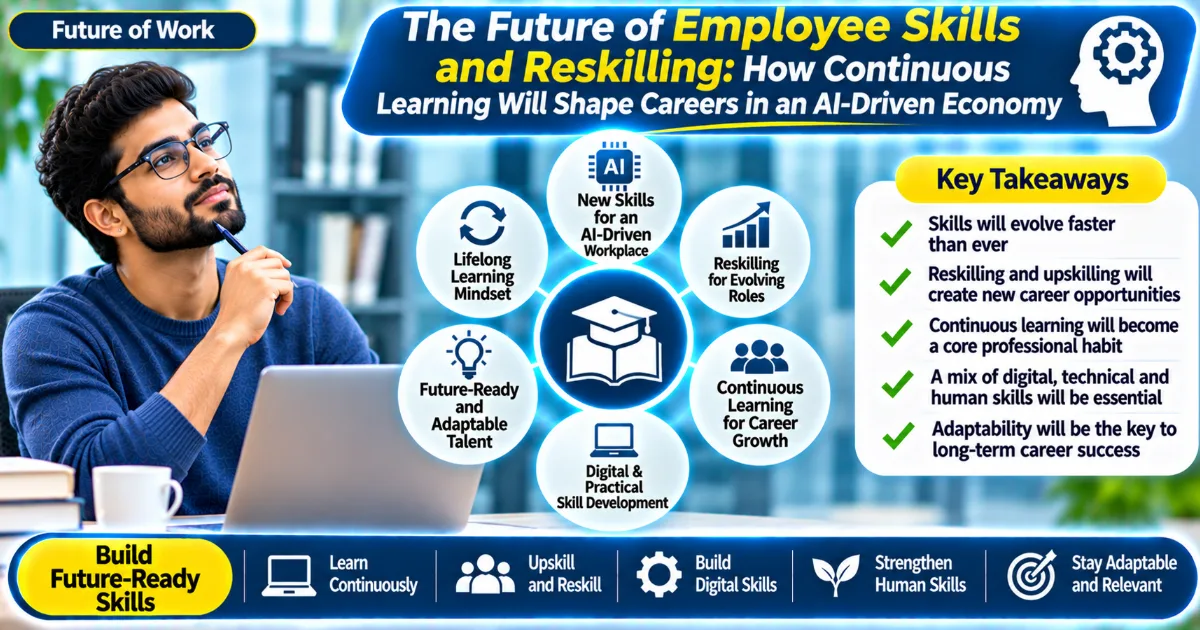
In Post 24 of the Future of Work series, we will explore The Future of Employee Skills and Reskilling: How Continuous Learning Will Shape Careers in an AI-Driven Economy. We will examine how automation and AI are changing skill requirements, why traditional career paths are evolving, and how employees and organisations can prepare for the jobs of tomorrow.
#FutureOfWork #WorkplaceLeadership #FutureOfLeadership #AIAtWork #RemoteWork