The Changing Relationship Between Talent, Work, and Opportunity
The global employment landscape is undergoing a major transformation. For decades, professional opportunities were largely connected to geographical location, formal employment structures, and traditional recruitment processes. Businesses generally hired people who lived within commuting distance or were willing to relocate. Professionals often depended on local employers, personal networks, and conventional job advertisements to find work.
Digital technology has changed this relationship. Today, a graphic designer in India can work with a startup in Germany, a software developer in Poland can contribute to a project in the United States, and a marketing consultant in Brazil can support a business in Singapore. Online freelancing platforms have made these connections easier by bringing clients and independent professionals together through digital marketplaces.
Freelancing platforms are no longer simply websites where individuals search for temporary projects. They have become important parts of the modern talent economy. They provide systems for discovering professionals, publishing projects, comparing proposals, negotiating prices, managing contracts, exchanging files, processing payments, and reviewing completed work. Some platforms also offer specialised recruitment, enterprise talent management, project collaboration, and AI-supported matching.
This development has created opportunities for businesses and independent workers. Companies can access specialised skills without maintaining a large permanent workforce for every requirement. Professionals can build careers across industries and geographical boundaries without depending entirely on traditional employers. Small businesses can find expertise that might otherwise be too expensive or difficult to access.
Continue Reading
However, the growth of freelancing platforms has also introduced challenges. Competition can be intense, platform fees can affect earnings, and new freelancers may struggle to establish credibility. Businesses must evaluate professional quality, protect confidential information, and manage remote working relationships. Platform algorithms can influence which professionals receive visibility, while artificial intelligence is changing how projects are created, evaluated, and delivered.
The future of freelancing platforms will depend on how effectively they address these challenges while improving access, trust, transparency, and professional opportunities. This article examines how online marketplaces are changing the global talent economy, the opportunities they create, the problems they must solve, and what freelancers and businesses should expect in the years ahead.
Understanding the Modern Freelancing Platform Economy
A freelancing platform is a digital marketplace that connects independent professionals with businesses or individuals seeking specific services. These platforms generally allow clients to describe their requirements and freelancers to present their skills, experience, portfolios, pricing, and proposals.
The platform may support the entire working relationship, from discovering a freelancer to completing a project and processing payment. The exact services differ between platforms. Some focus on short-term tasks, while others specialise in long-term contracts, professional recruitment, creative services, technical development, or enterprise workforce solutions.
The modern freelancing economy includes several different working arrangements. A freelancer may accept a one-time assignment, work on a fixed-price project, charge an hourly rate, provide ongoing services through a monthly agreement, or develop a long-term relationship with a client. Some professionals work independently for multiple customers, while others use freelancing platforms to find opportunities between permanent jobs.
It is important to distinguish freelancing platforms from traditional employment websites. A conventional job portal generally connects employers with candidates seeking formal employment. A freelancing marketplace often focuses on defined services, project deliverables, independent contracts, and flexible working relationships.
However, the boundaries are becoming less distinct. Some marketplaces now support long-term engagements, while some recruitment platforms offer access to contract professionals and specialised independent talent.
The result is a more flexible talent ecosystem in which businesses can combine permanent employees, contractors, consultants, agencies, and independent specialists according to their requirements.
How Freelancing Platforms Have Evolved
The freelancing marketplace has developed through several stages as internet access, digital payments, cloud technology, and remote collaboration have improved.
The Early Online Freelancing Marketplaces
Early online marketplaces helped businesses discover independent professionals beyond their immediate geographical areas. Clients could publish projects, receive proposals, compare prices, and communicate with freelancers through digital systems.
These platforms were particularly useful for work that could be delivered electronically, including writing, translation, programming, graphic design, and administrative support.
Initially, many marketplaces focused on connecting buyers and sellers. As competition increased, platforms began introducing additional services such as payment protection, dispute resolution, ratings, profile verification, and project management.
The Growth of Specialised Platforms
As the freelance economy expanded, specialised marketplaces emerged for particular professional categories. Some focused on software development and engineering, others on creative services, consulting, design, marketing, or premium technical talent.
Specialisation helped platforms create more relevant experiences for both clients and freelancers. Businesses could search within a particular professional category, while freelancers could reach customers looking for their specific expertise.
Specialised marketplaces also created opportunities for professionals to demonstrate their knowledge through portfolios, assessments, certifications, and previous project experience.
The Expansion of Global Remote Work
Improvements in cloud computing, broadband connectivity, video conferencing, and collaboration software made it easier to manage projects across countries.
Businesses increasingly recognised that many assignments did not require employees to be physically present in an office. They could work with independent professionals in different locations and coordinate activities through digital systems.
This expanded the potential market for freelancers. A professional no longer needed to depend exclusively on clients in their home city or country.
The Integration of Business Management Features
Freelancing platforms gradually expanded beyond project discovery. Many began offering payment processing, contracts, messaging, time tracking, milestone management, file sharing, and other operational features.
These tools helped reduce some of the administrative difficulties associated with independent work. Clients could manage project activity in one environment, while freelancers could communicate and track their responsibilities.
The platform increasingly became an intermediary that supported the working relationship rather than simply introducing two parties.
How Online Freelancing Platforms Work
Although platforms have different business models, most follow a similar process.
A client creates an account and describes a requirement. The project may include the expected deliverables, budget, timeline, required skills, and other conditions. The platform then makes the opportunity visible to suitable freelancers or allows the client to search for professionals directly.
Freelancers review the requirement and decide whether to submit a proposal. A proposal may include an introduction, relevant experience, portfolio examples, estimated cost, delivery schedule, and questions about the project.
The client evaluates the proposals, communicates with shortlisted candidates, and selects a professional. Depending on the platform, the parties may agree on a fixed-price contract, hourly engagement, milestone-based arrangement, or another payment structure.
Work begins once the necessary terms are established. The freelancer delivers the agreed output, the client reviews it, and payment is processed according to the platform's rules.
After completion, both parties may provide feedback or ratings. This information can influence future opportunities and help other users assess the reliability of a potential working partner.
A well-designed marketplace aims to make each stage clear, predictable, and secure. However, the quality of the experience depends on the platform's policies, verification procedures, dispute mechanisms, and the behaviour of its users.
Major Freelancing Platforms and Their Role in the Talent Economy
Several established platforms have helped shape the global freelancing market. Each has a different positioning, service structure, and approach to connecting businesses with professionals.
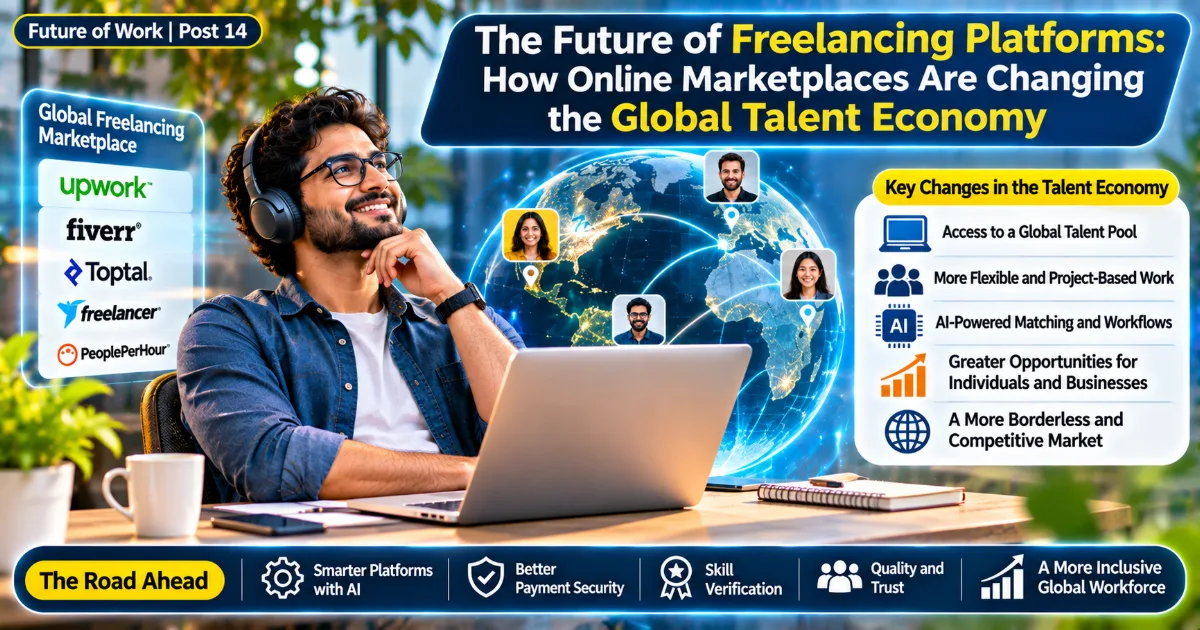
Upwork
<text weight="semibold" inline><Entity value="Upwork" category="software" disambig="Freelance services and talent marketplace"/></text> is a broad marketplace that connects businesses with independent professionals across areas such as software development, design, writing, marketing, consulting, and administrative support.
Its model supports different types of working relationships, including hourly contracts and fixed-price projects. This makes it relevant to businesses seeking both short assignments and longer engagements.
For freelancers, a marketplace of this kind provides access to international opportunities, but success requires a strong profile, relevant proposals, reliable delivery, and a clear professional identity.
Fiverr
<text weight="semibold" inline><Entity value="Fiverr" category="software" disambig="Digital freelance services marketplace"/></text> is known for a service-based marketplace model in which freelancers present defined offerings that clients can discover and purchase.
This approach can be useful for professionals who provide clearly packaged services, such as logo design, video editing, website development, writing, or marketing assistance.
The model encourages freelancers to communicate the scope, price, and expected delivery of their services clearly. Businesses can compare available offerings and choose according to their requirements.
Freelancer.com
<text weight="semibold" inline><Entity value="Freelancer.com" category="software" disambig="Online freelancing and project marketplace"/></text> provides a marketplace where clients can publish projects and freelancers can compete by submitting bids.
It covers a wide range of professional categories, including technology, design, writing, data entry, and business services.
The bidding model can create opportunities for new professionals, although competition and pricing pressure may become significant in popular categories.
Toptal
<text weight="semibold" inline><Entity value="Toptal" category="company" disambig="Specialised network for freelance professional talent"/></text> focuses on connecting businesses with experienced professionals in areas such as software development, design, finance, and consulting.
Its positioning is based on a more selective talent network rather than a completely open marketplace. This model may appeal to businesses seeking specialised expertise and professionals with substantial experience.
PeoplePerHour
<text weight="semibold" inline><Entity value="PeoplePerHour" category="software" disambig="Freelance services marketplace"/></text> connects clients with independent professionals across different service categories. Its marketplace supports project-based work and packaged services.
Such platforms demonstrate that freelancing marketplaces can adopt different approaches while serving the same broader purpose: helping businesses access independent professional capabilities.
The existence of multiple models is important because no single marketplace can meet every client's requirements or every freelancer's professional goals.
How Freelancing Platforms Benefit Businesses
Online freelancing marketplaces provide businesses with access to skills and services that may be difficult to source through conventional recruitment.
Access to a Global Talent Pool
A business is no longer limited to professionals living near its office when it needs certain digital services.
A startup may find a mobile application developer in another country, hire a designer for a branding project, or engage a specialist consultant for a short assignment.
This broader talent pool can improve access to specialised expertise, particularly for businesses operating in smaller markets or regions with limited professional resources.
However, global access also means that businesses must evaluate candidates carefully. Location alone should not determine professional suitability.
Greater Flexibility in Hiring
Traditional recruitment can involve advertising positions, screening candidates, conducting interviews, negotiating employment terms, and onboarding permanent employees.
For a short-term requirement, this process may be disproportionate.
Freelancing platforms allow businesses to identify professionals for specific assignments. A company may hire a developer for a website redesign, a writer for a research project, or a consultant for a limited period.
This can help organisations adjust their talent requirements according to project needs.
Access to Specialised Expertise
Some projects require skills that a business does not need every day. Hiring a full-time specialist may not be practical when the requirement is occasional.
A marketplace can help the organisation find professionals with relevant experience for a defined assignment.
For example, a small business may need a cybersecurity assessment, a data analytics project, or a user experience review without maintaining a permanent specialist team.
Support for Startups and Small Businesses
Startups often operate with limited budgets and changing priorities. They may need support across technology, branding, content, marketing, and operations before they can build permanent departments.
Freelancing marketplaces can help these businesses access professional services without immediately expanding their payroll.
The key is to define requirements properly and avoid treating the lowest price as the only selection criterion. Poor-quality work can create additional costs and delays.
Faster Project Resourcing
A marketplace may help a business discover suitable professionals more quickly than a conventional recruitment process, especially when the requirement is clearly defined and the necessary skills are readily available.
However, speed should not replace due diligence. Businesses still need to review portfolios, confirm experience, agree on deliverables, and establish appropriate contractual terms.
How Freelancing Platforms Benefit Independent Professionals
For freelancers, digital marketplaces can provide access to customers, professional visibility, and business opportunities that might otherwise require significant networking.
Access to International Clients
Freelancers can present their services to businesses beyond their local markets. This can create opportunities to work with international customers and develop experience across different industries.
Professionals who build strong portfolios and communicate effectively may establish long-term relationships with clients in multiple countries.
Lower Barriers to Starting Independent Work
Starting a freelance business traditionally required personal contacts, marketing activity, referrals, and a process for finding customers.
Online marketplaces provide an additional channel through which professionals can present their services and respond to project requirements.
This does not guarantee immediate success. New freelancers still need to establish credibility, demonstrate skills, and understand how to compete effectively.
Opportunities to Build a Professional Reputation
Ratings, reviews, completed projects, and client feedback can help freelancers demonstrate reliability.
A strong record may make it easier to attract future customers, particularly when the portfolio contains relevant examples and the reviews describe specific results.
Freelancers should focus on building a reputation through consistent work rather than attempting to maximise ratings through unsuitable projects.
Flexibility and Professional Independence
Freelancers may have greater control over which projects they accept, how they organise their schedules, and which professional areas they develop.
This flexibility can support people who want to build independent careers, work with several clients, or combine professional services with other activities.
However, independence also brings responsibility for business development, financial planning, contracts, taxes, and professional learning.
Opportunities to Develop New Skills
Working with different clients can expose freelancers to new industries, technologies, business processes, and customer expectations.
A professional who begins with website design may gradually develop skills in user experience, branding, accessibility, or conversion optimisation.
This can support career development, provided that the freelancer invests in learning and maintains a clear professional direction.
The Challenges Facing Freelancers in Online Marketplaces
Despite their advantages, freelancing platforms do not guarantee stable income or professional success.
Intense Competition
Popular categories may contain thousands of professionals offering similar services. New freelancers can find it difficult to stand out, particularly when they have limited reviews or no established client relationships.
Competition may also come from professionals working in different economic environments, which can create pressure on pricing.
Freelancers need to differentiate themselves through expertise, service quality, communication, and demonstrable results.
Price Pressure and Low-Budget Projects
Some clients select professionals primarily on price. This can encourage freelancers to reduce rates below what is sustainable for the time and expertise required.
Low pricing may help a new professional secure an initial assignment, but it should not become a permanent business strategy.
Freelancers should calculate the time involved, platform charges, taxes, tools, revisions, communication, and other operating expenses before deciding on a price.
Dependence on Platform Algorithms
Marketplace visibility may be influenced by ranking systems, profile completeness, client feedback, response rates, recent activity, and other platform-specific factors.
These systems can help clients discover relevant professionals, but they may also create uncertainty for freelancers. Changes to platform rules or ranking mechanisms can affect the number of opportunities a professional receives.
Freelancers should avoid depending entirely on one platform. Building a portfolio, professional network, independent reputation, and direct client relationships can reduce that dependence.
Platform Fees and Payment Costs
Freelancers may pay service charges or other fees depending on the platform's business model. Payment processing, currency conversion, withdrawal methods, and local taxes may also affect the final amount received.
Professionals should understand the complete fee structure before accepting projects. The amount agreed with a client may not be the amount ultimately available as personal income.
Unclear Project Requirements
A project may appear straightforward when advertised but become more complicated once work begins.
Clients may request additional features, multiple revisions, or tasks that were not included in the original agreement.
Freelancers should clarify scope, deliverables, timelines, revision limits, responsibilities, and payment milestones before starting work.
Income Uncertainty
Independent professionals do not always receive a regular monthly salary. Projects may be delayed, cancelled, or completed earlier than expected.
A freelancer who depends on a single large client may face financial difficulties if that relationship ends.
Financial planning, emergency savings, diversified clients, and recurring service agreements can help reduce some of these risks.
Challenges Businesses Face When Hiring Through Marketplaces
Businesses also need to understand the limitations of online talent marketplaces.
Evaluating Professional Quality
A polished profile does not necessarily prove that a freelancer can complete a particular project successfully.
Businesses should review relevant work samples, ask practical questions, understand the proposed approach, and assess communication quality.
For complex projects, a clearly defined paid trial or limited initial assignment may help evaluate working compatibility.
Managing Confidential Information
Freelancers may need access to business documents, customer information, software systems, or internal processes.
Companies should establish appropriate confidentiality agreements, access controls, data handling requirements, and security procedures.
Sensitive information should only be shared when necessary and through approved systems.
Maintaining Consistent Quality
When a business works with multiple independent professionals, it needs consistent standards for deliverables, documentation, communication, and quality assurance.
Clear briefs, review processes, and acceptance criteria can help maintain consistency.
Coordination Across Time Zones
International freelancers may work during different hours. This can make meetings, approvals, and urgent communication more difficult.
Businesses should agree on expected response times, meeting availability, delivery schedules, and escalation procedures before the engagement begins.
Managing Long-Term Relationships
Some assignments require more than a single delivery. Businesses may need ongoing maintenance, updates, technical support, or repeated content production.
A marketplace engagement should therefore include a clear understanding of whether the work is temporary or ongoing, who owns the deliverables, and how future changes will be handled.
How Artificial Intelligence Is Transforming Freelancing Platforms
Artificial intelligence is likely to become one of the most influential technologies shaping the future of freelancing marketplaces.
AI can help platforms understand project requirements, identify relevant skills, improve search results, assist with communication, and automate parts of the marketplace experience.
Smarter Freelancer Matching
Traditional marketplace searches may depend heavily on keywords, categories, and manually selected filters.
AI-supported systems can potentially analyse the meaning of a project description and compare it with professional profiles, portfolios, skills, and previous work.
For example, a client searching for someone to improve an online store may need a combination of user experience, frontend development, performance optimisation, and conversion knowledge. An intelligent matching system could help identify professionals whose experience covers these related requirements.
However, automated recommendations should remain transparent and open to human review. A matching algorithm may overlook capable professionals if their profiles use different terminology or lack sufficient historical data.
AI-Assisted Project Creation
Clients may struggle to describe technical requirements clearly. AI tools can help convert an initial idea into a more structured project brief.
A business owner might describe a need for a mobile application in ordinary language. An AI assistant could help organise the requirements into features, deliverables, milestones, and skill categories.
This could improve project clarity and reduce misunderstandings between clients and freelancers.
Proposal and Profile Assistance
AI tools can help freelancers prepare professional introductions, organise portfolio information, and improve the clarity of proposals.
These tools may reduce administrative effort, especially for independent professionals managing several opportunities.
However, automated proposals can become repetitive and generic. Freelancers still need to demonstrate that they understand the client's actual problem and can provide a relevant solution.
Automated Administrative Support
Platforms may use AI to assist with project summaries, contract workflows, scheduling, support requests, payment notifications, and dispute documentation.
These capabilities could make marketplaces easier to use and reduce the time spent on routine administration.
Important decisions involving payment disputes, account restrictions, or professional reputation should still have suitable human review and appeal processes.
New Opportunities and New Competition
AI can help freelancers deliver certain tasks more efficiently, but it can also change the value of services that depend primarily on routine production.
For example, basic content drafting, simple graphic variations, routine coding assistance, and data organisation may become increasingly automated.
Freelancers will need to develop skills that complement AI, including problem-solving, strategy, specialised knowledge, communication, creativity, and quality control.
The strongest professionals may be those who use AI to improve delivery while maintaining responsibility for the final outcome.
The Future of Pricing and Payment Models
Freelancing marketplaces are likely to continue experimenting with different ways of pricing professional services.
Fixed-Price Projects
Fixed-price arrangements work well when deliverables can be clearly defined. The client agrees to a price for a specified result, while the freelancer takes responsibility for completing the agreed scope.
This model can provide budget predictability, but unclear requirements may create disagreements.
Hourly Contracts
Hourly arrangements may be suitable for ongoing work, evolving requirements, consulting, and technical support.
They allow the client to pay for time spent, but require appropriate tracking and agreement about working expectations.
Milestone-Based Payments
Milestone payments divide a project into stages. Each stage has an agreed output and payment condition.
This approach can reduce risk for both parties because progress is reviewed at defined points rather than waiting until the entire project is complete.
Retainer-Based Services
Some freelancers provide ongoing services through monthly agreements. This can be useful for businesses that need continuous marketing, maintenance, consulting, design, or technical support.
For freelancers, retainers may create more predictable income. For clients, they can provide consistent access to professional support.
Outcome-Based Pricing
As professionals become more specialised, some may charge according to the value or business outcome they help create rather than only the hours required.
This approach requires clear measurement and agreement. It may be suitable for certain consulting, strategy, optimisation, and performance-related assignments, but it is not appropriate for every type of work.
How Freelancers Can Succeed in the Future Marketplace
The growing number of professionals using online marketplaces means that freelancers need a clear strategy to build sustainable careers.
Develop a Specialised Professional Identity
A freelancer who presents themselves as an expert in a specific problem may be easier for clients to evaluate than someone who offers a long list of unrelated services.
Specialisation does not mean refusing every project outside one narrow category. It means developing a clear area of expertise and communicating the value of that expertise.
For example, instead of presenting themselves only as a graphic designer, a professional may focus on brand identity for technology startups or user interface design for financial applications.
Build a Strong Portfolio
A portfolio should demonstrate the freelancer's ability to solve relevant problems.
It may include completed projects, case studies, design examples, technical demonstrations, writing samples, or measurable outcomes.
Where client confidentiality applies, professionals should obtain permission before publishing work or use anonymised examples.
Write Personalised Proposals
Clients receive many proposals, especially for popular projects. A generic introduction is unlikely to communicate professional understanding.
A strong proposal should explain the freelancer's understanding of the requirement, relevant experience, proposed approach, possible risks, and expected deliverables.
The purpose is not to write the longest proposal. It is to demonstrate that the professional has understood the problem and can provide a practical solution.
Focus on Communication
Reliable communication can distinguish a professional from competitors with similar technical skills.
Freelancers should ask relevant questions, provide realistic timelines, communicate delays early, and keep clients informed about progress.
They should avoid promising results that cannot be delivered.
Use AI Responsibly
AI can help freelancers research, plan, organise, and improve productivity. However, professionals should review all AI-generated output and remain responsible for quality, originality, accuracy, and confidentiality.
Clients should also be informed when a project requires specific disclosure about AI-assisted work.
Diversify Client Acquisition
Freelancers should not depend entirely on a single marketplace. They can build professional networks, maintain independent portfolios, participate in industry events, develop referral relationships, and establish direct business connections.
This can reduce exposure to platform policy changes and unpredictable marketplace visibility.
How Businesses Can Use Freelancing Platforms More Effectively
Businesses can improve the results of marketplace hiring by treating freelancers as professional partners rather than simply low-cost service providers.
Write Clear Project Briefs
A useful project brief should explain the business objective, required deliverables, expected timeline, budget range, technical requirements, and evaluation criteria.
Clients should identify what is essential and what is optional. Clear briefs help freelancers prepare more accurate proposals and reduce misunderstandings.
Evaluate Skills Beyond Ratings
Ratings can provide useful information, but they should not be the only selection criterion.
Businesses should examine portfolio relevance, professional experience, communication, problem-solving, and the proposed approach.
A freelancer with fewer reviews may still be highly capable, particularly if they have relevant work experience outside the platform.
Establish Fair Contracts
Contracts should define deliverables, payment arrangements, deadlines, revision procedures, ownership rights, confidentiality, and conditions for ending the engagement.
For larger assignments, milestone-based arrangements can help both parties manage progress and expectations.
Build Long-Term Professional Relationships
Businesses often benefit from working repeatedly with reliable freelancers who understand their products, customers, and internal processes.
Long-term relationships can reduce onboarding time and improve consistency. They also allow freelancers to develop deeper knowledge of the business.
Provide Constructive Feedback
Clear feedback helps freelancers improve their work and understand client expectations.
Businesses should explain what needs to change, why it matters, and which requirements are most important. Feedback should focus on the work and agreed standards rather than personal criticism.
The Changing Relationship Between Freelancers and Traditional Employment
Freelancing platforms are not necessarily replacing traditional employment. Instead, they are expanding the range of ways businesses can access talent.
Many organisations will continue to rely on permanent employees for responsibilities that require long-term institutional knowledge, ongoing coordination, leadership, security, or continuous operational presence.
At the same time, independent professionals may support projects that require specialised expertise, temporary capacity, or flexible delivery.
This creates a mixed workforce model in which companies combine permanent teams with external specialists.
For professionals, this means that career paths may become less linear. A person might work as a permanent employee, take on independent projects, move into consulting, and later establish a specialised service business.
The challenge will be maintaining financial security, professional development, and appropriate employment protections across different arrangements.
Organisations and policymakers will need to consider how social protection, benefits, taxation, and fair working conditions should apply as independent work becomes more significant.
What the Future Freelancing Marketplace Should Improve
The next generation of freelancing platforms will need to solve several important problems to remain useful and trustworthy.
First, platforms should improve transparency in fees, payment conditions, ranking systems, account decisions, and dispute resolution. Freelancers and clients need to understand how important marketplace decisions are made.
Second, identity and skill verification should become more reliable. Clients need confidence that profiles represent genuine professionals, while skilled freelancers need protection against impersonation and fraudulent competition.
Third, payment protection and dispute resolution should become more effective. Both parties need fair processes when projects are delayed, deliverables are disputed, or payments are withheld.
Fourth, platforms should improve accessibility for new professionals. A marketplace that rewards only established accounts may make it difficult for capable newcomers to receive their first opportunities.
Fifth, AI-powered recommendations should be designed responsibly. Platforms should avoid reinforcing unfair patterns or making important decisions through systems that users cannot understand or challenge.
Finally, marketplaces should support long-term professional development. Freelancers need more than access to individual projects. They need ways to demonstrate skills, build careers, develop expertise, and maintain professional credibility.
The Role of Freelancing Platforms in India's Future Talent Economy
India has a large and diverse workforce, with professionals working across technology, design, education, marketing, finance, consulting, content, and many other industries.
Online marketplaces can help Indian professionals reach clients outside their immediate cities and regions. This may create opportunities for people who have strong skills but limited access to local employment markets.
Opportunities for Students and Early-Career Professionals
Students and recent graduates may use suitable freelance projects to build practical experience, develop portfolios, and understand client expectations.
However, they should avoid accepting responsibilities beyond their current capabilities or neglecting formal education and professional development.
Smaller, clearly defined assignments can provide a starting point for learning how professional work is delivered.
Opportunities for Small Businesses
Indian startups and small businesses can use freelancing marketplaces to access services such as website development, design, digital marketing, research, and business consulting.
This may help them launch projects without immediately hiring full-time teams for every function.
Businesses should still evaluate professional quality, security, and contractual requirements carefully.
Opportunities Beyond Major Technology Cities
Remote freelancing can allow professionals in smaller cities and towns to access customers in larger markets.
This may broaden the distribution of professional opportunities, although reliable internet, digital literacy, payment access, and skill development remain essential.
The Importance of Professional Standards
As Indian freelancers work with more international clients, professional communication, documentation, delivery quality, confidentiality, and contractual awareness will become increasingly important.
Long-term success will depend on building trust and demonstrating expertise rather than competing only through low prices.
Conclusion: Freelancing Platforms Are Becoming a Foundation of the Global Talent Economy
Freelancing platforms have changed how businesses discover professionals and how independent workers access opportunities. They have reduced some geographical barriers, created new ways to organise projects, and made specialised talent more accessible to organisations of different sizes.
For businesses, these marketplaces offer flexibility, access to expertise, and opportunities to manage project requirements without expanding permanent teams for every task. For freelancers, they provide visibility, international opportunities, professional feedback, and the possibility of building independent careers.
However, the marketplace model also creates challenges. Competition, platform fees, income uncertainty, algorithmic visibility, security risks, and unclear project requirements can affect both clients and professionals.
Artificial intelligence will influence the next stage of development. Smarter matching, automated administration, improved project descriptions, and AI-assisted workflows may make platforms more efficient. At the same time, professionals will need to develop skills that complement automation and provide value beyond routine task completion.
The most successful freelancing platforms will not simply be those with the largest number of registered users. They will be those that build trust, improve professional discovery, support fair transactions, protect users, and help people develop sustainable working relationships.
The global talent economy is moving towards greater flexibility and a wider range of professional arrangements. Freelancing platforms will play an important role in this transition, but their long-term value will depend on whether they create meaningful opportunities for both businesses and the people providing their skills.
The future of freelancing is not just about finding someone to complete a task online. It is about building a more connected professional economy in which talent can be discovered, trusted, developed, and rewarded across geographical boundaries.
#FutureOfWork #FreelancingPlatforms #GigEconomy #FutureOfFreelancing #GlobalTalent