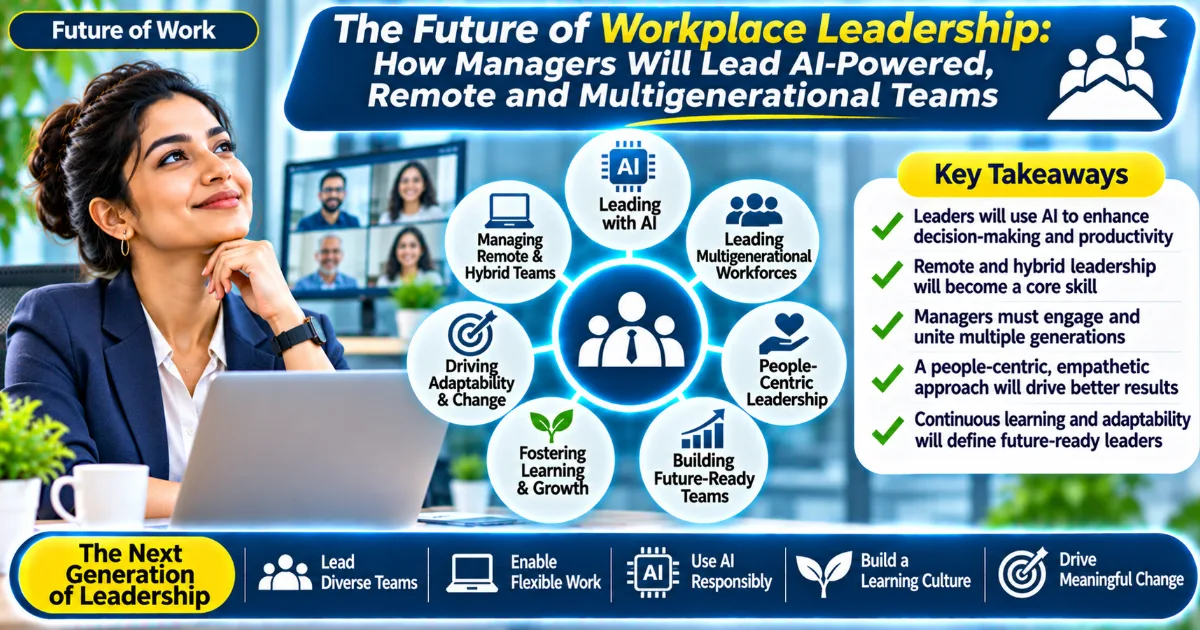
Leadership is entering a period of significant transformation. For decades, organisational leadership was largely associated with setting business objectives, managing teams, allocating resources, monitoring performance and ensuring that employees followed established processes. These responsibilities remain important, but the environment in which leaders operate is changing rapidly. Artificial intelligence, automation, remote work, global competition, changing employee expectations and continuous technological disruption are reshaping how organisations function.
The traditional image of a leader as the person who holds the most information, makes the final decision and supervises every activity is becoming less relevant in many modern workplaces. Employees now have access to information, digital tools and specialist knowledge that were once available only to senior management. Teams can collaborate across countries, complete complex projects remotely and use artificial intelligence to perform tasks that previously required considerable manual effort.
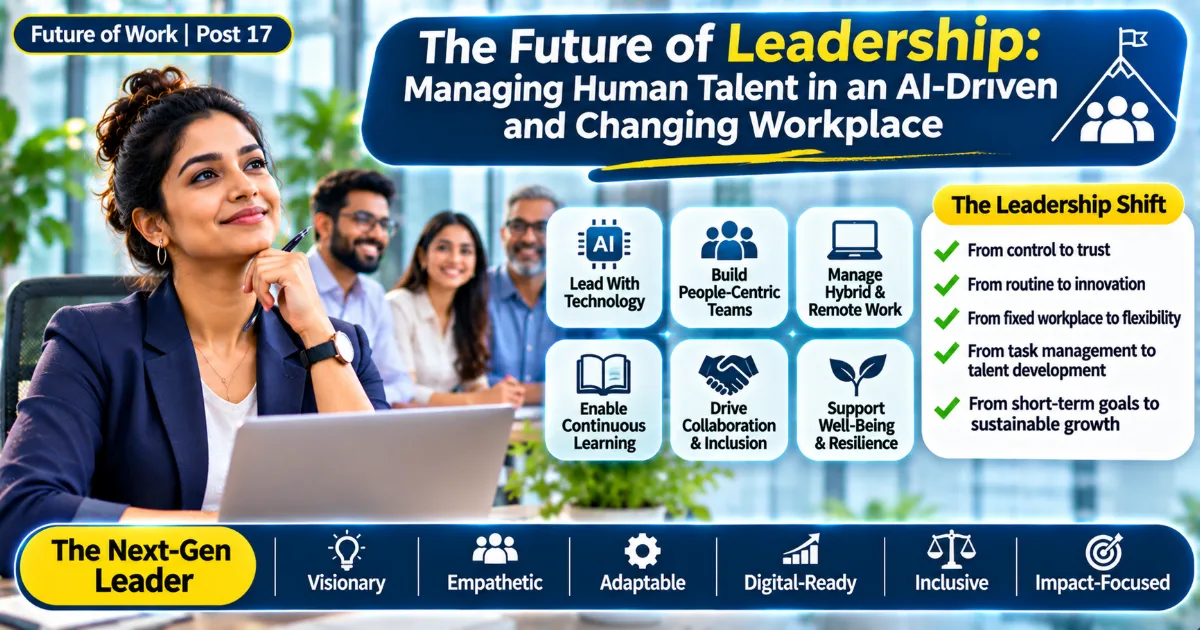
These developments are changing the relationship between leaders and employees. Instead of concentrating primarily on controlling activities, future leaders will need to create environments where people can learn, collaborate, make responsible decisions and adapt to new challenges. They will need to understand technology without losing sight of the human capabilities that make organisations successful.
The future of leadership will therefore depend on a combination of digital understanding, emotional intelligence, strategic thinking, adaptability, communication and ethical decision-making. Leaders will be expected to manage both technological systems and human talent, ensuring that innovation supports employees rather than creating unnecessary uncertainty.
This transformation does not mean that traditional leadership principles will disappear. Accountability, integrity, discipline, clear direction and sound judgement will remain essential. What will change is how these qualities are demonstrated and applied. The next generation of successful leaders will be those who combine technological awareness with human understanding and build organisations that can grow through continuous change.
Continue Reading
Why Traditional Leadership Models Are Changing
Traditional leadership structures were developed in workplaces where information moved through clearly defined organisational levels. Senior leaders established objectives, middle managers translated them into departmental plans and employees completed assigned responsibilities. This structure worked effectively in many environments where processes were relatively predictable and decisions could be made through established reporting channels.
However, modern organisations operate in a more dynamic environment. Customer expectations can change quickly, competitors introduce new technologies and businesses must respond to developments across different markets. A decision that once took several weeks may now need to be made within hours or days.
Employees also expect greater participation in workplace decisions. Many professionals want to understand the purpose behind their responsibilities, contribute ideas and receive opportunities to develop their skills. They may be less motivated by management approaches based entirely on supervision, rigid hierarchy and control.
Remote and hybrid working have further changed traditional management practices. Leaders can no longer rely on physical visibility as the primary indication of employee participation. They need to understand project progress, outcomes, collaboration and individual performance through clearer systems of communication and accountability.
Artificial intelligence is accelerating these changes. When technology can process information, prepare reports and automate routine activities, leaders must reconsider how work is organised and where human judgement creates the greatest value.
The result is a gradual movement towards more adaptive leadership models. Leaders will need to provide direction without controlling every activity, establish accountability without unnecessary micromanagement and encourage innovation while maintaining appropriate standards.
Artificial Intelligence Will Change What Leaders Do
Artificial intelligence is becoming part of everyday business operations. Organisations are using AI-powered tools for research, customer support, document processing, data analysis, software development, recruitment administration and operational planning. As these capabilities improve, leaders will need to understand how technology changes the structure of work.
One important responsibility will be identifying which activities should be automated and which require human judgement. Repetitive administrative processes may be suitable for automation, while complex decisions involving ethics, relationships, negotiation and uncertain circumstances may require significant human involvement.
For example, an AI system may help a manager analyse sales performance across different regions and identify patterns that deserve attention. However, deciding how to respond may require knowledge of local market conditions, customer relationships, employee capabilities and long-term business priorities. The system can provide information, but leadership responsibility remains with people.
Leaders will also need to understand the limitations of AI-generated information. Automated systems can produce inaccurate results, reflect weaknesses in their training data or present uncertain conclusions with considerable confidence. Employees should not be expected to accept every automated recommendation without review.
Another responsibility will be establishing appropriate governance. Organisations need clear rules about data access, confidentiality, intellectual property, automated decision-making and human oversight. Leaders must ensure that employees understand which tools are approved and how information should be handled.
The most effective leaders will not necessarily be those who understand every technical detail of artificial intelligence. They will be those who can ask the right questions, evaluate business implications, identify risks and guide employees in using technology responsibly.
The Shift from Command-and-Control to Trust-Based Leadership
One of the most important changes in modern leadership is the movement away from excessive supervision towards greater trust and accountability.
Command-and-control leadership relies heavily on instructions, approvals and close monitoring. This approach may be necessary in certain safety-critical or highly regulated environments, but applying it to every professional activity can reduce initiative and slow down decision-making.
Knowledge workers often need space to analyse problems, experiment with ideas and make decisions within their areas of responsibility. When every small action requires managerial approval, employees may become dependent on instructions rather than developing professional judgement.
Trust-based leadership provides employees with clear objectives, appropriate resources and defined boundaries while allowing them to determine how best to complete their work. Managers remain responsible for performance, but they focus more on outcomes than constant supervision.
For example, a project leader can establish the expected deliverables, quality standards, budget and deadlines. Team members can then organise their tasks, recommend improvements and coordinate their work within the agreed framework.
Trust does not mean the absence of accountability. Employees must understand their responsibilities, communicate progress and address problems honestly. Leaders must also intervene when performance, conduct or operational requirements demand it.
The objective is to create a workplace where employees have enough independence to contribute effectively while remaining connected to shared business goals.
Emotional Intelligence Will Become a Critical Leadership Skill
As technology takes over more routine activities, human capabilities such as empathy, communication, relationship management and emotional intelligence will become increasingly important.
Emotional intelligence involves recognising and managing one's own emotions while understanding the feelings and perspectives of other people. In leadership, this capability influences how managers communicate, resolve disagreements, respond to pressure and support employees through change.
A technically capable manager may understand business systems and operational processes but still struggle to lead effectively if they cannot communicate with people. Employees need leaders who can listen carefully, provide constructive feedback and handle difficult conversations with professionalism.
Emotional intelligence is particularly important during organisational transformation. Employees may feel uncertain when new technologies are introduced, roles are redesigned or established processes change. Some may worry about job security, while others may feel overwhelmed by the expectation to learn new tools.
A supportive leader acknowledges these concerns and provides honest information. Instead of dismissing employee questions, they explain what is changing, why the change is necessary and what support will be available.
Empathy does not mean avoiding difficult decisions or lowering performance expectations. It means understanding the human consequences of decisions and communicating them responsibly.
Future leaders will need to combine professional discipline with emotional awareness. They must be able to make difficult choices while maintaining respect, transparency and trust.
Leading Hybrid and Remote Teams
Remote and hybrid work have changed how teams communicate, collaborate and maintain professional relationships. Employees may work from different cities, countries or time zones, making traditional office-based management practices less effective.
Future leaders must develop the ability to manage performance without relying on physical presence. This requires clear objectives, reliable communication channels, appropriate documentation and regular opportunities for collaboration.
One important principle is outcome-based performance management. Employees should be evaluated through the quality, reliability and impact of their work rather than simply the time they spend online or the frequency with which they appear in meetings.
Communication also requires greater structure. Teams should know which channels are used for urgent issues, project updates, documentation and general discussions. Important decisions should be recorded so that employees who cannot attend a meeting can still understand what was agreed.
Leaders must also pay attention to employee isolation. Remote workers may miss informal conversations, spontaneous learning opportunities and social connections that develop naturally in physical offices. Regular one-to-one discussions, team sessions and mentoring arrangements can help maintain relationships.
Hybrid teams require additional care to ensure that remote employees are not disadvantaged. Managers should avoid making important decisions exclusively through informal office conversations that exclude colleagues working elsewhere.
Successful remote leadership combines flexibility with consistency. Employees need freedom to work effectively from different locations, but they also need shared expectations, communication standards and a clear sense of team purpose.
Managing Human Talent in an AI-Driven Workplace
The relationship between employees and technology will become one of the defining leadership challenges of the future. Organisations will increasingly depend on people who can work alongside intelligent systems, interpret their outputs and use them to improve business performance.
Leaders must understand that automation does not affect every role in the same way. Some activities may be replaced, others may be redesigned and new responsibilities may emerge. Employees may need to develop different capabilities even when their job titles remain unchanged.
For example, a marketing professional may spend less time preparing routine reports because AI tools can automate parts of the process. However, the role may place greater emphasis on customer understanding, campaign strategy, creative direction and evaluating the quality of automated recommendations.
Similarly, software development teams may use AI assistants to generate code or identify potential errors. Human developers will continue to need skills in architecture, security, requirements analysis, testing and understanding the needs of users.
Leaders should therefore focus on redesigning work rather than viewing automation only as a way to reduce headcount. They need to examine how technology can remove repetitive activities and allow employees to concentrate on higher-value responsibilities.
This approach requires communication and planning. Employees should understand how their roles may evolve and what opportunities will be available to develop relevant skills. Where job displacement cannot be avoided, organisations should handle the situation transparently and responsibly.
The future of talent management will depend on helping people adapt to changing work rather than expecting employees to remain permanently attached to outdated processes.
Continuous Learning Will Become a Leadership Responsibility
Learning and development have traditionally been treated as activities managed primarily by HR departments. In the future, leaders will need to make continuous learning part of everyday work.
Technological change means that the skills required today may not be sufficient several years from now. Employees may need to learn new software, understand emerging regulations, work with AI systems or develop capabilities that did not exist when they began their careers.
Leaders should encourage employees to view learning as an ongoing professional responsibility rather than an occasional training requirement. This includes providing access to relevant courses, mentoring, practical projects and opportunities to apply new knowledge.
Managers should also create conditions in which employees have time to learn. A company cannot realistically expect continuous development if workloads leave no room for training or experimentation.
Learning should be connected to business needs and individual career goals. An employee preparing for a leadership role may benefit from communication and decision-making development, while a technical professional may need advanced knowledge of emerging tools and security practices.
Future leaders should also be willing to learn themselves. Employees are unlikely to embrace continuous development if senior managers treat their own knowledge as permanent or dismiss new approaches simply because they are unfamiliar.
A learning-oriented leadership culture recognises that expertise is valuable but that no individual or organisation can remain effective without adapting.
Developing Leaders Who Understand Technology
Digital leadership is becoming an essential organisational capability. Leaders do not need to become software engineers or data scientists, but they should understand how technology affects business models, workforce structures and customer experiences.
Digital literacy includes the ability to evaluate technology choices, understand data, recognise cybersecurity risks and assess the practical limitations of automated systems.
A leader considering an AI-based customer support system, for example, should understand more than its potential cost savings. They should examine customer experience, accuracy, data protection, escalation procedures and the impact on employees responsible for complex customer interactions.
Similarly, leaders adopting new collaboration platforms should consider whether the tools are accessible, secure and appropriate for the organisation's working arrangements.
Technology decisions should be connected to clear business objectives. Purchasing software because it is popular or introducing automation without understanding the underlying process can create unnecessary costs and operational problems.
Digital leaders also need to encourage responsible experimentation. Employees should have opportunities to test new tools in controlled environments, share lessons and identify practical applications. At the same time, organisations must establish boundaries around confidential information, approved systems and security.
The strongest digital leaders will combine curiosity with critical thinking. They will be open to innovation without assuming that every new technology automatically improves business performance.
Communication Will Become More Important Than Ever
Modern organisations communicate through meetings, emails, messaging platforms, project management systems, video calls and digital collaboration tools. While technology makes communication faster, it can also create confusion when information is fragmented or expectations are unclear.
Future leaders must be able to communicate with clarity across different formats and audiences. They should explain business priorities, provide context for decisions and ensure that employees understand how their responsibilities contribute to wider organisational goals.
Communication during change is particularly important. When organisations introduce new technology, restructure teams or modify working arrangements, employees need timely and accurate information. Silence can create rumours and uncertainty, while vague announcements may lead to unrealistic expectations.
Leaders should also become better listeners. Communication is not limited to delivering instructions. Employees often have information about operational problems, customer concerns and process weaknesses that senior management may not see directly.
A leader who listens carefully can identify issues earlier and make better-informed decisions. This requires creating channels where employees can raise concerns without unnecessary fear of negative consequences.
Written communication will remain important in distributed workplaces. Clear documentation helps teams understand decisions, maintain continuity and reduce dependence on informal conversations.
The future leader will be expected to communicate consistently, listen actively and make complex information understandable.
Ethical Leadership in the Age of Artificial Intelligence
The growing use of artificial intelligence creates new ethical responsibilities for organisational leaders. Decisions involving employee data, automated recruitment, workplace monitoring and performance evaluation can have significant consequences for individuals.
Organisations may use technology to analyse productivity, identify training requirements or support recruitment decisions. However, these systems must be used responsibly and within applicable legal and ethical boundaries.
Employee privacy should be protected. Leaders must ensure that information is collected for legitimate purposes, accessed only by authorised individuals and retained according to appropriate policies. Employees should understand what information is collected and how it may be used.
Bias is another important concern. AI systems can reproduce patterns present in historical data. If previous recruitment or promotion decisions contained unfair outcomes, automated systems may continue to reflect those patterns.
Human oversight is therefore essential in consequential decisions. Leaders should ensure that automated recommendations can be examined, challenged and corrected where necessary.
Ethical leadership also includes being honest about the capabilities and limitations of technology. Businesses should not present automated outputs as unquestionably accurate or allow employees to believe that every decision is free from human judgement.
Trust depends on transparency, accountability and responsible conduct. Future leaders will need to ensure that innovation respects the rights and dignity of employees and customers.
Building Inclusive and Collaborative Teams
The future workplace will bring together employees with different professional experiences, cultural backgrounds, communication preferences and personal circumstances. Leaders must understand how to create teams in which these differences contribute to better collaboration.
An inclusive leader does not expect everyone to think or work in exactly the same way. Instead, they establish shared standards of respect and accountability while allowing different perspectives to be expressed.
Meetings should provide meaningful opportunities for participation. Managers can share agendas in advance, invite input from quieter team members and provide written channels for employees who prefer to communicate outside group discussions.
Leaders should also examine how work and opportunities are distributed. Important projects, mentoring and career development should not repeatedly go to the same small group simply because those employees have greater informal visibility.
Conflict management is another important capability. Different perspectives can produce disagreements, but disagreement does not need to become personal conflict. Leaders should encourage evidence-based discussion, clarify misunderstandings and focus attention on shared objectives.
An inclusive team does not mean a team without differences of opinion. It means people can challenge ideas professionally while respecting one another.
Decision-Making in a More Complex Business Environment
Future leaders will face decisions involving greater amounts of information, faster technological change and more complex business risks. Artificial intelligence may provide analysis and forecasts, but leadership decisions will still require judgement.
Data-driven decision-making can help organisations identify patterns, evaluate alternatives and understand operational performance. However, data does not always explain why a particular outcome occurred. Leaders must consider context, limitations and possible alternative interpretations.
For example, a business may notice that customer satisfaction has declined in a particular region. Data may identify the timing and scale of the decline, but understanding its causes could require conversations with customers, employees and local partners.
Good leaders combine quantitative evidence with practical experience and stakeholder perspectives. They also recognise when information is incomplete and communicate uncertainty honestly.
Decision-making should be appropriately distributed. Employees closest to a problem may have the information required to resolve it quickly. Leaders can establish clear decision-making authority so that teams do not need unnecessary approval for every operational issue.
At the same time, high-impact decisions involving safety, financial exposure, legal obligations or organisational strategy may require broader review.
The objective is to make decisions that are timely, informed and accountable.
Supporting Employee Well-Being and Sustainable Performance
The future of leadership will require a broader understanding of performance. Organisations need productive employees, but sustainable performance depends on more than increasing workloads or extending working hours.
Employee well-being can be influenced by workload, management behaviour, job security, workplace relationships and the ability to balance professional and personal responsibilities. Leaders should understand these factors when planning projects and setting expectations.
A team that operates under constant pressure may deliver short-term results but experience fatigue, disengagement and increased turnover over time. Managers should monitor workload distribution, clarify priorities and address recurring operational problems.
Flexible working arrangements can help employees manage personal commitments, but flexibility should be supported by clear expectations and fair access. Employees should not feel that they must remain available at all hours simply because they work remotely.
Leaders should also encourage employees to use appropriate support services and take available leave. However, wellness programmes cannot compensate for poor management practices or unrealistic business demands.
Sustainable performance requires a workplace where employees have the resources, clarity and support needed to complete their responsibilities effectively.
Leadership Challenges in the Future Workplace
Although the future offers opportunities, leaders will face several challenges while adapting to new expectations.
One challenge is resistance to change. Employees and managers may be comfortable with existing processes and uncertain about new technologies or responsibilities. Leaders must explain the purpose of change, provide appropriate training and allow time for adaptation.
Another challenge is managing technological complexity. Businesses may adopt several tools and systems that do not integrate effectively. Leaders need to prioritise solutions that address real problems rather than introducing technology without a clear objective.
Information overload is also becoming a concern. Employees may receive more messages, reports and automated alerts than they can reasonably process. Leaders should help teams distinguish between urgent information and material that does not require immediate attention.
Maintaining trust will be equally important. Excessive monitoring, unclear AI policies and inconsistent communication can damage employee confidence. Leaders must balance business requirements with respect for privacy and professional independence.
Finally, leaders must manage uncertainty. Economic conditions, technological developments and customer expectations can change quickly. Not every decision will produce the expected outcome. Effective leadership involves learning from mistakes, adjusting plans and maintaining direction without pretending to have perfect information.
How Organisations Can Prepare Their Next Generation of Leaders
Businesses should not wait until senior positions become vacant before developing future leaders. Leadership capability needs to be built across the organisation through practical experience, structured development and ongoing feedback.
One approach is to identify employees who demonstrate relevant capabilities such as communication, accountability, problem-solving and collaboration. Leadership potential should not be assessed only through technical performance or personal relationships with senior managers.
Organisations can provide development opportunities through mentoring, project leadership, cross-functional assignments and management training. Employees should have opportunities to practise decision-making and team coordination before taking on larger responsibilities.
Digital leadership should also be included in development programmes. Future managers need to understand data, automation, cybersecurity, AI governance and technology adoption. They should be able to evaluate the business implications of new tools without relying entirely on technical specialists.
Emotional intelligence, inclusive leadership and ethical decision-making should receive equal attention. Technical knowledge alone does not prepare someone to manage complex human relationships.
Leadership development should also be evaluated. Organisations can gather feedback from employees, review team outcomes and examine whether newly developed leaders demonstrate the expected behaviours.
A strong leadership pipeline helps businesses reduce dependence on a small number of individuals and prepares the organisation to respond to future changes.
The Future of Leadership in India
India's business environment includes global technology companies, emerging startups, manufacturing organisations, financial institutions, professional services firms and a large number of small and medium-sized enterprises. Each operates under different conditions, but many face common leadership challenges involving digital transformation, talent development and changing workforce expectations.
The expansion of digital services and AI adoption is creating demand for leaders who understand technology and can guide employees through new ways of working. Organisations need managers who can identify opportunities for automation while supporting employees whose responsibilities may change.
India's young and increasingly skilled workforce also creates opportunities for new leadership approaches. Employees may expect faster learning opportunities, meaningful career progression, transparent communication and exposure to modern technologies. Organisations that provide these opportunities may be better positioned to attract and develop talent.
At the same time, leaders must recognise the diversity of the Indian workforce. Employees work across different languages, regions, educational backgrounds and economic circumstances. Inclusive management practices and fair access to development can help organisations make better use of this talent.
Small businesses and startups may face resource limitations, but they can still build effective leadership cultures through clear communication, responsible delegation, practical training and transparent decision-making.
For Indian organisations, the future of leadership will involve combining technological progress with strong human management. Businesses that invest in both areas can build teams that are more adaptable and prepared for changing market conditions.
Conclusion: The Next Generation of Leaders Will Combine Technology with Human Understanding
The future of leadership will be shaped by the ability to manage change while keeping people at the centre of organisational decisions. Artificial intelligence and automation will transform business processes, but they will not remove the need for judgement, empathy, communication and accountability.
Future leaders must understand technology well enough to evaluate its opportunities and risks. They must also recognise that employees need direction, trust, learning opportunities and fair treatment as their responsibilities evolve.
The movement towards hybrid work, distributed teams and more flexible organisational structures will require leaders to communicate clearly and measure performance through meaningful outcomes. Continuous learning will become essential, and managers will need to create environments where employees can develop new capabilities throughout their careers.
Ethical decision-making will become increasingly important as organisations rely on automated systems and larger volumes of data. Leaders must protect privacy, review potential bias and ensure that important decisions remain accountable.
Above all, leadership will become less about controlling every activity and more about creating the conditions in which people can perform, grow and contribute. The most successful organisations will be led by individuals who can combine strategic vision with practical execution, technological awareness with human understanding, and business ambition with responsibility.
The future leader will not be defined only by authority or position. They will be defined by their ability to build trust, develop talent, make thoughtful decisions and guide people through continuous transformation. In an AI-driven workplace, technology may change how work gets done, but the quality of leadership will continue to shape what organisations become.
What Comes Next in the Future of Work Series?
In Post 18, we will explore The Future of Workplace Productivity: How AI, Automation and Human Collaboration Will Redefine Performance, examining how organisations can improve efficiency, measure meaningful outcomes and build productive teams without sacrificing creativity, quality or employee well-being.
#FutureOfWork #FutureOfLeadership #AILeadership #DigitalTransformation #TalentManagement