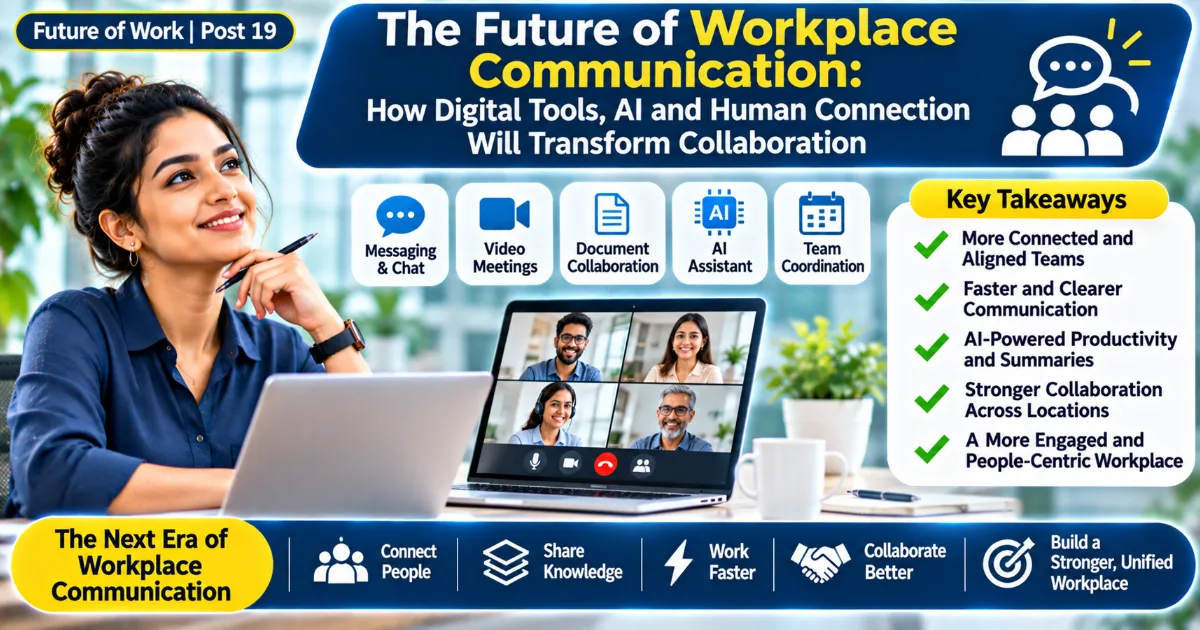
Communication is one of the most important foundations of every successful organisation. Business strategies may define where a company wants to go, technology may provide the tools required to reach its objectives, and employees may contribute the knowledge and effort needed to complete the work. However, without effective communication, these elements cannot operate together efficiently.
For decades, workplace communication relied heavily on face-to-face conversations, telephone calls, printed documents, office meetings and formal reporting structures. Employees generally worked in shared physical locations, making it easier to exchange information through direct conversations and informal interactions. Managers could discuss problems with their teams, colleagues could ask questions immediately and important decisions were often communicated through established organisational channels.
The modern workplace looks very different. Employees may work from home, company offices, coworking spaces or different countries. Teams collaborate across time zones, projects involve external partners and business information moves through messaging platforms, video conferences, cloud documents and project management systems. Artificial intelligence is also becoming part of everyday communication, helping employees draft messages, summarise meetings, translate information and organise discussions.
These developments are creating new opportunities, but they are also introducing challenges. More communication does not always mean better communication. Employees may receive hundreds of notifications, attend unnecessary meetings and struggle to identify which information requires their attention. Digital tools can connect people across the world, but they cannot automatically create trust, understanding or meaningful professional relationships.
The future of workplace communication will therefore depend on finding the right balance between technology and human connection. Artificial intelligence and digital platforms will make information easier to exchange, while empathy, clarity, listening and collaboration will remain essential to building productive teams.
Continue Reading
Organisations that understand this balance will be better prepared to manage distributed workforces, improve decision-making, strengthen employee relationships and create workplaces where information flows effectively.
Why Workplace Communication Is Changing
The changing nature of work is one of the biggest reasons workplace communication is evolving. Traditional office environments allowed employees to exchange information through physical proximity. A colleague could walk to another department, ask a question and receive an immediate response. Managers could gather employees in a meeting room to explain a new process or discuss an urgent issue.
Remote and hybrid working have changed these patterns. Employees may no longer share the same working hours or physical location. A project team could include professionals based in Bengaluru, London, Singapore and New York. Coordinating such a team requires communication systems that support both real-time discussions and information sharing across different schedules.
Globalisation has also increased the complexity of communication. Businesses work with international clients, suppliers and partners who may have different languages, cultural expectations and professional practices. Messages must be clear enough to avoid misunderstandings while remaining respectful of different working environments.
Another important factor is the speed of business operations. Customers expect faster responses, markets change quickly and organisations need to make decisions using information from multiple sources. Communication systems must support timely collaboration without overwhelming employees.
Technology is also changing the amount of information organisations generate. Digital platforms create messages, reports, dashboards, notifications and automated updates. Employees need to know which information matters, where it is stored and how it should be used.
The future workplace will therefore require communication strategies that are more intentional. Businesses will need to decide which information belongs in meetings, which should be documented, which requires immediate attention and which can be shared asynchronously.
Digital Communication Tools Will Become the Foundation of Modern Work
Digital communication platforms have become essential to modern organisations. They allow employees to exchange information, coordinate tasks, share documents and collaborate without being physically present in the same location.
Instant messaging tools support quick questions and everyday coordination. Video conferencing platforms enable discussions between distributed teams. Cloud-based document systems allow multiple employees to review and edit information. Project management platforms connect conversations with tasks, deadlines and responsibilities.
The future will involve deeper integration between these systems. Instead of switching between several disconnected applications, employees will increasingly expect communication, documentation and task management to work together.
For example, a project discussion may take place in a digital workspace where employees can view the relevant documents, assign responsibilities and track decisions. A meeting summary may automatically connect to the project plan, allowing employees to identify the next steps without searching through multiple messages.
Integration can reduce duplicated work and improve information accessibility. However, organisations must avoid introducing too many tools. When employees are required to monitor several messaging platforms and document systems, communication can become fragmented.
Businesses should select tools according to their actual requirements. They should establish clear guidelines explaining which platform is used for urgent communication, project discussions, formal announcements, document storage and external collaboration.
The objective is not to use the largest number of digital tools. It is to create a connected communication environment where employees can find the information they need without unnecessary effort.
Artificial Intelligence Will Transform Workplace Communication
Artificial intelligence is beginning to influence how employees write, understand and exchange information. AI-powered assistants can help draft emails, summarise lengthy documents, prepare meeting notes, translate messages and organise information from different sources.
These capabilities can save time, particularly when employees work with large volumes of communication. A manager preparing for a project review may use an AI assistant to summarise previous discussions and identify outstanding tasks. A customer support employee may use AI to prepare a response based on approved information. A team working across different languages may use translation tools to improve accessibility.
AI can also help employees organise meetings. Systems may generate transcripts, identify discussion topics and produce summaries of decisions. This can reduce the need for employees to take detailed notes while participating in a discussion.
However, AI-generated communication must be reviewed carefully. An automated summary may omit an important qualification, misunderstand a speaker or present an uncertain statement as a confirmed decision. A generated email may sound professional while containing inaccurate information.
Organisations should establish clear expectations around human review. Employees remain responsible for the accuracy, tone and appropriateness of communication sent in their name. Confidential information should only be processed through approved systems, and organisations must consider privacy, security and data retention requirements.
AI should support communication rather than remove human responsibility. Its greatest value will come from reducing administrative effort and helping employees focus on understanding information, making decisions and maintaining professional relationships.
Human Connection Will Remain Essential
Digital tools can make communication faster, but they cannot replace every aspect of human interaction. Trust, empathy, mutual understanding and professional relationships develop through meaningful exchanges between people.
Employees need to feel that their contributions are recognised and that their concerns are taken seriously. A messaging platform may deliver information instantly, but it cannot automatically create a supportive team culture.
Human connection becomes particularly important during difficult situations. A performance concern, workplace disagreement, organisational restructuring or personal challenge may require a sensitive conversation. Sending a short automated message in such circumstances can create confusion or make employees feel undervalued.
Managers must understand when digital communication is appropriate and when direct conversation is more effective. Complex feedback, conflict resolution and important career discussions often benefit from a private conversation where participants can ask questions and understand one another's perspectives.
Informal interactions also have value. Conversations before a meeting, discussions during a break and spontaneous exchanges between colleagues can help build relationships and encourage knowledge sharing. Remote teams may need to create deliberate opportunities for these interactions.
The future workplace will not be purely digital or entirely dependent on face-to-face communication. It will combine digital convenience with meaningful human interaction, using each approach where it creates the greatest value.
The Rise of Asynchronous Communication
Asynchronous communication allows employees to exchange information without requiring everyone to respond at the same time. It is becoming increasingly important as organisations adopt remote work and collaborate across different time zones.
Traditional workplace communication often assumes that employees are available for immediate discussions. This can create scheduling difficulties for global teams and interrupt employees who need uninterrupted time to complete complex tasks.
Asynchronous communication provides an alternative. Employees can share written updates, recorded explanations, project notes and documented decisions that colleagues can review when appropriate.
For example, a team member in India can provide a detailed project update at the end of their working day. A colleague in Europe can review the information during their morning and continue the work without waiting for a live meeting.
This approach can reduce unnecessary meetings and improve flexibility. It also creates a written record that employees can refer to later.
However, asynchronous communication requires clarity. Messages should explain the context, the information being shared, the action required and the expected response time. A vague message without a clear request may create more confusion than a short conversation.
Organisations should also distinguish between urgent and non-urgent matters. Critical operational issues may require immediate communication, while routine updates can be handled asynchronously.
The goal is to reduce unnecessary interruptions while ensuring that important information reaches the right people at the right time.
Better Meetings Will Improve Collaboration
Meetings remain an important part of workplace communication, but their effectiveness depends on how they are organised. Many employees spend a considerable portion of their working week attending discussions that lack clear objectives or produce no meaningful decisions.
Future organisations will need to become more selective about when meetings are necessary. A meeting should have a defined purpose, relevant participants and an expected outcome.
Status updates that do not require discussion can often be shared through written reports. Simple approvals may be handled through workflow systems. Complex decisions, brainstorming sessions and sensitive discussions may benefit from direct interaction.
Meeting preparation is equally important. Participants should receive an agenda and relevant documents in advance. This allows them to understand the topic and prepare useful contributions.
During the meeting, leaders should ensure that discussions remain focused and that different participants have an opportunity to contribute. Important decisions, responsibilities and deadlines should be recorded clearly.
AI-powered meeting assistants may support transcription and summarisation, but employees should understand when recording is taking place and how the resulting information will be stored and used. Consent, confidentiality and organisational policies must be respected.
A productive meeting should leave participants with greater clarity than they had before joining it. If a discussion does not require interaction or decision-making, a different communication method may be more effective.
Communication Across Remote and Hybrid Teams
Remote and hybrid work have made communication more complex because employees may not share the same physical environment or working schedule. Teams must create systems that support collaboration without depending on constant availability.
One important requirement is establishing communication expectations. Employees should know when they are expected to be available, which channels are used for urgent issues and how quickly they should respond to routine messages.
Managers should avoid assuming that remote employees are less productive simply because they are not physically visible. Communication should focus on project progress, outcomes, responsibilities and obstacles rather than continuous online presence.
Documentation becomes especially important in distributed teams. Project decisions, responsibilities and process instructions should be recorded in accessible locations. This reduces the risk of important information remaining in private conversations or disappearing inside message histories.
Hybrid teams must also avoid creating two different workplace experiences. Employees working from the office may have more opportunities for informal discussions, while remote colleagues may receive information later. Managers should ensure that important decisions and development opportunities are shared fairly.
Regular team discussions can help maintain relationships, but they should be balanced with focused work. One-to-one conversations are also valuable because employees may have concerns they do not feel comfortable raising in a group meeting.
Successful distributed communication depends on clarity, documentation, trust and consistent access to information.
The Importance of Clear and Inclusive Communication
Workplaces bring together people with different languages, cultural backgrounds, professional experiences and communication preferences. Organisations must ensure that information can be understood by the people who need it.
Clear communication avoids unnecessary jargon, ambiguous instructions and unexplained abbreviations. Employees should be able to understand what is expected, why a decision has been made and where they can obtain further information.
Inclusive communication also considers accessibility. Video meetings may require captions, important documents may need accessible formatting and digital platforms should work with appropriate assistive technologies.
Language differences can create additional challenges for international teams. Employees who communicate in a second language may need more time to process complex discussions. Written summaries and clear documentation can help ensure that important information is not lost.
Managers should also be aware of different communication styles. Some employees may be comfortable contributing immediately during a meeting, while others may prefer to consider an issue before responding. Providing multiple ways to share feedback can improve participation.
Respectful communication is equally important. Employees should be able to disagree professionally without personal attacks or dismissive behaviour. Leaders must address harassment, exclusion and inappropriate conduct consistently.
Inclusive communication is not about simplifying every discussion or avoiding difficult subjects. It is about ensuring that employees can understand information, express their views and participate meaningfully.
Cross-Cultural Communication in Global Organisations
As businesses expand internationally, employees increasingly work with colleagues, customers and partners from different cultural environments. This creates opportunities for collaboration but also increases the possibility of misunderstanding.
Cultural differences can influence communication expectations, approaches to feedback, meeting participation and decision-making. Some employees may prefer direct and concise communication, while others may use a more indirect approach when discussing disagreement. These patterns vary between individuals and should not be treated as fixed rules about entire cultures.
Organisations can support cross-cultural communication by encouraging curiosity and mutual respect. Employees should be willing to clarify meaning rather than immediately assuming that a different communication style indicates a lack of interest or professionalism.
Time zones and local holidays also need consideration. Scheduling every important meeting around the working hours of one office can create an unfair burden for colleagues in other regions. Rotating meeting times and using asynchronous updates can distribute the inconvenience more fairly.
Language accessibility is another practical issue. Important instructions should use clear language, and organisations may need translation support for essential documents or customer-facing communication.
Global teams become more effective when they establish shared communication standards while respecting local differences. The aim is to create common understanding without expecting everyone to communicate in exactly the same way.
Communication Will Become More Data-Driven
Digital platforms generate information about how teams communicate, where collaboration takes place and how work progresses. Organisations may use analytics to understand response patterns, identify communication bottlenecks and improve information flow.
For example, a business may discover that project decisions are frequently delayed because employees are unsure who has approval authority. Another organisation may find that important updates are distributed through several channels, making it difficult for employees to identify the latest version.
Communication analytics can help identify these problems. Businesses may examine project delays, document access patterns, meeting participation and employee feedback to understand where communication systems need improvement.
However, data should be used carefully. Measuring the number of messages sent by an employee does not necessarily reveal the quality of their communication or their contribution to the team. High message volume may indicate a communication problem rather than strong collaboration.
Organisations should avoid using communication analytics as a tool for excessive employee surveillance. Employees should understand what information is collected, why it is needed and how it will be used.
The most useful communication analytics focus on improving processes and reducing friction. They help organisations understand how information moves through the business rather than judging employees through simplistic activity measures.
Breaking Down Communication Silos
Communication silos occur when departments or teams operate with limited information about one another's activities. They can create duplicated work, conflicting priorities and poor coordination.
For example, a marketing department may launch a campaign without receiving updated information from the product team. Customer support may continue using outdated instructions because product changes were not communicated clearly. Finance may receive project information too late to plan resources effectively.
These problems often occur when departments use separate systems, follow different reporting structures or focus exclusively on their own objectives.
Organisations can reduce silos by improving cross-functional communication. Shared project spaces, common documentation and regular coordination between relevant teams can help employees understand how their responsibilities connect.
Cross-functional projects are another useful approach. Employees from different departments can work together towards a shared objective, creating opportunities to exchange knowledge and understand operational challenges.
Leaders should also establish clear ownership of important information. Employees need to know which team is responsible for maintaining particular documents, policies and process updates.
Breaking down silos does not mean every employee needs access to every conversation. Confidentiality and role-based access remain important. The objective is to ensure that relevant information reaches the people who need it to perform their responsibilities.
The Role of Leadership in Effective Workplace Communication
Leadership behaviour has a direct influence on organisational communication. Employees observe how managers share information, respond to questions, handle disagreements and communicate difficult decisions.
A leader who provides clear explanations and listens to employee concerns can help create a culture of trust. A manager who frequently changes instructions without explanation may create uncertainty and reduce confidence.
Transparency is particularly important during organisational change. Employees need to understand what is happening, why decisions are being made and how those decisions may affect their work. Leaders should communicate honestly, including when some information is not yet available.
Active listening is another essential capability. Managers should give employees an opportunity to explain problems rather than immediately offering solutions or dismissing concerns. Listening can reveal operational issues that may not appear in formal reports.
Leaders must also adapt their communication to different situations. A strategic announcement may require a structured presentation, while a sensitive performance issue may require a private discussion. An urgent operational problem may need a concise instruction followed by a documented explanation.
Consistency matters as well. Messages from senior leadership, HR and departmental managers should not contradict one another. When different leaders communicate conflicting information, employees may lose confidence in organisational decisions.
Effective leaders understand that communication is not simply the act of sending information. It is the process of creating shared understanding and enabling people to act with clarity.
Artificial Intelligence and the Risks of Automated Communication
Although AI can improve communication efficiency, organisations must recognise the risks associated with relying too heavily on automated messages and generated content.
AI-generated messages may sound polished while failing to reflect the actual situation. An automated response to a customer complaint may overlook emotional context. A generated employee announcement may use language that appears insensitive or unclear. A meeting summary may misrepresent what participants agreed.
Organisations should establish review processes for important communications. Messages involving employment decisions, legal obligations, customer commitments or sensitive matters should receive appropriate human review.
Privacy is another important consideration. Employees may use AI assistants to summarise emails or documents that contain confidential information. If the system is not approved for such use, sensitive data could be exposed.
There is also a risk that excessive automation makes communication feel impersonal. Employees and customers may become frustrated when they cannot reach a person capable of understanding their situation.
Businesses should design clear escalation paths. Automated systems can handle routine questions, but complex matters should be transferred to qualified employees.
AI should improve the speed and accessibility of communication without reducing accountability or human connection. The appropriate balance will depend on the sensitivity and complexity of each interaction.
Communication and Employee Engagement
Employee engagement is influenced by whether people understand their responsibilities, feel connected to organisational goals and believe that their contributions matter. Communication plays an important role in creating these conditions.
Employees who receive clear information about business priorities can better understand how their work contributes to wider objectives. Regular feedback helps them recognise strengths, identify areas for improvement and understand expectations.
Communication also provides opportunities for employees to express concerns and suggest improvements. When organisations listen and respond constructively, employees may feel more involved in decisions that affect their work.
Recognition is another important element. Managers should acknowledge meaningful contributions and explain why particular work has created value. Recognition should be fair, specific and connected to actual performance.
Poor communication can produce the opposite effect. Employees may feel disconnected when decisions are made without explanation, when important information is shared inconsistently or when feedback is limited to criticism.
Organisations should therefore treat communication as part of the employee experience. It should continue throughout recruitment, onboarding, development, performance management and organisational change.
Cybersecurity and Confidentiality in Digital Communication
As more workplace communication moves to digital platforms, protecting information becomes increasingly important. Emails, messaging systems, shared documents and video conferences may contain customer information, financial details, intellectual property and confidential business plans.
Organisations must establish appropriate security standards for communication systems. These may include multi-factor authentication, access controls, encryption, secure file sharing and employee training.
Employees should understand how to identify phishing messages, suspicious links and impersonation attempts. Attackers may use information gathered from public sources or compromised accounts to create messages that appear to come from trusted colleagues.
Clear policies should explain which platforms are approved for business communication and how confidential information should be shared. Employees should avoid transferring sensitive documents through personal accounts or unapproved services.
Access should follow the principle of giving employees the information required for their responsibilities without exposing unnecessary data. Organisations should review permissions when employees change roles or leave the business.
Remote and hybrid working require additional attention. Employees may access information through home networks and personal devices, making security awareness and device management important.
A productive communication system must also be a secure one. Businesses need to protect the information that enables collaboration and maintain employee and customer trust.
Building a Future-Ready Workplace Communication Strategy
Organisations should approach communication as a business capability rather than simply a collection of software tools. A well-designed strategy begins with understanding how employees currently exchange information and where problems occur.
The first step is identifying communication requirements across different teams. Customer support, engineering, finance, marketing and senior leadership may need different channels and levels of detail. A single communication method may not suit every activity.
The second step is selecting appropriate tools. Businesses should prioritise platforms that integrate effectively, provide reliable security and support the working arrangements of their employees. New tools should solve identified problems rather than create additional complexity.
The third step is establishing communication standards. Employees should understand where official announcements are published, how project decisions are recorded and which channels are appropriate for urgent matters.
Training is also necessary. Employees may need guidance on digital collaboration, accessible communication, AI usage, cybersecurity and professional writing. Managers may require additional development in active listening, feedback and cross-cultural communication.
Organisations should regularly evaluate their communication practices through employee feedback, project outcomes and operational indicators. They should identify unnecessary meetings, duplicated messages and information gaps.
Finally, communication strategies should remain adaptable. New technologies and workforce arrangements will continue to emerge, and businesses must be willing to improve their systems as requirements change.
The Future of Workplace Communication in India
India's business environment includes technology companies, global service providers, startups, manufacturing organisations, financial institutions, educational institutions and businesses operating across multiple regions. Communication requirements vary between these sectors, but digital collaboration is becoming increasingly important.
Many Indian organisations work with international customers and partners. Their employees may coordinate projects across time zones and communicate with colleagues from different cultural and linguistic backgrounds. Clear documentation, reliable collaboration platforms and effective meeting practices are essential in these environments.
Language accessibility is particularly relevant in a country with many languages and regional communication preferences. Organisations may need to provide important information in accessible formats and ensure that employees can understand workplace policies and instructions.
The growth of remote and hybrid work has also increased the importance of digital communication skills. Employees need to collaborate effectively through video meetings, messaging platforms, cloud documents and project management systems.
AI tools may support communication through translation, summarisation and content preparation. However, organisations must ensure that generated information is accurate, culturally appropriate and handled securely.
Small and medium-sized businesses can benefit from practical digital communication systems without adopting expensive enterprise platforms. A carefully selected combination of messaging, cloud documentation and task management tools may be sufficient for many teams.
For Indian employers, the future opportunity lies in combining digital efficiency with clear communication, professional relationships and inclusive workplace practices.
Conclusion: The Future Will Depend on Better Communication, Not More Messages
Workplace communication is moving into a new era shaped by digital platforms, artificial intelligence, remote collaboration and increasingly connected teams. These developments will make information easier to exchange and help organisations coordinate work across geographical boundaries.
However, the future of communication will not be determined by the number of messages employees send or the number of tools businesses adopt. It will depend on whether information is clear, relevant, accessible and useful.
Artificial intelligence will help employees draft messages, summarise discussions and organise information. Digital collaboration platforms will connect teams and support flexible working arrangements. Asynchronous communication will reduce unnecessary meetings, while data analytics may help organisations identify communication problems.
Yet human connection will remain essential. Trust, empathy, active listening and respectful disagreement cannot be replaced by software. Leaders must create environments where employees feel comfortable asking questions, sharing ideas and raising concerns.
Businesses will need to protect confidential information, establish responsible AI practices and ensure that communication systems are accessible to different employees. They must also reduce unnecessary interruptions and create space for focused work.
The most successful workplaces will combine technology with thoughtful communication practices. They will use digital tools to make collaboration easier while preserving the relationships that help people work together effectively.
The future of work will be more connected, but connection alone is not enough. Organisations must ensure that people understand one another, share knowledge and move towards common goals. Better communication will ultimately create stronger teams, more informed decisions and more productive organisations.